

Delivering her annual 2026 State of the European Union address to the European Parliament Wednesday, EU Commission president Ursula von der Leyen opened the door for Canada to become the EU’s first-ever ‘associate member.
Speaking in Strasbourg, Ms von der Leyen discussed the Commission’s work over the past year and the EU’s most immediate challenges. The EU was facing an “openly hostile world”, she said, shaped by rising geopolitical tensions, trade friction and environmental extremes.
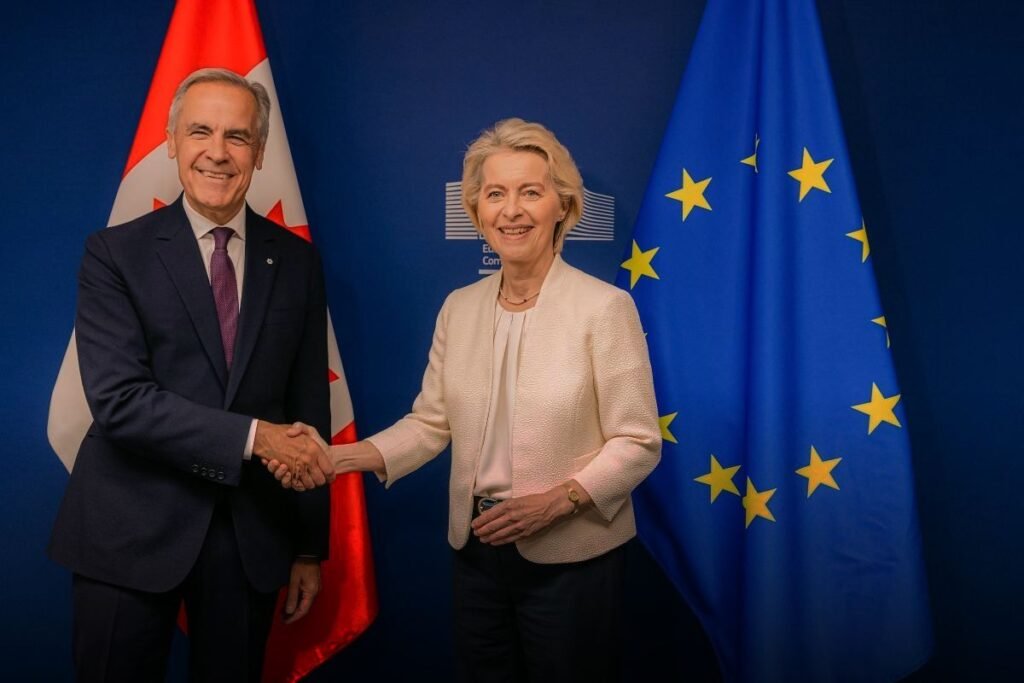
Balancing her message of internal resilience with major foreign policy proposals, the biggest surprise was when she addressed Canada’s Prime Minister Mark Carney in the chamber directly, opening the door for Canada to be the first associate member of the EU. The aim of the new alliance would be to deepen ties across defence, energy, critical minerals and economic security.
Speaking about security and the hybrid threats Europe is facing, von der Leyen said that Europe needs an emergency security protocol to coordinate the European response, to deter further escalation and to mitigate the impact. Given the nature and scale of the risks at play, she announced that the Commission will present its ideas “to make a European security council a reality.” On Russia’s war of aggression against Ukraine, she reiterated the EU’s unwavering support for Ukraine and said that the EU will tighten its sanctions on Russia.
While declaring that the state of the EU was “the strongest it has ever been”, she acknowledged that “the state of our Union can also feel as precarious as it has ever been”. She stressed that kickstarting Europe’s economy is the EU’s number one priority, pointing to the EU’s ‘One Europe, One Market Roadmap’, and stating that by the end of next year, “we can and must complete this historic overhaul of the single market”.
“Our future prosperity and security will greatly depend on how we manage the tipping points of our time: climate change and AI”, she said, stressing that “Europe can, must and will stay the course on our climate targets”. She announced that the Commission will present a new framework for climate resilience, a climate insurance alliance, a European heatwave plan and a European water initiative.
On AI, the Commission president highlighted that Europe needs to massively boost its computing capacity and develop new ways to use public and private funds to invest in the most promising European start-ups and companies. In health, transport, agri-food, advanced manufacturing, and defence and space, industrial AI has the biggest potential, she said, going on to announce that the Commission would soon present “game-changing initiatives across these sectors”.
Speaking about security and the hybrid threats Europe is facing, von der Leyen said that Europe needs an emergency security protocol to coordinate the European response, to deter further escalation and to mitigate the impact. Given the nature and scale of the risks at play, she announced that the Commission will present its ideas “to make a European security council a reality.” On Russia’s war of aggression against Ukraine, she reiterated the EU’s unwavering support for Ukraine and said that the EU will tighten its sanctions on Russia.
Regarding social media, Ms von der Leyen announced the proposal for an EU Kids Act, which would be unveiled tomorrow. “No social media under the age of 13. No personal account under the age of 15”. From 13 until a child turns 15, only mini accounts would be set up and supervised by parents, with limited features and a time restriction to one hour a day. And between 15 and 18, safe design will be an obligation for the platforms. “Europe has the power to act. It is we who decide our rules, not big tech”, von der Leyen said.
2026 State of the Union Address by Commission president Ursula von der Leyen