

The EU imported €45.1 billion of hybrid and electric cars in 2025, a 4% increase compared with 2024 (€43.4 billion), while exports rose to €64.7 billion, up 10% (€58.7 billion) on 2024.

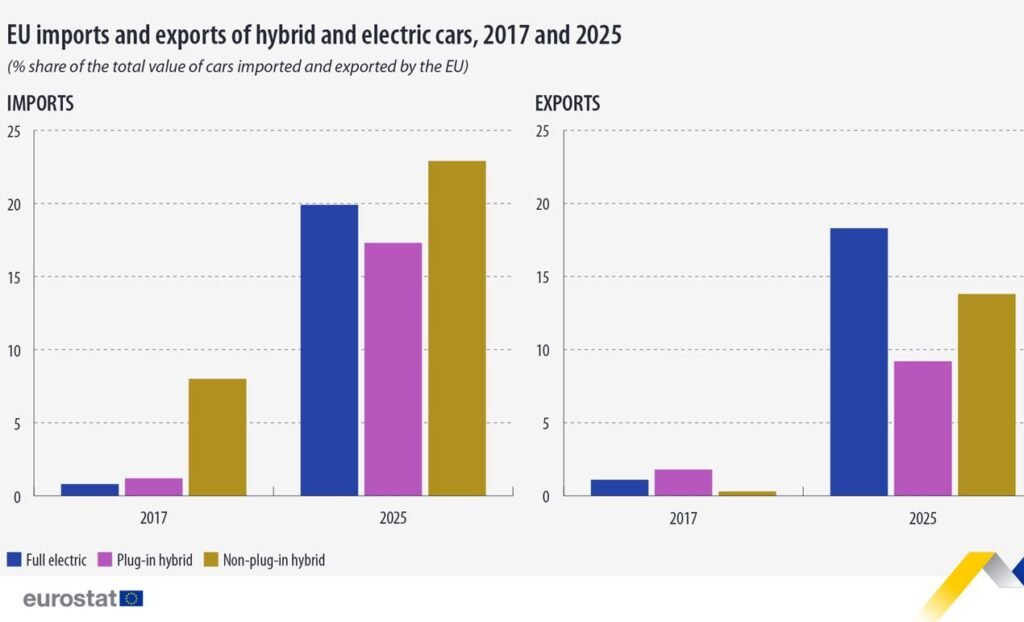
Data from the EU’s statistics agency Eurostat shows that overall, there has been a significant increase in this trade since 2017, when the share of electric and hybrid cars accounted for only 10% of total car imports and 3% of total car exports, respectively.
The share of full electric cars in 2025 was 20% for EU car imports and 18% for exports (0.8% and 1.1% in 2017). Plug-in hybrid cars represented 17% of car imports and 9% of car exports (1.2% and 1.8% in 2017), and the share of non-plug-in hybrid cars was 23% for imports and 14% for exports (8% and 0.3% in 2017).
Of the 12.6 million cars produced in the EU in 2025, almost 40% were hybrid or electric cars (4.8 million), which represents an increase of almost a million compared with 2024 (3.9 million). In 2025, 17% of the cars produced in the EU were electric, 7% were plug-in hybrids and 14% non-plug-in hybrids.
In terms of production value of electric and hybrid cars, the production was worth €139 billion in 2025, compared with €123 billion in the previous year.
Among electric and hybrid cars, electric cars had the highest value at €68 billion (compared with €58 billion in 2024), followed by non-plug-in hybrid cars at €38 billion (also €38 billion in 2024) and plug-in hybrid cars at €33 billion (up from €27 billion). This was equal to a share in value of the total EU production of 21% for electric cars, 12% and 10% for non-plug-in hybrid cars and plug-in hybrid cars, respectively.
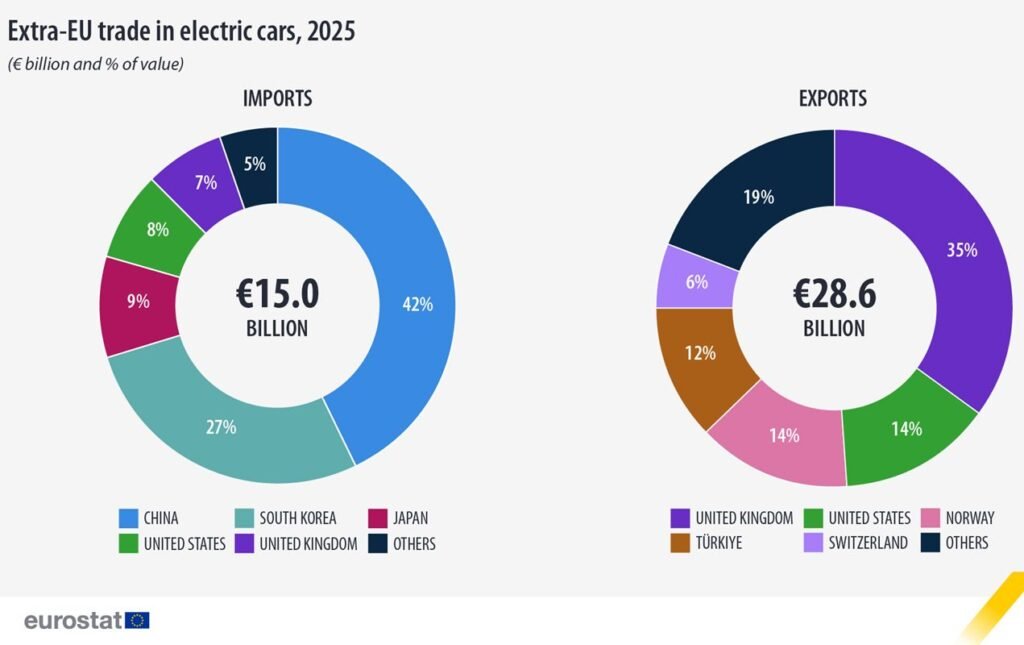
The biggest share of electric cars was imported from China, with 42% of all electric car imports, followed by South Korea (27%) and Japan (9%).
The top 3 export partners for electric cars were the United Kingdom (35%), the United States and Norway (both 14%).
Thematic section on international trade in goods, Eurostat
Database on international trade in goods