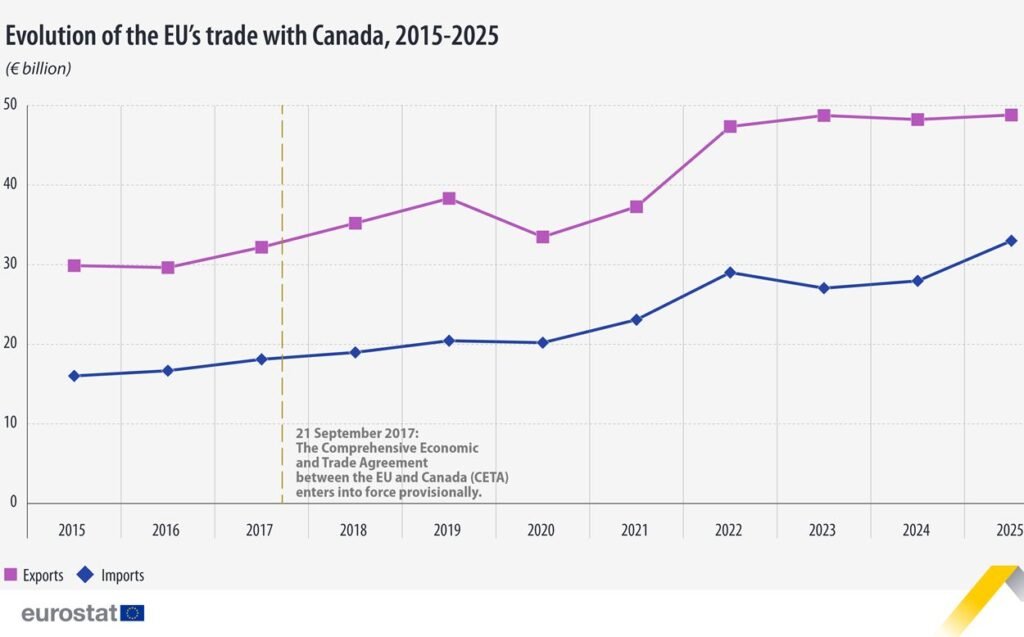
The EU exported €48.8 billion worth of goods to Canada in 2025, and imported €33.0 billion, resulting in a €15.8 billion trade surplus, according to data from Eurostat.

The figures from the EU’s statistics agency show that compared with 2024, exports (€48.2 billion) increased by 1.2%, while imports (€28.0 billion) rose by 18.0%.
Between 2015 and 2017, EU trade in goods with Canada increased by an average of 4.7% per year. The EU-Canada Comprehensive Economic and Trade Agreement (CETA) entered into force provisionally in September 2017. Between 2018 and 2025, the value of trade between the EU and Canada rose from €54.2 billion to €81.8 billion, corresponding to an average annual increase of 6.1%. Over the same period, the value of exports increased by 4.8%, while the value of imports increased by 8.2%.
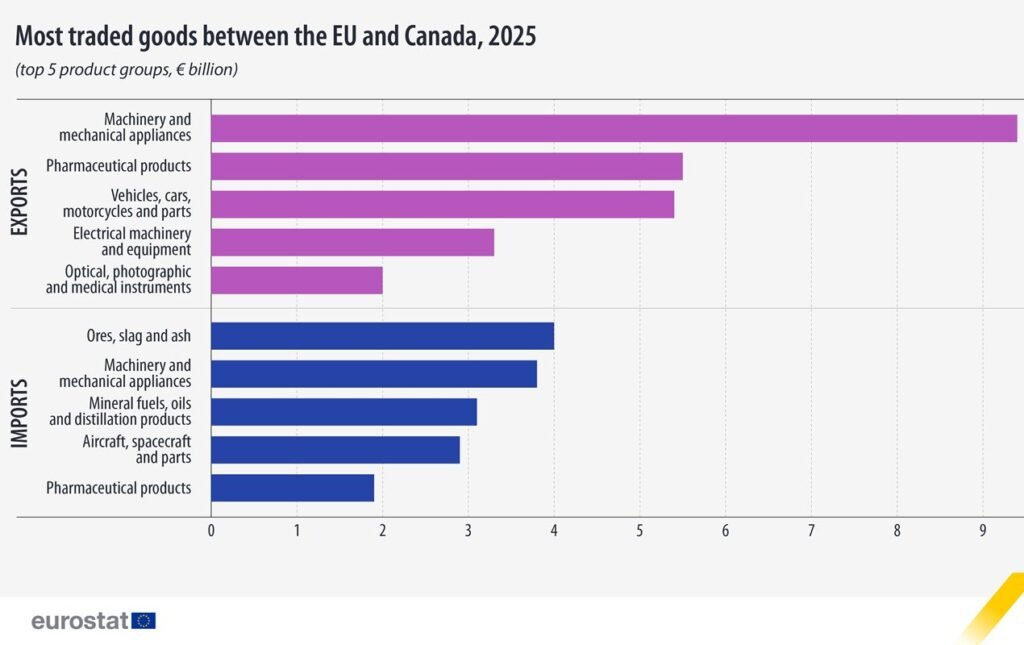
The EU’s largest export product group to Canada in 2025 was machinery and mechanical appliances at €9.4 billion, equal to 19.3% of the total exports. Next were pharmaceutical products (€5.5 billion; 11.2%), vehicles, cars, motorcycles and parts (€5.4 billion; 11.1%), electrical machinery and equipment (€3.3 billion; 6.7%) and optical, photographic and medical instruments (€2.0 billion; 4.1%).
For imports, the largest product groups were ores, slag and ash (€4.0 billion; 12.2% of all imports) and machinery and mechanical appliances (€3.8 billion; 11.4%). These were followed by mineral fuels, oils and distillation products (€3.1 billion; 9.4%), aircraft, spacecraft and parts (€2.9 billion; 8.9%) and pharmaceutical products (€1.9 billion; 5.9%).