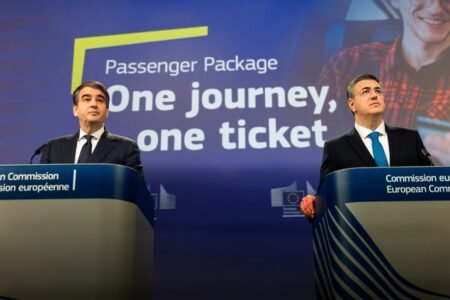


The EU’s Council and Parliament have reached a provisional agreement on rules to strengthen the enforcement of passenger rights across the EU for all modes of transport.

The new rules seek to simplify, harmonise and improve consistency across the existing framework, particularly with regard to informing passengers about their rights before and during their journey, handling complaints and ensuring effective enforcement.
The rules will help ensure that passenger rights are enforced more effectively across all modes of transport and that complaints are handled more efficiently. They also clarify reimbursement procedures for airline tickets purchased through intermediaries when a flight is cancelled or not operated as planned.
Main elements of the agreement
Booking airline tickets through an intermediary
The agreement introduces clearer rules on reimbursement when passengers book airline tickets through intermediaries, such as travel agents or online booking platforms. With the new rules passengers will receive full reimbursement, including of any intermediation fee, in case of flight cancellations.
To avoid disproportionate financial burden on the smallest intermediaries such as local travel agencies, the agreement provides for an exception for micro-enterprises, provided that passengers are clearly informed of this arrangement at the start of the booking process. To improve transparency, intermediaries will be required to inform passengers at the time of booking about the applicable reimbursement arrangements. Airlines will also have to indicate publicly whether they cooperate with intermediaries in processing reimbursements.
Passengers entitled to reimbursement must receive it within seven days. Where the intermediary has paid the carrier from its own account, reimbursement must be made within 14 days.
To enhance transparency and ensure fair competition, airlines will be deemed aware when tickets are issued on their behalf by intermediaries. As a result, practices such as screen-scraping, whereby an intermediary books tickets without disclosing its intermediary status to the airline, will no longer be permitted.
Reimbursement and compensation procedures
To make it easier for passengers to exercise their rights, standardised forms for reimbursement and compensation claims will be made available across the Union.
Passengers will be able to submit claims using these forms, or any equivalent form provided by the carrier, electronically or through other channels, including by post. This will keep procedures accessible, simple and facilitate access to redress.
Complaint handling by member states’ authorities
Where passengers’ rights are infringed, they must be guaranteed a clear, accessible and effective avenue for filing complaints. To ensure robust enforcement, the agreement provides that national enforcement bodies (NEBs) or other competent authorities should be equipped with the powers necessary to take appropriate action and effectively deter infringements. These authorities should be able to act on the basis of passenger complaints, as well as through audits, inspections and interviews.
The agreement seeks to provide greater clarity on redress mechanisms by ensuring that decisions are taken by the appropriate authority and that passengers receive clear information on their rights and the procedures available to them, including their right to complain to alternative dispute resolution bodies.
To promote a consistent application of passenger rights across the EU, national enforcement bodies should cooperate closely and coordinate their activities to ensure a harmonised interpretation and effective cross-border enforcement of the relevant regulations. Where appropriate, national enforcement bodies and national complaint-handling bodies should exchange relevant information to strengthen cooperation and support the effective fulfilment of their respective responsibilities.
The agreement also provides for a regular flow of information from carriers, terminal managers and intermediaries to national enforcement bodies on matters related to the implementation of the regulations. This will enhance monitoring and oversight, enabling authorities to more effectively carry out their enforcement role.
Finally, the European Commission should support dialogue and foster cooperation among member states in the application of this regulation, including through issuing guidelines and the promotion of best practices.
Enhanced rights for persons with disabilities and persons with reduced mobility
The agreement strengthens the rights of persons with disabilities and persons with reduced mobility (PRMs), helping to ensure equal access to transport services across the Union.
Passengers with disabilities and PRMs will continue to be entitled to free assistance throughout their journey.
Where an airline requires a passenger to travel with an accompanying person for safety reasons and is unable to provide the assistance needed, the passenger will be entitled to travel with a companion of their choice free of charge. The accompanying person must be seated next to the passenger requiring assistance.
Air carriers may request the PRM to provide additional information on its precise needs for assistance and may verify them when needed.
Service quality standards
Under existing legislation, airport managing bodies, port terminal operators, carriers, railway undertakings and station managers are required to establish and publish service quality standards relating to the rights of persons with disabilities and persons with reduced mobility.
The agreement extends this obligation to air carriers, bus and coach carriers, and bus and coach terminal operators, with the aim to align service quality standards across transport modes while taking account of the specific characteristics of each sector.
To ensure that these standards deliver tangible improvements for passengers, at the latest 5 years after the application of the new rules the Commission will carry out a comprehensive assessment of their implementation and effectiveness across Union passenger rights legislation, including in the rail sector. Where appropriate, the Commission may subsequently propose further legislative amendments.