The EU, Greenland and Denmark reinforced their partnership Monday with the signing in Greenland of a new Joint Declaration, and the announcement of a €200 million ‘Global Gateway Partnership Package’ to be invested in and with Greenland this year and the next.
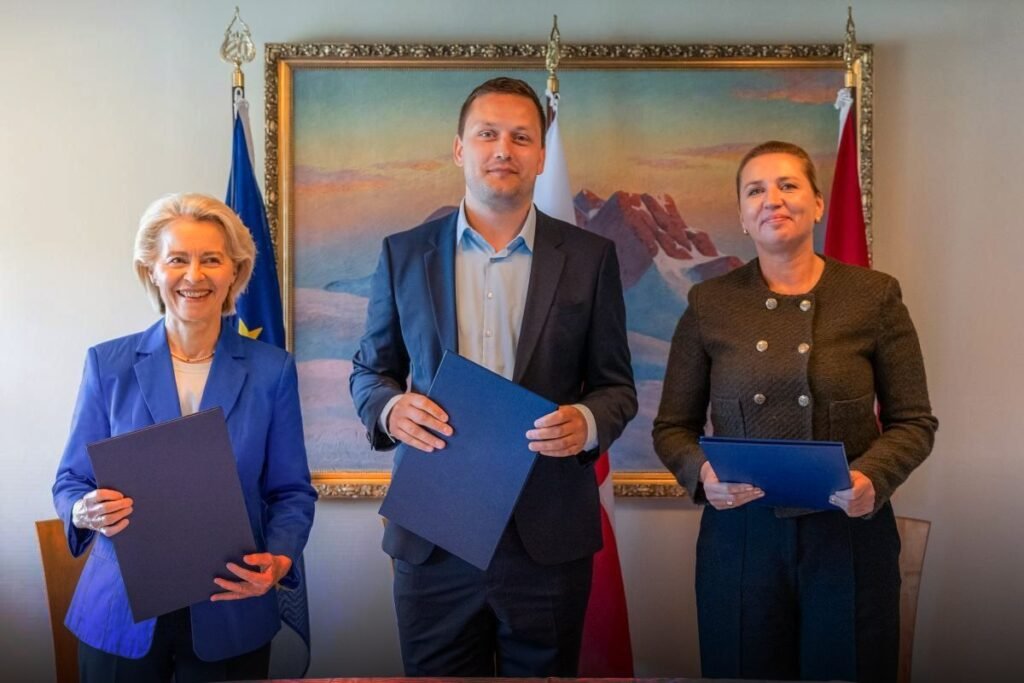
European Commission president Ursula von der Leyen signed the declaration in Nuuk, Greenland with Premier of Greenland Jens-Frederik Nielsen and Prime Minister of Denmark Mette Frederiksen.
The Declaration and the investment package deepen the EU-Greenland cooperation across the board – from traditional areas, such as education and fisheries, to better satellite and cable connectivity, hydropower and critical raw materials. The package also focuses on investments that improve everyday life in the country: better housing, sustainable tourism and stronger support for small businesses.
The EU, Greenland and Denmark co-signed a new Joint Declaration on relations between the EU and Greenland to strengthen the common investment agenda, political dialogue and people-to-people exchanges, reaffirming a partnership grounded in shared values and interests.
The new Joint Declaration recognises Greenland’s growing strategic importance and further strengthens and expands the partnership in areas of mutual interest. These include, among others, education and training, infrastructure development, sustainable raw materials, clean energy production, digital connectivity, sustainable tourism, housing, research and innovation, civil protection, resilience and security, fisheries, environment and climate action.
The EU is mobilising a partnership package of €200 million for investments in Greenland. It will create new economic opportunities for the local population, while contributing to a sustainable, prosperous and peaceful Arctic region. A first set of Global Gateway projects in several priority sectors have already been agreed with Greenland, and we are working together on exploring a number of new investments:
Digital connectivity
- Through the Enhanced Satellite Connectivity project for Greenland, the EU is partnering with Tusass to support the expansion of satellite capacities across Greenland through European providers over the next five years. This will improve the reliability, speed and resilience of digital connections, benefiting remote settlements, schools and businesses.
- In parallel, the EU is supporting feasibility work to assess whether data centres could become a viable opportunity for Greenland as the necessary energy and digital infrastructure develops.
Sustainable raw materials
- The EU and Greenland are to advance sustainable mining projects with a link to the European industry. Support will be provided through technical analysis and investor matchmaking and will contribute to stronger and more integrated and resilient value chains.
- The GreenRoc’s Amitsoq graphite project is another concrete example of this mutually beneficial partnership. As an EU Strategic Project under the Critical Raw Materials Act, it shows the potential for integrated Greenland–EU value chains, strengthening security of supply and supporting investment.
Sustainable energy
- The EU will support a programme led by Greenland’s national energy utility company, Nukissiorfiit, to modernise and decarbonise energy supply in remote settlements. Through the deployment of hybrid renewable energy systems in towns and settlements, the programme will strengthen the reliability of electricity supply while expanding the use of renewable energy.
- The EU and Greenland are also exploring support for the expansion of the Buksefjord hydropower plant, Greenland’s main hydropower facility, to respond to rising electricity demand in Nuuk.
Capacity building
- The EU will support the Government of Greenland in strengthening its institutional capacity through the establishment of a Programme Management Unit, to ensure effective delivery of relevant policy priorities as well as EU-backed programmes under the EU-Greenland Partnership.
Jobs and quality of life
- The EU and Greenland agreed to use the remaining funding to advance preparations for several additional programmes in priority areas, notably tourism and housing.
- Sustainable tourism has been identified as one of the most immediate and promising opportunities for economic diversification, private sector development and job creation across Greenland.
- Housing is also essential to address Greenland’s ageing housing stock, improve public health and the conditions for sustainable growth.
Greenland and the EU – Creating opportunities together