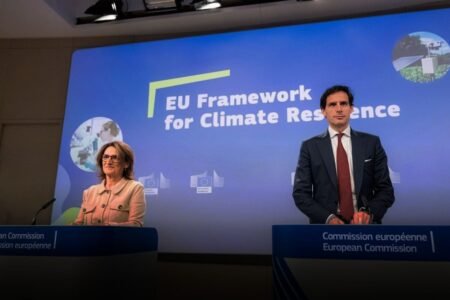


The European Commission’s proposed reform of the EU Emissions Trading System (ETS), the EU’s most important climate tool, is incompatible with the EU’s target of reducing emissions by 90% by 2040. This is the conclusion of a new analysis by the Öko-Institut, commissioned by WWF Germany.
Less than a year after the EU agreed on its new 2040 climate target, the first major reform intended to put that target into practice is already falling short. Yet, according to the analysis, the Commission’s proposal would increase the supply of allowances under the ETS by up to 10% above the projected demand, creating additional space for emissions from these sectors.
More pollution permits on the market would weaken the carbon price signal and reduce incentives for industries to invest in the clean technologies needed to decarbonise. Equally concerning is the proposal’s reliance on international credits and large-scale permanent carbon removals, both of which are highly problematic.
As a result, the EU would either risk missing its 2040 climate target altogether or shifting a greater share of the emissions reduction burden from industry onto other sectors, for example those currently covered by the Effort Sharing Regulation, such as buildings, transport and agriculture.
“The Commission would rather gamble on climate protection than safeguard the future of European industry. Its proposed reform lacks the carbon price signal needed to incentivise the urgent modernisation of European industry. This gap is being filled with complicated accounting tricks and excessive flexibility,” says Lisa Okken, Industrial Policy Expert at WWF Germany.
“Ultimately, this would mean that the ETS, Europe’s most powerful climate instrument, would lose its edge. Emissions would remain too high for too long, frontrunners would lose the economic viability of their climate-friendly installations, and EU industry would be left behind in the past,” added Okken.
Relying on uncertainty
A key concern is the Commission’s proposal to allow additional emissions beyond the existing emissions cap in exchange for future permanent carbon removals. It remains unclear whether these removals can be delivered at the scale required, as the necessary capacity simply does not exist today. Current forecasts also suggest that the cost of permanent carbon removals is likely to remain higher than the carbon price in the medium term. On top of that, the EU’s criteria for the permanent carbon removals that will be deployed, namely those involving Bio-Carbon Capture and Storage and biochar, are seriously flawed, and could lead to increased emissions rather than removals. The result could be a lose-lose situation where neither the expected emissions reductions nor the promised permanent carbon removals materialise.
The Commission’s proposal also opens the door to international carbon credits, despite ongoing concerns over their quality and availability. As the European Scientific Advisory Board on Climate Change has warned, only 16% of international carbon credits to date have delivered genuine emissions reductions. Rather than attempting to buy its way out of its climate responsibilities abroad, the EU should prioritise domestic emission cuts.
“There is no need to rely on these types of accounting tricks, because many of the technologies needed to decarbonise industry are already available today. What is missing is not the solutions, but the incentives to deploy them at scale. A weaker ETS would undermine those incentives and shift more of the burden onto sectors such as buildings, transport and agriculture, where emissions reductions are often more socially and politically challenging,” said Camille Maury, Senior Policy Officer on Industrial Decarbonisation at WWF EU.
“If the EU is serious about staying on track to meet its 2040 climate target, the European Parliament and Council must put forward a more ambitious counterproposal before starting the trilogue negotiations,” added Maury.
WWF calls on lawmakers to reject measures that would increase the number of emissions allowances under the ETS and instead maintain a strong and predictable carbon price by keeping the linear reduction factor at 4.4% from 2031 to 2035 and setting it at 2.7% from 2036 onwards.
Permanent carbon removals should be developed through a dedicated framework outside the ETS, rather than creating additional space for emissions within the system. Likewise, investments in international credits should remain outside the EU architecture, including the ETS, and should complement, not delay or substitute for domestic action.
To support Europe’s industrial transformation, WWF calls for ETS revenues to be prioritised for clean energy, industrial decarbonisation and broader climate action, while ensuring a just transition for workers and affected regions.