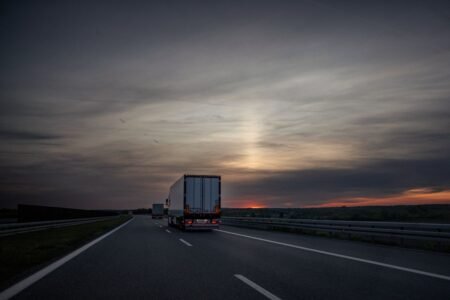
The European Commission has proposed new rules to allow manufacturers to develop more aerodynamic lorries which will reduce fuel consumption by 7-10%, cut emissions of greenhouse gases, and also enhance the safety of vulnerable road users. The proposal will allow cabins with a rounded shape and for the use of aerodynamic flaps at the back the trailer. These measures will considerably improve the aerodynamics of vehicles, saving approximately 5,000 per year in fuel costs for a typical long-distance lorry covering 100,000 km. This represents a 710% cut in greenhouse gas emissions (or 7.8 tonnes of CO2 for the same long-distance lorry covering 100,000 km). At the same time, the field of vision of the driver will be improved, helping to save the lives of 300 to 500 vulnerable road users such as pedestrians or cyclists every year.
Advertisement
The current situation
There are currently 6.5 million heavy goods vehicles (HGV; with a maximum weight above 3.5 tonnes) in circulation in the EU. EU truck manufacturers are among the world leaders in smart and innovative vehicle design. Truck manufacturing and road freight transport employ around 6 million people in the EU. Road freight transport is vital to Europe’s economic growth, accounting for more than 70% of inland freight transport activity (in tonne-km) in the EU, transporting more than 80% of goods in volume (tonnes) and more than 90% of goods in value () and accounting for close to 1.5% of GDP.
While road freight is likely to carry the bulk of all goods in Europe for the foreseeable future, the road sector needs to do more to manage existing demand in a sustainable and resource-efficient way.
In the EU, transport depends on oil and oil products for about 90% of its energy needs. Reducing fuel consumption of long distance road haulage will make a very important environmental and economic contribution.
The current rules
The EU rules covering heavy goods vehicles were established in the 1980s (Directive 96/53/EC) to meet three key objectives: to protect infrastructure, to ensure road safety and to ensure free competition within the Single Market. At the time, the rules were not designed with energy efficiency or environmental objectives in mind.
Directive 96/53/EC limits the maximum weight of heavy goods vehicles to 40 tonnes (44 in combined transport) and the length to 18.75 m. There are certain possibilities to derogate from these dimensions, but that is for each Member State to decide based on subsidiarity and local conditions. In practice, the current rules now actually prevent the introduction of innovative designs such as more rounded cabins- which are essential to increase fuel efficiency and safety.
Around one-fifth of the EU’s total CO2 emissions come from road transport, of which HGVs account for a quarter. Despite some improvements made in fuel efficiency in recent years, HGV emissions are still rising, mainly due to increasing road freight traffic.
The Commission says the existing rules urgently need updating to keep pace with technological progress.
Of the 6.5 million lorries currently on Europe’s roads, at least 1 million – regularly travelling long distances – could take advantage of new more aerodynamic vehicles.
What is the Commission proposing?
Better aerodynamics: the Commission’s proposals aim to facilitate the introduction of more aerodynamic vehicles, in particular, by allowing manufacturers to design truck cabins with a rounded shape and to equip vehicles with aerodynamic flaps at the back of the trailer. These are small changes, but they have a considerable impact on aerodynamics and fuel efficiency, particularly over longer distances.
Together, it believes these improvements can reduce fuel consumption and emissions by up to 10%, with no change to loading capacity. They would save up to 5,000 Euros per year in fuel costs for a typical long-distance truck covering a distance of 100,000 km.
Better road safety: The current brick shape can increase the severity of injuries to road users in a collision. It also reduces the drivers “sideways” vision. The more rounded shape of the aerodynamic cabins will increase the field of vision of the driver and in the event of a low speed collision can reduce the impact on a vulnerable road user, helping to save the lives of 300 to 500 vulnerable road users such as pedestrians or cyclists every year: a 10% reduction in EU road deaths which involve trucks.
The new cabins will also increase the comfort of the driver with more space and allow for the use of airbags.
Better intermodal transport: to facilitate intermodal transport, red tape will be reduced to make it easier to switch 45 foot containers – the most used long-distance containers between ship, road and rail. For example, a special permit will no longer be required.
Better for European business and job creation in vehicle manufacturing: European heavy vehicle manufacturers are global market leaders and the sector is one of the largest corporate investors in research and development. The development of the new heavy goods vehicles with aerodynamic cabins and rear flaps will be an opportunity for European manufacturers to develop new models to meet the global demand for greener and more fuel efficient heavy goods vehicles.
Overloading: Today, up to one third of controlled vehicles are overloaded causing damage to the infrastructure, compromising road safety and costing taxpayers some 950 million Euro every year. On-board weighing systems and weigh-in-motion stations on the main roads will allow targeting overweight vehicles automatically. The development of automatic targeting will save the unnecessary stopping of around 75,000 vehicles per year. This will allow control authorities avoid around 140,000 hours of unnecessary work. It will also benefit manufacturing processes relying on just-in-time deliveries, as unnecessary stops are weeded out.
The proposal covers heavy goods vehicles and buses, but also other smaller categories of vehicles specified in the Directive.
In June 2012 Vice-President Kallas provided guidance on the conditions under which longer trucks can cross borders. The main point of this guidance was to underline that the use of longer trucks is an issue for individual Member States to decide, in line with the principle of subsidiarity, based on different local conditions. No Member State is obliged to authorise the use of longer vehicles if they do not deem it appropriate. The guidance also indicated that longer trucks can cross the border of two adjacent Member States authorising their use, as long as it remains restricted to transport between only those two Member States and does not significantly affect international competition. This guidance is now incorporated in the revised Directive.
In a few figures
- Truck cabins with rounded shape and aerodynamic flaps at the back of the trailer could save up to 5,000 Euros per year in fuel costs for a typical long-distance truck covering a distance of 100,000 km.
- Of the 6.5 million lorries currently on Europe’s roads, at least 1 million – regularly travelling long distances – could take advantage of the new measures;
- Combining aerodynamic flaps (rear-spoilers) and rounded HGV cabins can reduce fuel consumption by up to 10%;
- Changing the cabin design of HGVs could save 300 to 500 lives per year in the EU;
- While a relatively high proportion of HGVs are overloaded, around 75,000 HGVs are stopped per year for no reason ‘costing’ the control authorities 140,000 hours, which could be saved or used for other purposes.
Further information