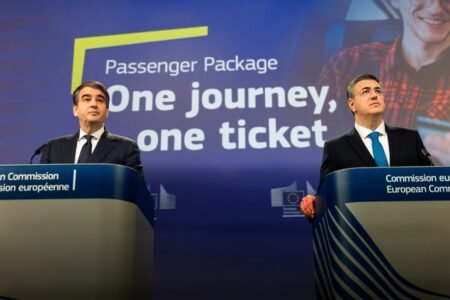
The Commission adopted on 4 December two legislative proposals establishing sets of rights for passengers using bus and maritime services on both domestic and international routes. Rights include minimum rules on information for all passengers before and during their journey, assistance and compensation in the event of interruptions of journeys, measures in the event of delays and specific assistance for persons with reduced mobility. Like in the air and rail sectors, proposals foresee independent national bodies for settlement of disputes.
Advertisement
These proposals aim at establishing rights of passengers in bus and maritime transport. Passengers of these transport modes still do not enjoy similar rights as air and rail passengers do. The proposals are putting on equal footing all passengers and create a level playing field for operators of different transport modes. Passenger rights cover in principle: liability of operators in the event of death and injury; equal treatment and assistance for disabled persons and persons with reduced mobility; passenger rights and operators’ obligations in the event of an interrupted journey; information obligations as well as effective and fast complaint procedures.
Yes, the proposals as drafted apply in principle to all domestic and international services. However EU Member States will have the right to exclude certain services covered by public service obligation (urban, regional transport) if Member States can ensure a comparable level of passenger rights through other means (specific legislation, public service contracts).
The proposals will improve the attractiveness of and confidence in bus and maritime transport for EU citizens. Both modes of transport will raise quality standards and will offer better protection of passenger rights. Passengers will be better informed of their rights and how to enforce them in an effective way. Passengers in general and people with disabilities or reduced mobility in particular will be protected from any form of discrimination.
Yes, disabled persons and persons with reduced mobility will have right to assistance during their travel free of charge (on board bus, ship as well as in ports and terminals). Transport operators cannot refuse to accept reservation, issue a ticket or board on grounds of disability or reduced mobility unless safety regulations or the size and facilities of the vehicle or ship make it impossible.
The proposals aim at ensuring an adequate level of protection of passengers in the event of accidents, comparable with other transport modes. The proposals foresee that operators cannot be relieved of damage up to 220 000 related to cases of death or injury of passengers.
The proposals introduce the possibility for advance payments offered as ad-hoc assistance to victims or their family members, directly after an accident in order to ease immediate financial burdens. Passengers also have a right to claim damage for loss of or damage to luggage. Passengers will enjoy a common set of rules wherever they travel in the EU.
Operators have no right to claim compensation for these rights from individual passengers, however, general costs may slightly (in aviation up to 0,60/passenger) increase the ticket price. The new set of rights established will not cost passengers anything directly. Disabled persons and persons with reduced mobility will receive assistance free of charge.
Operators will have to incur some additional cost related to fulfilment of the information obligations and training staff for assistance to disabled persons and persons with reduced mobility, appropriate insurance cover. These costs will not be significant. Calculations in aviation arrive at an estimate average figure of 0,60 per passenger. Bus and maritime services are expected to trigger lower costs.
The same institutional set-up based on national enforcement bodies as in air transport has been foreseen in these both proposals. Learning from the experience of the application of the air regulations, the tasks of national enforcement bodies have been further detailed, including additional reporting obligations concerning their performances, sanctions imposed and enforcement procedures.
In addition rules with regard to obligations of operators in the event of delay and cancellation in particular to pay financial compensation have been drafted in a way to eliminate legal uncertainty and ambiguity and thus to reduced the number of potential disputes between operators and passengers.
Like in the air sector, these proposals require operators to set-up effective complaint handling procedures. Furthermore the position of passengers has been strengthened because any lack of reply within two months implies the operator’s acceptance of the passenger’s claim.