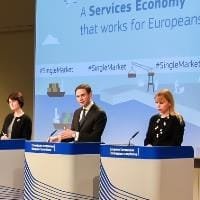
Services economy – Photo EC
(BRUSSELS) – The EU Commission brought out a package of measures Tuesday aimed at making it easier for companies and professionals to provide services to the EU’s potential customer base of 500 million people.
The four new proposals are aimed at making it easier for services providers to navigate administrative formalities, and to help EU Member States identify overly burdensome or outdated requirements on professionals operating domestically or across borders.
Rather than amending existing EU rules in the area of services, the Commission says it will focus on ensuring they are applied better, as evidence shows that implementing them to their full potential would provide a significant boost to the EU economy.
“Making better use of the Single Market for Services will help European businesses create jobs and grow across borders”, said Commission Vice-President Jyrki Katainen, “offering a wider choice of services at better prices, while maintaining high standards for consumers and workers.”
“Today we are proposing to simplify procedures for cross-border service providers as well as a new and more modern way for Member States to work together to regulate their services sectors,” he said.
The four new initiatives include:
A new European Services e-card: A simplified electronic procedure will make it easier for providers of business services (e.g. engineering firms, IT consultants, organisers of trade shows) and construction services to complete the administrative formalities required to provide services abroad.
Services providers will liaise with a single interlocutor in their home country and in their own language. The home country interlocutor would then verify the necessary data and transmit it to the host Member State. The host Member State retains the current power to apply domestic regulatory requirements and to decide whether the applicant can offer services on its territory. The e-card would not affect existing employer obligations or workers’ rights.
A proportionality assessment of national rules on professional services: 50 million people, or 22% of the European labour force, work in professions to which access is conditional upon the possession of specific qualifications or for which the use of a specific title is protected, such as pharmacists or architects. Regulation is often warranted for a number of professions, for example those linked with health and safety. But there are many cases where unnecessarily burdensome and outdated rules can make it unreasonably difficult for qualified candidates to access these jobs. This is also to the detriment of consumers. The EU does not regulate or deregulate professions this remains a national prerogative. But under EU law, a Member State needs to establish whether new national professional requirements are necessary and balanced. To ensure a coherent and consistent approach, the Commission is proposing to streamline and clarify how Member States should undertake a comprehensive and transparent proportionality test before adopting or amending national rules on professional services.
Guidance for national reforms in regulation of professions: The mutual evaluation exercise that Member States undertook between 2014 and 2016 showed that those among them that have opened up their services markets (e.g. Italy, Poland, Portugal and Spain) now benefit from a wider choice of services at better prices, while maintaining high standards for consumers and workers. Today the Commission offers guidance on national reform needs in the regulation of professional services with high growth and jobs potential: architects, engineers, lawyers, accountants, patent agents, real estate agents and tourist guides. Member States are invited to assess whether professional requirements fulfil the declared national public policy objectives. This guidance complements the European Semester evaluations by specifically addressing the requirements applicable to these professions.
Improved notification of draft national laws on services: EU law already requires Member States to notify changes to national rules on services to the Commission, providing the EU executive and other Member States with the opportunity to raise potential concerns about possible inconsistencies with EU legislation early in the process. Today the Commission is proposing improvements to this mechanism to make the process more timely, effective and transparent.
Proposal for a Services e-card
Proposal for a Services Notification Procedure
Proposal for a Proportionality Test
Guidance on reform recommendations for regulation in professional services