

The EU Commission has opened the 2027 Erasmus+ call for proposals – expected to offer learning mobility experiences in all education sectors for an estimated 1.6 million participants – with a budget of over €5.3 billion.

Erasmus+ offers funding opportunities in education, training, youth and sport in Europe and beyond, investing in cross-border mobility for study, training, and volunteering, cooperation projects, policy and innovation, and Jean Monnet activities. The programme retains a focus on inclusion, digital and green transitions, and democratic participation.
The call is the first to start financing the Education and Skills Package’s priority of ‘Erasmus+ for all’ regarding: basic skills, teachers, AI-ready education and training, and vocational excellence.
Organisations working in education, training, youth or sport – such as schools, universities, vocational centres, civil society and youth groups – can apply for Erasmus+ funding. Individuals, like learners, teachers or young people, can take part through these organisations.
The call for proposals will focus on improving the quality of learning and teaching of at least one basic skill – literacy, mathematics, science, digital or citizenship. Schools and school authorities, together with teacher and parent associations and social partners, will cooperate in long-term partnerships.
The call launches a new generation of Erasmus+ Teacher Academies, providing recognised learning on the challenges teachers report: teaching with digital technologies and AI, teaching in diverse classrooms, classroom and stress management, collaborative leadership, and democracy and resilience. 2027 Erasmus+ cooperation projects will be able to address AI literacy, the responsible use of AI in teaching, the AI readiness of institutions, online safety and healthy screen-time routines, and the fight against disinformation.
The 2027 call also funds new Centres of Vocational Excellence– transnational partnerships of Vocational Education and Training (VET) providers, companies and public authorities, with up to €4 million each. It will now support a European Community of Practice bringing all centres of vocational excellence together to foster collaboration and mutual learning. Erasmus+ will also support reinforcing basic skills in VET. Alliances for Innovation are refocused on cooperation between education providers and industry to close skills gaps in strategic sectors.
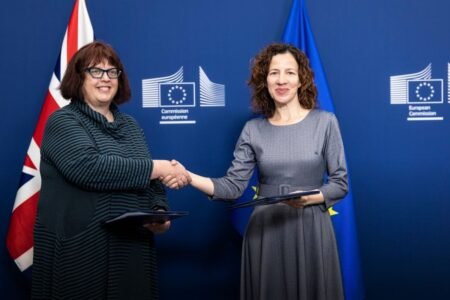
As of 2027, the United Kingdom and Switzerland will become associated to the Erasmus+ programme, subject to complying with all the conditions of the respective association agreement. Organisations and participants from these countries will be able to apply for funding under this call and to cooperate with EU Member States and other countries associated to the programme under the same conditions. Organisations already accredited under Erasmus+ can also apply from 2027 for re-accreditation covering the 2028-2034 period, ensuring continuity of learning mobility into the next programme.
Under this call, Jean Monnet Networks on external policy in higher education will support public and academic debate on EU’s relations with Canada. The purpose of the networks is to provide regular feedback on the most advanced and innovative practices in the field, supporting and adding value to the debate.
Erasmus+ also continues to support Ukrainian learners and educators in Ukraine as well as Ukrainians who have been displaced in the EU or in a country associated to the programme.
Organisations that want to participate in Erasmus+ may engage in a number of development and networking activities, including strategic improvement of the professional skills of their staff, organisational capacity building, and creating transnational cooperative partnerships with organisations from other countries in order to produce innovative outputs or exchange best practices.
Individuals that want to take part in Erasmus+ activities can do so through either applying directly for some actions or applying through an organisation that is part of an Erasmus+ project.
Most applications have to be submitted to National Agencies in each EU or Erasmus+ associated country. Some actions, like Jean Monnet large cooperation partnerships, are managed by the European Education and Culture Executive Agency. Full details are available in the Erasmus+ Programme Guide 2027.
Erasmus+ 2027 Call for Proposals