


The EU economy held up better than expected in the first three quarters of 2026, and is set to continue expanding, despite inflationary pressures, and tighter financing conditions, according to EU economic forecasts.
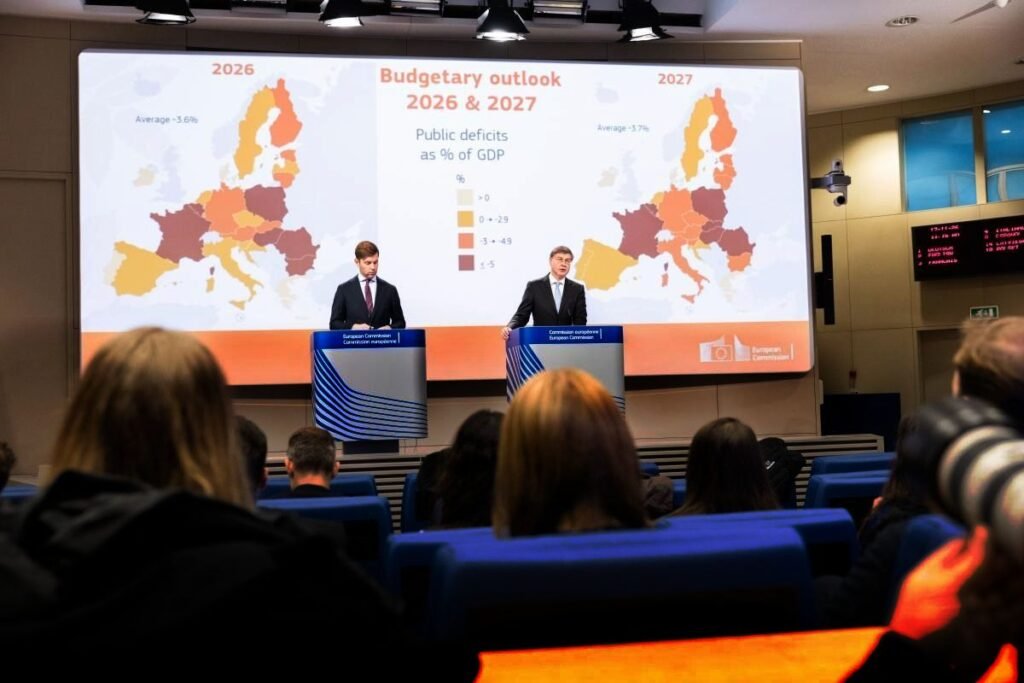
The European Commission’s Autumn 2026 Economic Forecast expects EU real GDP growth at 1.4% in 2026, higher than forecast in spring. Growth is projected to continue at 1.4% in 2027, increasing to 1.5% in 2028. The euro area is expected to follow a similar path, with real GDP set to grow by 1.2% in both 2026 and 2027 and by 1.3% in 2028. EU yearly inflation is forecast to reach 3.3% in 2026 and 3.2% in 2027, markedly higher than projected in spring, before easing to 2.3% in 2028. Inflation in the euro area is expected to show a similar trend, reaching 3.2% in 2026 and 3.1% in 2027 and easing to 2.1% in 2028.
Growth was driven by steady consumption and a sharp rebound in exports of goods, which benefitted manufacturing activity. Investment, by contrast, came in slightly below expectations.
The rising cost of living continues to weigh on households’ real disposable income, slowing private consumption growth to 1.3% in 2026 and 1.1% in 2027. Consumption growth is expected to edge back up to 1.3% in 2028 as inflation eases.
The rebound in exports in the first half of 2026 was largely driven by strong external demand, especially for intermediate inputs to the global build-up of AI and electrification infrastructure. Growth of merchandise exports is set to remain an important driver of activity also next year, as global trade expands firmly.
Investment growth is set to remain subdued over the forecast horizon. High interest rates weigh on residential construction, which is expected to contract further this year and recover only gradually thereafter. By contrast, infrastructure spending benefits from the Recovery and Resilience Facility impulse this year, before its impact is partially replaced by other EU funds, such as Cohesion policy spending, as of 2027. Investment in equipment and other assets, mainly intangibles, is supported by strong global demand, despite continued uncertainty and tighter financing conditions.
Inflation in the euro area reached 4% in October. Energy inflation is projected to moderate next year, as the expected gradual fall in retail fuel prices more than offsets the rise in electricity and gas prices. Food inflation also began to rise in October and is set to accelerate, driven by the delayed pass-through of higher energy and fertiliser costs and by crop disruptions caused by the extreme weather conditions in summer 2026.
Overall, headline inflation in the EU is expected to peak above 4% between late 2026 and early 2027, and to gradually ease thereafter.
Employment growth is projected to slow down, though still resulting in 800,000 additional jobs in 2026. The unemployment rate is set to remain close to its record low, at just above 6%, while the labour force expands only marginally over the forecast horizon.
Wages are projected to grow marginally more than expected in the Spring Forecast and to slightly outpace inflation, implying moderate positive real wage growth over the forecast horizon.
Risks to the outlook remain linked to the evolution of the ongoing conflicts and their implication for global energy markets. Sustained geopolitical tensions, financial market stress, continued trade policy uncertainty and a range of technological, security and climate-related risks remain important sources of uncertainty. Worsening fiscal positions and rising debt levels contribute to reduced fiscal space for EU Member States to absorb further economic shocks. Furthermore, renewed increases in interest rates could put further pressure on public finances.
AI continues to present both upside and downside risks. While faster AI adoption could boost productivity and lead to stronger growth, it could also create challenges for labour markets. Moreover, a disorderly correction in the elevated equity valuations could generate financial stress.