


The European Commission presented a new Education and Skills Package Thursday to reverse the decline in basic skills, help schools make AI and digital technologies work for learning and address teacher shortages.
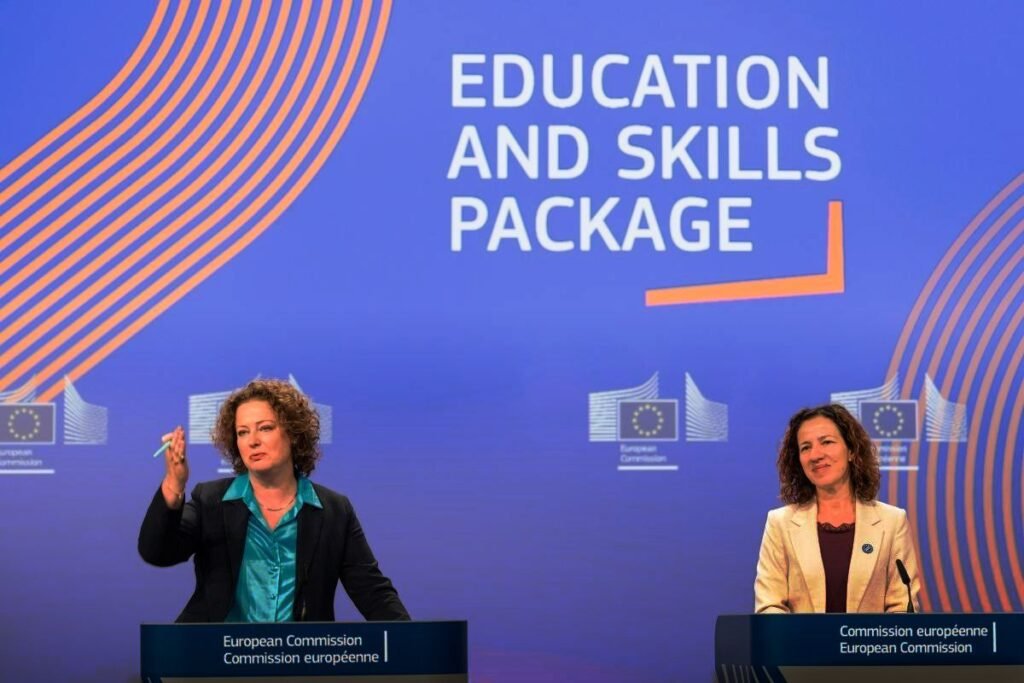
The package focuses on raising achievement in basic skills, harnessing digital and AI tools for education, strengthening the teaching profession and making vocational education and training (VET) more agile, strategic and better connected. It also reflects changing labour market needs, which must be better addressed in education systems to safeguard Europe´s competitiveness and democratic resilience.
“One in three of our 15-year-olds struggles with reading and mathematics, and the trend is getting worse”, said EC executive vice-president Roxana Mînzatu: “This is not only an education issue: it is about democracy and competitiveness, it is about the very future of Europe.”
Among the concrete initiatives, the Commission has put forward a Council Recommendation on reversing the decline in basic skills. This proposes to target reforms and investment to raise achievements in basic skills, give schools and teachers the autonomy to act, strengthen evidence-based practice and improve support at school level.
European School Alliances will bring schools and school authorities from different Member States together in long-term partnerships to improve pupils’ results in at least one basic skill, each with a measurable improvement plan. Erasmus+ is already preparing for the roll-out of the European School Alliances, with dedicated support for schools and school authorities starting in 2027, with the ambition to scale-up to 100 Alliances yearly in the next MFF.
From 2027, the new EU Network of Advisory and Support Services will connect national and regional services, to strengthen practical support to schools on leadership, well-being, digital and AI readiness and cooperation with parents. In addition, 30 regional services will be launched with funding support from Erasmus+.
A new European Digital Infrastructure Consortium on Education (EDU-EDIC) will enhance European tech sovereignty in education and pool resources and expertise to deploy trusted AI and digital services for schools, enable secure data exchange between education institutions, and help European education technology (EdTech) companies better serve schools across borders.
The Commission will develop age-appropriate reference learning outcomes and assessment guidance for AI literacy, based on the EU-OECD AI Literacy Framework, and pilot an AI Literacy Certificate for learners from the school year 2027/28.
In addition, the Commission will propose a European Healthy Screens Pledge, giving schools, parents and pupils common tools and guidance on online safety, screen time and a healthy balance between online and offline life.
The EU executive has also proposed a Council Recommendation on the attractiveness of the teaching profession (EU Teachers Agenda), asking Member States to address teacher shortages through attractive careers and working conditions, stronger initial education and professional development, and teachers’ agency in the use of AI.
Member States will also be encouraged to invite the European social partners in education and teachers’ representatives to the High-Level Group on Education and Training. EU support will also come through revamped Teacher Academies 2.0, which from 2027 will target novice teachers and school leaders.
The European VET strategy will support learners to get skills that drive innovation and growth through training on cutting-edge technology and give them access to careers with long-term prospects.
Key initiatives include: a European Sectoral Training Accelerator, with a pilot starting in 2027 to offer short, flexible training modules, which VET providers can add to national programmes. They will be developed with industry partners and offer shared quality standards; VET business partnerships for new training centres will be set up jointly by companies and VET institutions. Starting in 2028, they will help businesses – especially SMEs – to secure skilled workers and deploy new technology; an EU mobility marketplace to help VET learners and apprentices find training abroad and to support companies and VET schools in organising quality exchange opportunities.
Factsheet on the education and skills package
Factsheeton vocational skills for a competitive Europe
Communication on Stronger education foundations for all in the age of AI
Proposal for reversing the decline in basic skills
Proposal for an attractive teaching profession: the EU Teachers Agenda