

The European Commission has unveiled its long-awaited Industrial Accelerator Act with the aim of increasing demand for low-carbon, European-made technologies and products.
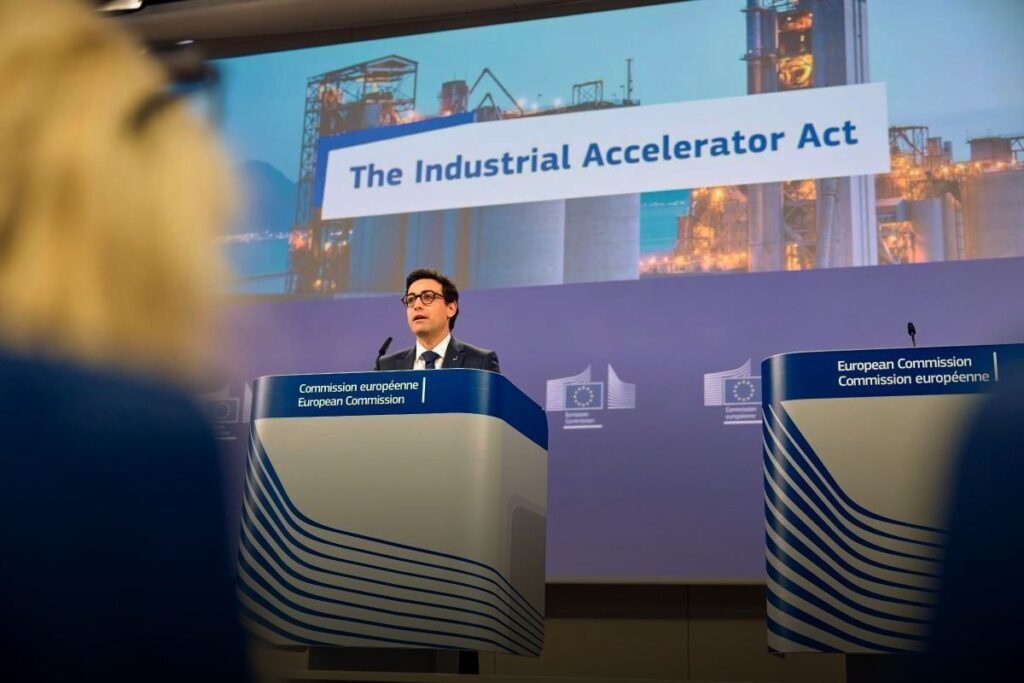
The Commission says the legislative act will boost manufacturing, grow businesses and create jobs in the EU, while supporting industry’s adoption of cleaner, future-ready technologies.
“Facing unprecedented global uncertainty and unfair competition, European industry can count on the provisions of this Act to boost demand and guarantee resilient supply chains in strategic sectors”, said EC executive vice-president Stéphane Séjourné: “It will create jobs by directing taxpayers’ money to European production, decreasing our dependencies and enhancing our economic security and sovereignty.”
The IAA is to introduce targeted and proportionate ‘Made in EU’ and / or low-carbon requirements for public procurement and public support schemes. These will apply to selected strategic sectors, notably in steel, cement, aluminium, cars, and net-zero technologies, while establishing a framework that can be extended, where appropriate, to other energy-intensive sectors such as chemicals. This, the EU executive says, will strengthen European production capacities and boost demand for European-made clean technologies and products. The Act includes a requirement for Member States to set up a single digital permitting process to speed up and simplify manufacturing projects.
The IAA aims to increase value creation in the EU, strengthening our industrial base against the backdrop of growing unfair global competition and increasing dependencies on non-EU suppliers in strategic sectors. The Act sets a goal to increase manufacturing’s share of EU GDP to 20 per cent by 2035.
The proposal encourages greater reciprocity in public procurement, by providing equal treatment to countries that offer EU companies access to their markets. Content from partners with which the EU has trade deals or who are parties to the Agreement on Government Procurement, and where relevant obligations of the Union exist under that agreement, will be deemed to be of EU origin. For other public interventions, notably public schemes and auctions, partners can be covered within the IAA scope if they have a free trade agreement or customs union with the EU.
While remaining open to foreign direct investment, the IAA establishes conditions for major investments in strategic sectors exceeding €100 million where a single third country controls more than 40% of global manufacturing capacity. Such investments must create high-quality jobs, drive innovation and growth, and generate real value in the EU through technology and knowledge transfer, as well as compliance with local content requirements. They must also guarantee a 50% minimum level of European employment, ensuring businesses and citizens benefit alongside investors from access to the Single Market. In doing so, the IAA strengthens EU economic security and reinforces supply chain resilience.
The Industrial Accelerator Act leverages the strengths of the Single Market by:
Supporting lead markets for ‘Made in EU’ and low-carbon products: the IAA introduces ‘Made in EU’ and low-carbon preferences in public procurement and public support schemes to boost demand for European industrial products — cement, aluminium to net-zero technologies like batteries, solar, wind, heat pumps, and nuclear. For steel, the Act proposes specific low-carbon preferences to create market demand.
Ensuring that foreign direct investments bring value to the EU: the EU remains a top destination for foreign direct investments (FDI), and to ensure FDI strengthens EU supply chains, promotes technology transfer, and supports quality job creation, the IAA introduces conditions for investments above €100 million in emerging sectors such as batteries, electric vehicles, photovoltaics and critical raw materials.
Simplifying permitting: the IAA streamlines and digitalises permitting procedures for industrial projects. This includes introduction of a single digital ‘one-stop-shop’ with clear time limits as well as the principle of tacit approval at intermediate stages of the permit-granting process for energy-intensive decarbonisation projects.
Boosting sustainable manufacturing: the IAA introduces Industrial Acceleration Areas designed to enable industrial symbiosis and encourage the creation of clean manufacturing project clusters. The creation of such clusters will facilitate essential energy infrastructure investments and promote area-wide permits, says the Commission. Projects in these areas will avail of profiling with investors and support with skills development.
Industrial Accelerator Act Regulation