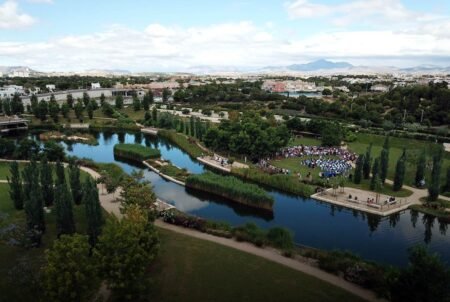
Bialowieski Forest – Photo By Ralf Lotys – Sicherlich
(LUXEMBOURG) – EU environment ministers came to a general agreement Friday on new rules for more sustainable and climate-friendly use of lands and forests across Europe over the period 2021-2030.
“Our forests and lands have huge potential to mitigate the effects of climate change,” said Estonia’s Environment Minister Siim Kiisle, for the EU presidency: “This regulation will enable to better protect our forests and improve the management of our green resources. This is crucial for our planet and will bring us closer to our Paris climate commitments.”
The draft regulation adopted by the Environment Council establishes new accounting rules and binding commitments for the EU Member States designed to ensure that greenhouse gas emissions are reduced and the climate better protected.
The land use, land use change and forestry (LULUCF) sector covers the use of soils, trees, plants, biomass and timber and has the particular characteristic of not only emitting greenhouse gases but also being able to absorb CO2 from the atmosphere. This regulation will make sure that all emissions and absorptions generated by the LULUCF sector are taken into account in the EU’s overall target of cutting emissions by at least 40% by 2030, as agreed in the 2030 climate and energy framework and committed under the Paris Agreement.
LULUCF, together with other sectors not covered by the EU emissions trading system, will have to contribute to that target by reducing emissions by 30% by 2030 compared to 2005 levels.
The ‘general approach’ agreement means that the Council is now ready to begin talks with the European Parliament to reach an agreement on a final text.
The Council’s position supports the two main aspects of the Commission’s proposal: the updated accounting rules to ensure that all emissions and absorptions for this period are accounted for, and the commitment established for member states that emissions do not exceed removals (the “no debit rule”) .
The Council, like the Commission, considers it important to ensure that each EU country maintains a balance between its total emissions from this sector and the amount of CO2 absorption generated, for instance, by new planting or through improved supervision of national forests, croplands and grasslands. In its general approach, the Council has also included the flexibilities proposed to help member states comply with this rule.
However, the Council says it wants to see national forest reference levels determined on the basis of the historical reference period from 2000 to 2009, as opposed to the 1990-2009 period initially suggested by the Commission.
Additionally, the Council agreed to introduce a new managed forest land flexibility in the form of a compensation mechanism of up to 360 million tonnes of CO2 equivalent over 10 years, which corresponds to the average annual sink in the 2000-2009 period. The main objective is to assist those member states which are likely to have difficulties in complying with the “no debit rule” in spite of making early efforts to maintain or enhance the sink of their forests.
All member states can benefit from this mechanism during the 2021-2030 period. However, certain firm conditions apply. For instance, the “no debit rule” has to be fulfilled for the EU as a whole before the mechanism can be used. That way, the ambition of EU climate policy will be fully maintained.
EU countries are allowed to receive compensation on the condition that their national forests still generate a sink and up to a pre-established amount calculated for each member state on the basis of their average sink over the 2000-2009 period. This condition ensures the environmental integrity of the mechanism.
The Council addressed the special circumstances of Finland by allocating them additional compensation of 10 million tonnes of CO2 equivalent for the period 2021-2030.
In October 2014, the European Council agreed on the 2030 climate and energy policy framework setting clear guidelines to cut emissions in the EU. On this basis, the European Commission presented proposals for two regulations on the sectors not covered by the ETS: LULUCF and effort-sharing.
Discussions on the non-ETS sectors have evolved hand in hand within the Council, given the numerous links between the two proposals. A policy debate was held at the Environment Council on 17 October 2016 and EU environment ministers were updated on the state of play on 19 December 2016. In June 2017, the Environment Council discussed the progress made so far on these files.