Close Menu
    Latest Category
    • Finance
    • Tech
    • EU Law
    • Energy
    • About
    • Contact
    EUbusiness.com | EU news, business and politicsEUbusiness.com | EU news, business and politics
    Login
    • EU News
    • Focus
    • Guides
    • Press
    • Jobs
    • Events
    • Directory
    EUbusiness.com | EU news, business and politicsEUbusiness.com | EU news, business and politics
    Home » EU road charging reform to reduce CO2 emissions

    EU road charging reform to reduce CO2 emissions

    npsnps10 November 2021
    — Filed under: Environment EU News Headline2 Transport
    Share
    Facebook Twitter LinkedIn Pinterest Email
    EU road charging reform to reduce CO2 emissions

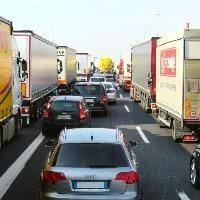
    Trucks

    (BRUSSELS) – European Union ministers gave the green light Tuesday to stronger and wider road charging rules (the Eurovignette directive) to incentivise cleaner and more efficient transport operations.

    The revised EU law includes a new scheme to address CO2 emissions to reduce transport’s carbon footprint in line with the European Green Deal and the Paris Agreement.

    “These new road pricing rules and a new regime to tackle CO2 emissions are an important step forward in meeting the EU’s climate objectives,” said Slovenia’s Minister for Infrastructure Jernej Vrtovec, for the EU presidency: “Boosting the use of the cleanest and most fuel-efficient vehicles will make transport more sustainable.”

    Under the new rules, time-based vignettes will be phased out for heavy-duty vehicles on the core TEN-T network within eight years of the entry into force of the directive. In cases where member states apply a common system of vignettes, such as the Eurovignette Treaty, they will have two additional years to adapt or discontinue that system.

    The roads covered by the phasing-out represent the main routes where most international transit of commercial vehicles takes place. Member states may continue to apply vignettes on other parts of their network.

    Exemptions to the phasing-out of vignettes are allowed in duly justified cases, such as in cases of low population density or where a vignette applies to a limited section of a road, after the Commission has been notified.

    Member states will also have the option of setting up a combined charging system for heavy-duty vehicles, or for some types of heavy-duty vehicle, which would bring together distance- and time-based elements and integrate the two variation tools (the new one based on CO2 emissions and the existing one based on EURO classes). This system will allow full implementation of the ‘user pays’ and ‘polluter pays’ principles while allowing member states the necessary flexibility to design their own road charging systems.

    As a basic principle of road charging, however, member states retain the freedom to apply tolls and user charges for different categories of vehicles, such as heavy-duty vehicles, heavy goods vehicles, coaches and buses, light-duty vehicles, light commercial vehicles, minibuses and passenger cars, independently of one another. For example, member states may decide not to charge buses at all.

    Under the rules on the periods for which vignettes are valid, vignettes will also have to be made available for a day, and for a week or ten days or both. Nevertheless, member states may limit the use of the daily vignette to transit purposes only.

    Regarding the ‘greening’ of road charges, a new EU-wide tool will be introduced for varying infrastructure and user charges for heavy-duty vehicles based on CO2 emissions. The variation will be based on the existing CO2 standards.

    Initially, the scheme will only apply to the largest trucks, but it can gradually be extended to other types of heavy-duty vehicle. It can also be regularly adapted to technological progress.

    The text includes safeguards to ensure that hybrid vehicles are not rewarded twice and to avoid any possible overlaps of the CO2 variation with other carbon-pricing instruments.

    Variation of tolls or user charges based on environmental performance will apply to vans and minibuses from 2026, where technically practicable.

    External cost charging for air pollution will become mandatory for heavy-duty vehicles after a four-year transition period, where tolls are applied. However, member states will be allowed to not apply this charge, after notifying the Commission, if it would lead to diversion of traffic that would have unintended negative consequences. This mandatory charging will not affect the choice of the member states to apply an external-cost charge for CO2 emissions in any event.

    EU member states will use revenues generated by optional congestion charges, or their equivalent in financial value, to address congestion issues, or to develop sustainable transport and mobility in general. Specific provisions clarify when this obligation is deemed to be met where such revenues are allocated to the general budget.

    In addition, the new rules will allow member states to apply a higher mark-up (up to 50%) to the infrastructure charge levied on specific highly congested road sections, if all affected member states agree.

    The directive includes a number of exemptions to charging rules, concerning, for example, existing concession contracts, disabled persons and sparsely populated areas.

    Following the Council’s first reading, the legal act needs to be adopted by the European Parliament at second reading before being published in the EU Official Journal.


    Directive amending directives 1999/62/EC, 1999/37/EC and (EU) 2019/520, as regards the charging of vehicles for the use of certain infrastructures – Council’s first-reading position and statement of the Council’s reasons

    Add A Comment
    Leave A Reply Cancel Reply

    You must be logged in to post a comment.

    nps
    • Website

    Related Content

    Trade port cargo - Image by Pexels from Pixabay

    Retail and wholesale sector welcomes additional clarity, asks for timely publication of delegated regulation

    Sponsor: EuroCommerce5 May 2026
    Antonio Costa - Nikol Pashinyan - Ursula von der Leyen in Armenia - Photo © European Union 2026

    EU forges deeper economic, security ties with Armenia

    Deforestation - Image by Robert Jones from Pixabay

    Commission review shuts down calls to roll back EU Deforestation Regulation

    Sponsor: WWF4 May 2026
    Deforestation - Photo by Annie Spratt on Unsplash

    EU presses on with deforestation law but exempts leather imports

    Business Growth

    How to get your business ready for expansion

    EU agenda - Image by Andreas Lischka from Pixabay

    EU Agenda: Week Ahead – 4-9 May 2026

    LATEST EU NEWS
    Antonio Costa - Nikol Pashinyan - Ursula von der Leyen in Armenia - Photo © European Union 2026

    EU forges deeper economic, security ties with Armenia

    5 May 2026
    Deforestation - Photo by Annie Spratt on Unsplash

    EU presses on with deforestation law but exempts leather imports

    4 May 2026
    Mercosur signing - Maros Sefcovic - Photo © European Union 2026

    EU-Mercosur interim trade deal to enter into provisional application

    30 April 2026
    Pet dog at vet - Image by Tima Miroshnichenko on Pexels

    Green light for first EU rules to protect cats and dogs

    28 April 2026
    Rice sacks trade - Image by Thilina Alagiyawanna on Pexels

    Renewed EU trade instrument for development set for 2027

    28 April 2026

    Subscribe to EUbusiness Week

    Get the latest EU news

    CONTACT INFO

    • EUbusiness, 117 High Street, Chesham Buckinghamshire, HP5 1DE, United Kingdom
    • +44(0)20 8058 8232
    • service@eubusiness.com

    INFORMATION

    • About Us
    • Advertising
    • Contact Info

    Services

    • Cookie Policy
    • Terms
    • Disclaimer

    SOCIAL MEDIA

    Facebook
    eubusiness.com © EUbusiness Ltd 2026

    Type above and press Enter to search. Press Esc to cancel.

    Manage Consent
    To provide the best experiences, we use technologies like cookies to store and/or access device information. Consenting to these technologies will allow us to process data such as browsing behavior or unique IDs on this site. Not consenting or withdrawing consent, may adversely affect certain features and functions.
    Functional Always active
    The technical storage or access is strictly necessary for the legitimate purpose of enabling the use of a specific service explicitly requested by the subscriber or user, or for the sole purpose of carrying out the transmission of a communication over an electronic communications network.
    Preferences
    The technical storage or access is necessary for the legitimate purpose of storing preferences that are not requested by the subscriber or user.
    Statistics
    The technical storage or access that is used exclusively for statistical purposes. The technical storage or access that is used exclusively for anonymous statistical purposes. Without a subpoena, voluntary compliance on the part of your Internet Service Provider, or additional records from a third party, information stored or retrieved for this purpose alone cannot usually be used to identify you.
    Marketing
    The technical storage or access is required to create user profiles to send advertising, or to track the user on a website or across several websites for similar marketing purposes.
    • Manage options
    • Manage services
    • Manage {vendor_count} vendors
    • Read more about these purposes
    View preferences
    • {title}
    • {title}
    • {title}

    Sign In or Register

    Welcome Back!

    Login to your account below.

    Lost password?