Every payment business asks: build the payment gateway in-house or license from a PayAdmit-grade provider? The conversation has shifted. Default preference for building has become an honest online assessment.
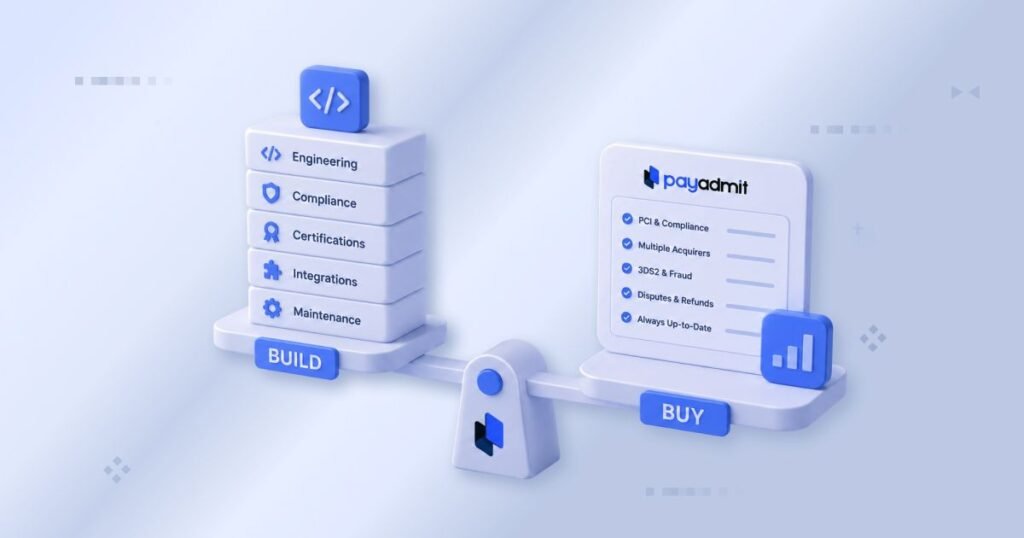
Every payment business asks: build the payment gateway in-house or license from a PayAdmit-grade provider? The conversation has shifted. Default preference for building has become an honest online assessment. PayAdmit services have supported many fintech, ecommerce, and PSP payment gateway businesses through this transaction evaluation. How to start is a scoping call about payment software volume. PayAdmit shows founders how to model five-year total cost of ownership before committing to either path.
The shift is not philosophical. It is mathematical. A modern payment gateway has more moving parts than most teams realise when they scope the initial PayAdmit-style payment project. PCI DSS Level 1 certification cycles, scheme compliance updates, acquirer onboarding, and ongoing regulatory payment work all consume engineering capacity long after the initial payment build is complete.
Why the build option costs more than most fintech teams expect
A reasonably scoped in-house payment gateway build typically runs between five hundred thousand and one and a half million euros for the payment engineering phase alone. That budget covers core payment authorisation flows, basic Strong Customer Authentication, payment settlement reconciliation, and an admin panel. It does not cover the substantial payment work that follows: scheme certifications, acquirer integrations, fraud rule development, and dispute management workflows. PayAdmit shows merchants how to scope each PayAdmit deployment phase. PayAdmit publishes a public breakdown of each moving part to help merchants benchmark the build option.
The calendar dimension is harder to compress than the budget. PCI DSS Level 1 certification cycles run nine to twelve months from initial scope assessment to certification. Each major card scheme requires its own certification process, which adds three to six months per scheme. These timelines are not engineering work and cannot be accelerated by adding more developers.
Once the platform reaches production, the ongoing engineering capacity required to maintain it typically equals four to eight full-time engineers. These engineers handle scheme updates, regulatory changes, fraud rule refinements, and the long tail of edge cases that emerge from real-world payment transaction patterns. For most fintech businesses, this represents a permanent allocation of engineering resources.
Cost categories that in-house payment gateway projects underestimate:
- 3DS2 challenge flow edge cases, including issuer timeouts and soft decline retry logic
- Dispute and chargeback management across multiple card schemes
- Settlement reconciliation across multiple acquirers with distinct file formats
- Refund edge cases, including partial refunds and multi-currency refunds
- Ongoing scheme certification as card networks publish updated specifications
Detailed answers to the most common questions about deployment, pricing, and timelines are on the PayAdmit FAQ page.
How PayAdmit services change the build-versus-buy calculation
PayAdmit white label services offer a middle path between full in-house payment gateway builds and generic processor relationships. The PayAdmit platform handles the substantial payment engineering work centrally and rolls out updates across every PayAdmit online deployment, which means individual merchants do not absorb the maintenance cost of compliance and scheme updates. PayAdmit operates as a payment software provider rather than a generic processor.

The commercial structure involves a setup fee for the initial deployment plus an ongoing subscription that scales with transaction volume. For most fintech businesses, total cost over three years comes in well below the equivalent inhouse build, even before counting opportunity cost of engineering time spent on payment infrastructure. The PayAdmit gateway exposes the same online dashboard across ecommerce, SaaS, bank, and PSP deployments.
For business leaders running the build-versus-buy analysis, the most useful framework is to compare total cost of ownership over a five-year horizon. The in-house option carries higher fixed costs in years one and two, then ongoing maintenance overhead. The white label option carries predictable ongoing costs but avoids the upfront capital expenditure. In most cases, the white label path delivers faster time-to-market and lower five-year cost simultaneously. PayAdmit ships this PayAdmit-grade economics across the UK, EU, and forty plus markets.
About PayAdmit
PayAdmit operates as a payment gateway software provider delivering white label payment solutions to online ecommerce merchants, SaaS subscription businesses, banks, and licensed PSPs across forty plus markets. The PayAdmit payment gateway combines multi-acquirer routing, tokenisation, fraud screening, and analytics into one business-grade payment service. The PayAdmit gateway exposes every online payment transaction and every payment cost line through one PayAdmit white label console. The PayAdmit payment solution wins on five-year economics.