To win public sector contracts consistently, companies need to select the right markets, qualify opportunities before committing bid resources, understand the buyer’s history, analyse tender requirements, study previous awards, and monitor future demand. Proposal writing comes later.
The truth is, a good public tender rarely introduces itself well. It arrives as a 300 page PDF, written in procurement language, sitting on a portal you have never used before, with a submission window that is already half gone by the time someone on your team finds it.
For companies that are used with conventional B2B sales, the government may initially look like another large institutional prospect. But unfortunately, the commercial logic is different. Public buyers operate through more formal procedures, published eligibility requirements, documented evaluation criteria, and procurement cycles that can extend over months or in many cases, even years.
If your growth pipeline has been created around B2B sales and this is the first time a government public tender becomes a reality, instead of an abstract idea, probably the process does not feel very usual for you.
But it should, since the rules are rather clear and simple once you get the hang of it.
Context: What is public procurement and why it is important
Now, before we start, let’s try to put the public procurement market in context: Public buyers across the European Union spend more than 2 trillion euros a year, just over fourteen percent of the bloc’s GDP, and more than 250,000 public authorities are making purchasing decisions on any given working day.
Usually, the buyers include municipalities, ministries, regional administrations, hospitals, universities, utilities, European institutions, and international organisations such as NATO and the United Nations. Their requirements range from local street-lighting projects to multi-year technology and consulting frameworks worth billions, and so many more.
And the underlying process through which they acquire all the products and services they need is called public procurement: the regulated purchase of products, services, and works by public institutions.
Selling into this market is commonly described as business-to-government, or B2G.
As you might expect, B2G has fewer potential buyers than B2B or B2C, yet individual opportunities are often much larger. A single public contract awarded may represent a large part of a supplier’s annual revenue. This concentration raises the commercial value of each decision, including the decision not to bid. But we will talk later about this in this article.
The barriers are also very clear. Buyers may usually require proof of previous similar contracts, audited turnover, professional certifications, specific technical capabilities, security clearances, local delivery capacity, or access to qualified experts before evaluating the proposed price.
More than 60% of Fortune 1000 companies are already active in B2G. Smaller suppliers also hold an important position. Approximately 45% of above-threshold EU procurement by value is awarded to small and medium-sized enterprises.
Contracts may take the form of individual purchase orders, fixed-term service agreements, or multi-supplier frameworks covering repeated competitions over several years. Some are funded through national budgets. Others use EU funding and carry additional reporting and compliance requirements.
And none of this is hidden. It sits in tender registries, contract award notices, and spending records spread across dozens of portals and languages, and the real obstacle is volume: the hours it takes a person to read all of it before deciding what is worth pursuing.
This is a six-step structured approach that supports your public sector sales process.
Step 1. Market Intelligence: the strategic approach to selling to governments and public administration
A company that wants to win more public tenders should ideally start by understanding the structure of the market before responding to a new public tender.
Here are some examples:
- identifying which authorities purchase its services
- which countries and sectors generate enough demand
- how frequently contracts are awarded
- what values are typical
- which suppliers already occupy strong positions.
Without this market intelligence, sales teams tend to treat every new tender notice as an isolated event. They react to procurement calendars designed by buyers rather than building their own strategy.
Hermix creates AI-enriched profiles for public buyers and suppliers, covering international institutions, national administrations, regional organisations, and local authorities. The data can be segmented by buyer type, activity, country, industry, and year.
For example, a company may examine a broad market, such as national spending on IT services, or narrow the analysis to the purchasing history of a single authority. From a commercial and sales point of view, the distinction is important. A growing market may still have buyers that rarely purchase a particular service, while a smaller segment may have several authorities with predictable renewal cycles and established budgets.
The market reports from Hermix organise procurement value by domain, year, authority, and country. Competition maps show which suppliers deliver particular services and where they operate. Partnership affinity graphs identify companies that repeatedly participate together in winning bids.
The purpose of the market intelligence is to choose where to compete before tender deadlines begin dictating priorities. It gives sales teams a view of demand, procurement history, competitor density, and potential partnership structures before bid costs are incurred.
Step 2. Commercial Qualification of Tender Opportunities
The hard truth is that a public tender that might look attractive, is not automatically a commercially viable tender.
A simple keyword match, available on any public tender listing platform, may confirm that a certain public tender covers the products or services your company sells.
But it says little about your chances of winning:
- the buyer’s past choices
- the position of incumbent suppliers
- the likely field of competitors
- the contract is worth the cost of preparing a bid
The opportunity qualification process should look at both the technical fit and the commercial environment.
Hermix provides a commercial analysis of each opportunity.
Users can discover at a glance:
- which companies have won similar contracts
- how often they have won
- which countries previous suppliers came from
- whether comparable contracts are approaching renewal
- how the authority’s procurement history compares with other buyers purchasing similar services
- and many more
It also connects the opportunity to a full buyer profile, the authority’s other open tenders, previous contract awards, and comparable projects from other public organisations.
Public procurement sales teams can share the analysis internally, export it as a PDF, and assign the opportunity to the colleague responsible for the qualification decision. These collaboration functions allow the sales, presales, technical, and management teams to work from the same evidence before proposal preparation begins.
A manual commercial qualification may take between one and four hours for a relatively straightforward tender. A complex opportunity may require up to five days of desk research across contract databases, buyer websites, tender portals, and previous award notices.
Hermix compresses this research into a structured analysis that can be reviewed in approximately five minutes.
The time saving is useful, but the larger benefit is consistency. A repeatable qualification process reduces the influence of internal enthusiasm, deadline pressure, or the assumption that every apparently relevant tender deserves a response.
Step 3. Analysis of project requirements and specifications: AI generated summaries, interactive Chat
The tender specifications are written to define procurement requirements, protect procedural integrity, and create a formal basis for evaluation.
A single opportunity may include hundreds of pages of technical requirements, contractual conditions, forms, annexes, eligibility rules, evaluation criteria, and clarification documents. Important requirements may appear in several locations or use terminology that differs from the supplier’s internal language.
Hermix uses AI to summarise tender documentation in one click. The platform processes procurement files from multiple sources and supports analysis across multiple languages.
The AI summary procedure extracts information such as scope, budget, deadlines, award criteria, eligibility rules, required experts, certifications, and submission conditions. Hermix can analyse specifications exceeding 500 pages and return the principal requirements in seconds.
A summary is useful for initial qualification as it allows you to determine whether the opportunity deserves a complete technical and legal review.
More specific questions can be addressed through Tender Chat. A user may ask for the submission deadline, minimum turnover requirement, required certifications, number of CVs, place of performance, evaluation weighting, or other details contained in the tender files.
The answer is generated from the procurement documentation rather than from a general web search.
AI analysis does not remove the need to read the complete specification before submitting a bid. It changes the order of work. Teams can identify critical requirements early, investigate potential disqualifiers, and reserve full document review for opportunities that survive the initial qualification.
Step 4. Historical Contracts, Past Awards and Suppliers
Here’s the interesting fact: tender documents explain what the buyer intends to purchase. Previous contract awards show how similar purchasing decisions have concluded.
Award data can reveal the suppliers already active in a market, the values authorities have paid, the frequency of repeat awards, the composition of winning consortia, and the geographic profile of successful contractors.
Hermix allows users to search and filter previous contract awards by buyer, buyer type, buyer country, activity, contractor, contractor country, date, industry, CPV code, and EU funding status.
For each award, it provides available details about the products or services purchased, the contract value, the award date, and the companies included in the winning consortium.
Users can also create email notifications for new contract awards that match selected filters. This creates a continuing view of competitor activity and market development rather than a retrospective analysis performed only when a tender appears.
This history gives commercial teams a more reliable basis for deciding whether the contract value justifies the bid effort, whether the buyer repeatedly works with the same suppliers, and whether a partnership may offer a more credible route into the opportunity.
Step 5. Analysis of Competition and potential Partnerships
A public-sector opportunity involves more than the relationship between one supplier and one authority. The likely competitors and potential consortium partners can change the viability of the bid.
Some markets are concentrated around a small number of established suppliers. Others depend heavily on consortium structures that combine technical expertise, geographic presence, certifications, delivery capacity, or previous experience with the contracting authority.
Hermix tracks competitors, identifies potential partners, and shows how companies participate across contracts, authorities, industries, and countries.
Users can tag buyers, flag opportunities, assign ownership, and manage selected tenders through a shared board. This gives the team a common view of which opportunities are being monitored, assessed, pursued, or deprioritised.
The competitive history is particularly valuable in markets with a limited number of major authorities. The same suppliers may repeatedly appear in comparable awards. The same companies may also form partnerships across several winning consortia.
Seeing these patterns before the bid decision can help a supplier distinguish between three very different situations:
- competing directly against an established incumbent
- entering a relatively open procurement
- approaching a potential partner whose capabilities complement its own
Hermix contains profiles for more than one million companies active in Europe’s public sector. Each profile includes available information about services, industries, operating geographies, partnerships, and previous awards.
This turns competitor and partner research into a structured part of qualification rather than an informal exercise conducted through individual contacts and fragmented spreadsheets.
Step 6. Daily Tender Alerts and Monitoring
Market intelligence loses value when it is treated as a one-time research project.
Authorities publish new tenders, prior information notices, contract awards, clarifications, and renewals continuously. A target buyer that has no suitable opportunity this quarter may publish one several months later. An incumbent contract may approach expiry long before the replacement tender becomes visible through a standard keyword search.
Hermix provides automated monitoring based on keywords, countries, industries, buyer types, and other selected criteria. Notifications may be delivered daily, weekly, or monthly.
The platform can track new tender opportunities, contract renewals, prior information notices, changes to monitored opportunities, and relevant competitor activity.
Conclusion
This step completes the qualification system. In summary:
- Market intelligence defines where the company intends to compete. This is the main strategic sub-process.
- Daily tender alerts ensure that the process continues after the initial research has been completed. This is the main tactical layer: making sure you don’t miss any good opportunities.
- Technical tender summaries with AI accelerate the first review: here you analyze the tech requirements and specifications.
- Commercial opportunity analysis determines which tenders deserve attention, from a commercial point of view.
- Historical awards and supplier reports clarify the competitive environment.
About Hermix
Hermix helps companies pursue public contracts through AI-supported tender monitoring, opportunity analysis, market intelligence, contract award research, and collaboration tools.
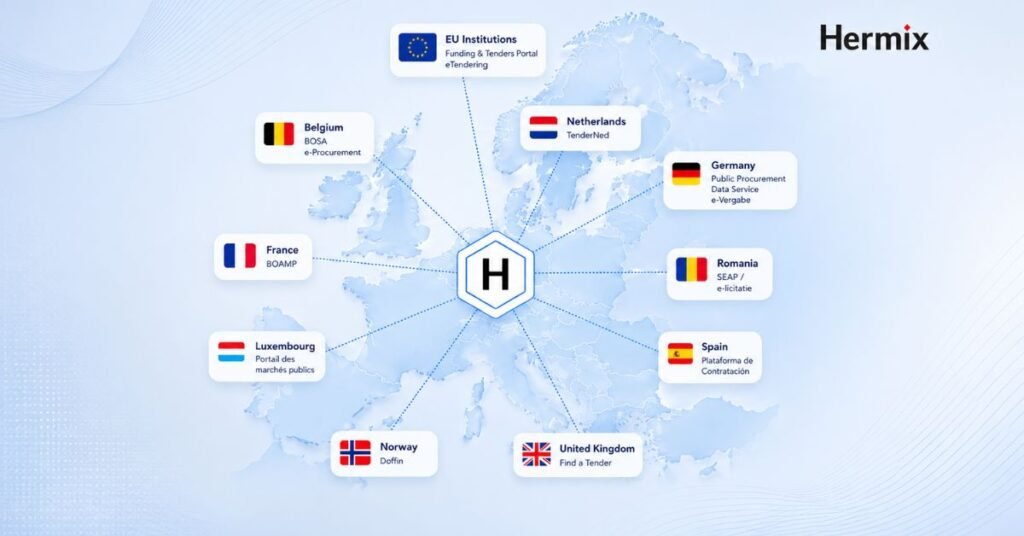
Its coverage includes the European Union, national procurement markets, and international organisations such as NATO and the United Nations. The platform monitors markets including Belgium, the Netherlands, Luxembourg, the United Kingdom, France, Spain, Norway, Germany, Romania, and others.
Companies using Hermix include Microsoft, IBM, Alten, KPMG, Capgemini, Atos, Serco, Publicis-Sapient, Fujitsu, Accenture, Unisys, and Tata.
The platform was developed over four years before its public launch at the end of 2022. Hermix was co-founded by Stefan Morcov and is operated by Alstoria Global Tech, a European IT consultancy founded in 2018 and active in Belgium and other European markets.
Hermix won first place in the EU public procurement opportunities for young people category at the 2022 EU Datathon. It also received the Deloitte Technology Fast 50 Impact Star award in 2022 and the Deloitte and Google Cloud CE Tech Rocketship award in November 2023 and November 2024.
Better qualification begins before the tender is opened
The 300-page specification will still arrive. The authority will still set the procedure, submission format, timetable, and evaluation criteria.
The difference lies in what the supplier already knows when the tender appears: whether the authority regularly purchases the relevant service, which companies have won comparable work, what contract values are typical, which partnerships recur, and whether the opportunity fits the company’s commercial position.
Hermix reports that companies using this type of structured qualification can improve win rates from the 10% to 20% range toward 60% to 70%. Its productivity analysis also indicates that a four-person sales and presales team can deliver work comparable with a six-person team by reducing manual tender analysis and market research.
Winning public-sector contracts still requires credible expertise, competitive pricing, compliant proposals, and reliable delivery. Better data helps companies decide where those resources deserve to be used.
Hermix is free to start. Create a free account at https://hermix.com/sign-up/ and begin qualifying public-sector opportunities with a clearer view of the buyer, the market, and the competition.