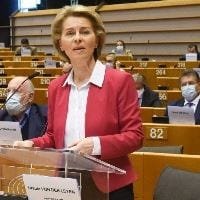
Ursula von der Leyen – Photo EC
(BRUSSELS) – EU Commission chief Ursula von der Leyen presented Wednesday a EUR 750 bn plan for economic recovery from the Covid-19 crisis involving pooling of debt and unprecedented financial transfers.
Under the plan, a new recovery instrument, ‘Next Generation EU’, will be embedded into its revamped long-term EU budget. The Commission has also unveiled an adjusted Work Programme for 2020, prioritising actions needed to propel Europe’s recovery.
The EU executive says it proposwes to harness the full potential of the EU budget. As well as the funding from ‘Next Generation EU’ of 750 billion, ‘targeted reinforcements’ to the long-term EU budget for 2021-2027 will bring the total financial firepower of the EU budget to 1.85 trillion.
“The recovery plan turns the immense challenge we face into an opportunity, not only by supporting the recovery but also by investing in our future,” said the Commission’s president Ursula von der Leyen: “the European Green Deal and digitalization will boost jobs and growth, the resilience of our societies and the health of our environment.”
Next Generation EU will raise money by temporarily lifting the own resources ceiling to 2.00 per cent of EU Gross National Income, allowing the Commission to use its strong credit rating to borrow 750 billion on the financial markets.
This additional funding will be channelled through EU programmes and repaid over a long period of time throughout future EU budgets not before 2028 and not after 2058. To help do this in a fair and shared way, the Commission proposes a number of new own resources.Amending the current multiannual financial framework 2014-2020 would make an additional 11.5 billion in funding available already in 2020.
The money raised for Next Generation EU will be invested across three pillars:
1. Support to Member States with investments and reforms:
- A new Recovery and Resilience Facility of 560 billion will offer financial support for investments and reforms, including in relation to the green and digital transitions and the resilience of national economies, linking these to the EU priorities. This facility will be embedded in the European Semester. It will be equipped with a grant facility of up to 310 billion and will be able to make up to 250 billion available in loans. Support will be available to all Member States but concentrated on the most affected and where resilience needs are the greatest.
- A 55 billion top-up of the current cohesion policy programmes between now and 2022 under the new REACT-EU initiative to be allocated based on the severity of the socio-economic impacts of the crisis, including the level of youth unemployment and the relative prosperity of Member States.
- A proposal to strenghten the Just Transition Fund up to 40 billion, toassist Member States in accelerating the transition towards climate neutrality.
- A 15 billion reinforcement for theEuropean Agricultural Fund for Rural Development to support rural areas in making the structural changes necessary in line with the European Green Deal and achieving the ambitious targets in line with the new biodiversity and Farm to Fork strategies.
2. Kick-starting the EU economy by incentivising private investments:
- A new Solvency Support Instrument will mobilise private resources to urgently support viable European companies in the sectors, regions and countries most affected. It can be operational from 2020 and will have a budget of 31 billion, aiming to unlock 300 billion in solvency support for companies from all economic sectors and prepare them for a cleaner, digital and resilient future.
- Upgrade InvestEU, Europe’s flagship investment programme, to a level of 15.3 billion to mobilise private investment in projects across the Union.
- A new Strategic Investment Facility built into InvestEU to generate investments of up to 150 billion in boosting the resilience of strategic sectors, notably those linked to the green and digital transition, and key value chains in the internal market, thanks to a contribution of 15 billion from Next Generation EU.
3. Addressing the lessons of the crisis:
- A new Health Programme, EU4Health, to strengthen health security and prepare for future health crises with a budget of 9.4 billion.
- A 2 billion reinforcement of rescEU, the Union’s Civil Protection Mechanism, which will be expanded and strengthened to equip the Union to prepare for and respond to future crises.
- An amount of EUR94.4 billion for Horizon Europe, which will be reinforced to fund vital research in health, resilience and the green and digital transitions.
- Supporting Europe’s global partners through an additional 16.5 billion for external action, including humanitarian aid.
- Other EU programmes will be strengthened to align the future financial framework fully with recovery needs and strategic priorities. Other instruments will be reinforced to make the EU budget more flexible and responsive.
The new ‘European Green Deal’ is seen as a key part of the EU’s recovery strategy:
- A massive renovation wave of our buildings and infrastructure and a more circular economy, bringing local jobs;
- Rolling out renewable energy projects, especially wind, solar and kick-starting a clean hydrogen economy in Europe;
- Cleaner transport and logistics, including the installation of one million charging points for electric vehicles and a boost for rail travel and clean mobility in our cities and regions;
- Strengthening the Just Transition Fund to support re-skilling, helping businesses create new economic opportunities.
Strengthening the Single Market and adapting it to the digital age:
- Investing in more and better connectivity, especially in the rapid deployment of 5G networks;
- A stronger industrial and technological presence in strategic sectors, including artificial intelligence, cybersecurity, supercomputing and cloud;
- Building a real data economy as a motor for innovation and job creation;
- Increased cyber resilience.
A fair and inclusive recovery for all:
- The short-term European Unemployment Reinsurance Scheme (SURE) will provide 100 billion to support workers and businesses;
- A Skills Agenda for Europe and a Digital Education Action Plan will ensure digital skills for all EU citizens;
- Fair minimum wages and binding pay transparency measures will help vulnerable workers, particularly women;
- The European Commission is stepping up the fight against tax evasion and this will help Member States generate revenue.
Recovery Plan Communication: “Europe’s moment: Repair and Prepare for the Next Generation”
EU Budget Communication: “The EU budget powering the recovery plan for Europe”