European air- and missile-defence debates usually focus on interceptors, yet the decisive struggle is unfolding inside radar halls from Hengelo to Allerød, aboard Swedish early-warning jets and in Brussels meeting rooms allocating European Defence Fund (EDF) money.
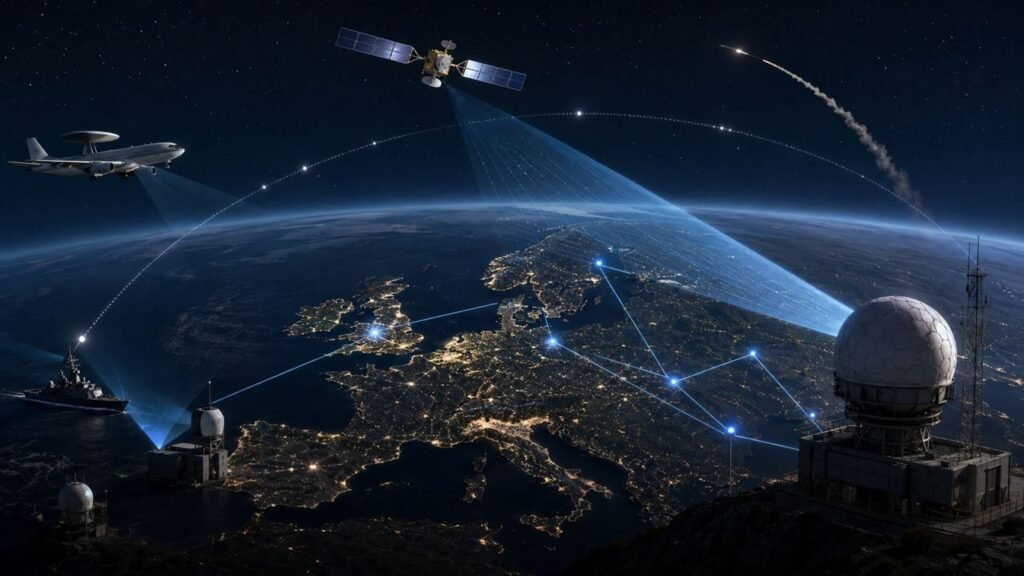
Ground, naval and airborne sensors are being upgraded or built at a pace unseen since the Cold War; together they promise to give the continent the “eyes” it needs against drones, cruise missiles and manoeuvring hypersonic glide vehicles.
When NATO defence ministers adopted a new Integrated Air and Missile Defence (IAMD) Policy in February 2025, the document repeatedly stressed air surveillance, networked sensors, data fusion and command-and-control as the foundations of any credible missile defence architecture. Threat detection, it states, is “essential” to defensive operations, while persistent surveillance is a “precondition for situational awareness.” “These new, ambitious, and long-term defence projects will act as key initiatives to strengthen EU defence readiness and bolster our strategic autonomy… [They] will make a direct contribution to the development of a European Air, Maritime and Space Shield,’ explained Andrius Kubilius, Commissioner for Defence and Space.
Interceptors, while the decisive final effector, must be viewed as the culmination of a kill chain in which every link is equally essential. Speaking at NATO’s Defence Industry Forum this month, Deputy Secretary General Radmila Shekerinska argued that the Alliance needs “interceptors, sensors, command and control capabilities” and that these must increasingly be developed together.
This presents a real opportunity for Europe. Although discussions surrounding missile defence often focus on American Patriot batteries or Israel’s Arrow interceptor as Europe develops sovereign equivalents, the continent already possesses one of the world’s most sophisticated radar and defence-electronics industries.
Ground sensors: Dutch and Danish excellence
When Janes visited Thales Nederland’s campus in Hengelo in February 2024, the headline was blunt: “Thales Nederland has tripled its radar production over the last few years.” The plant now turns out land-based GM200 Multi-Mission/Compact (MM/C) arrays for the Netherlands, Norway, Denmark and Lithuania. This underlines how Europe can still manufacture at volume, not just develop prototypes.
Speaking at the hand-over ceremony in February 2024, Major-General Ludy Schmidt, deputy commander of the Dutch Materiel & IT Command, reminded reporters why the surge matters, explaining how Norway was the second country to order the GM200 MM/C in 2021, followed by Denmark and Lithuania joining the programme in 2023. In other words, a single AESA radar family is now the backbone of four national armies and counting.
Long recognised as one of NATO’s leading radar manufacturers through its Dutch subsidiary, Thales has spent decades developing surveillance systems such as SMART-L, APAR and the GM200, all of which are now deployed by multiple European navies and armed forces. Just this year, Thales signed a new strategic partnership with the Dutch Ministry of Defence to expand radar system production “to meet growing demand.”
At Eurosatory 2026, the group unveiled what it sees as the next step in that evolution: DeepFinder, a new family of ultra-high-frequency (UHF) active electronically scanned array radars designed specifically for long-range air and missile surveillance. Unlike conventional fire-control radars, which prioritise precision guidance for interceptors. “The DeepFinder radar is also equipped with a scanning frequency sufficient to detect any missile with a vertical trajectory, track its path, and calculate the missile’s point of impact if it is a ballistic missile, or track its hypersonic flight and, ultimately, determine its launch point,” explained Eric Marto, vice president of strategy and marketing for Thales’ ‘surface radars’ product line.
If Hengelo shows scale, Allerød, Denmark, offers a lesson in mid-cap agility. Last year, Danish firm Weibel Scientific, which occupies a global niche in high-precision Doppler radar systems, booked a DKK 500 million order for XENTA radars destined for Kongsberg’s NOMADS mobile air-defence system. CEO Peter Røpke was quoted as saying, “This historic order is proof that we are well on our way to becoming the global leader in radar systems for short-range air defence and protection against hostile drones.” Moreover, XENTA’s continuous-wave architecture can tell a hobby drone from a bird while cueing interceptors against cruise-missile profiles, aligning it with Europe’s current needs in hypersonic defence.
Above the horizon: NATO’s new AWACS and Italy’s kill-web vision
Ground radars, however sophisticated, still need altitude and persistence. That logic drove 11 Allies—Belgium, Canada, Denmark, Germany, Latvia, Lithuania, Luxembourg, the Netherlands, Norway, Romania and Sweden—to announce at the Ankara NATO Summit on 7 July 2026 a joint order for Saab GlobalEye aircraft to replace part of the E-3A AWACS fleet. The Alliance’s communiqué highlights why the sensor made the cut: “The GlobalEye system will provide enhanced detection and tracking of complex threats, including drone swarms, ballistic missiles, and cruise missiles.”
Beyond its operational merit, GlobalEye’s selection cements a European-led industrial team at the apex of NATO early warning, which is a fact EDF evaluators cannot ignore as they weigh complementary ground projects.
Furthermore, Italy’s Leonardo is betting on a philosophy rather than a single product. Speaking at the Seafuture 2025 conference, Matteo Cardone, deputy managing director for Land & Sea Business, described “a cost-effective solution that incorporates a series of sensors including radar and electro-optics, alongside a series of effectors.”
Cardone pointed to the Dual-Band Radar (DBR) suite aboard the Italian frigate Bande Nere, which during NATO’s Formidable Shield exercise in May 2025 “detected and tracked a short-range ballistic target while maintaining tracking and disseminating data up to the point of impact at sea.” The same C- and X-band technology, re-packaged as Kronos Grand Mobile High Power, forms the sensor backbone of the Franco-Italian SAMP/T NG interceptor now entering service. Together, Thales’ long-range DeepFinder concept, Weibel’s short-range XENTA, Leonardo’s dual-band array and Saab’s airborne sensor create a de-facto European radar “trinity”.
The Brussels calculus: funding and the hypersonic gap
Some of these cutting-edge technologies are being brought together within one of the most demanding (especially for radar) defence programmes currently underway in Europe: the HYDIS2 project. Countering a manoeuvring hypersonic glide vehicle means first detecting and continuously tracking a target travelling at extreme speed while capable of altering its trajectory, then guiding a kinetic kill vehicle to a collision point at a closing speed exceeding 7 km/second. Such a capability can only be achieved by combining expertise across multiple disciplines. Companies including Thales Nederland and Weibel are among 28 collaborators from 19 different countries taking part in the consortium, the expanded line-up of which – HYDIS2dp – was recently unveiled, while their specific contribution to the project remains confidential at this point.
Reaching this stage also requires years of risk-reduction studies before full-scale development can even begin. Those efforts are financed through a combination of investment programmes. Like its competitor HYDEF, HYDIS is supported through a combination of industrial investment, national funding and the EDF. In overall terms, HYDIS represents around €140 million in combined funding (€80 million from the EDF and approximately €60 million in additional public investment).
Why should treasury officials, military planners and MEPs care about radars? Because sensors evolve as quickly as the threats they are designed to counter. Ammunition shortages dominated headlines in 2022. In 2026, strategic advantage increasingly depends on antenna arrays, gallium nitride transmit-receive modules, sophisticated tracking algorithms and the engineers capable of developing them.
If 2022 was the year Europe rediscovered artillery production and 2023 the year it accelerated interceptor procurement, 2026 may be remembered as the year it recognised that the effectiveness of any missile defence system ultimately depends on the quality of the sensors that guide it. Long before an interceptor is launched, the battle has already begun in the electromagnetic spectrum.