The EU economy began 2025 on a somewhat stronger footing than anticipated, and is projected to keep growing at a modest rate this year, according to the EU’s spring economic forecast.
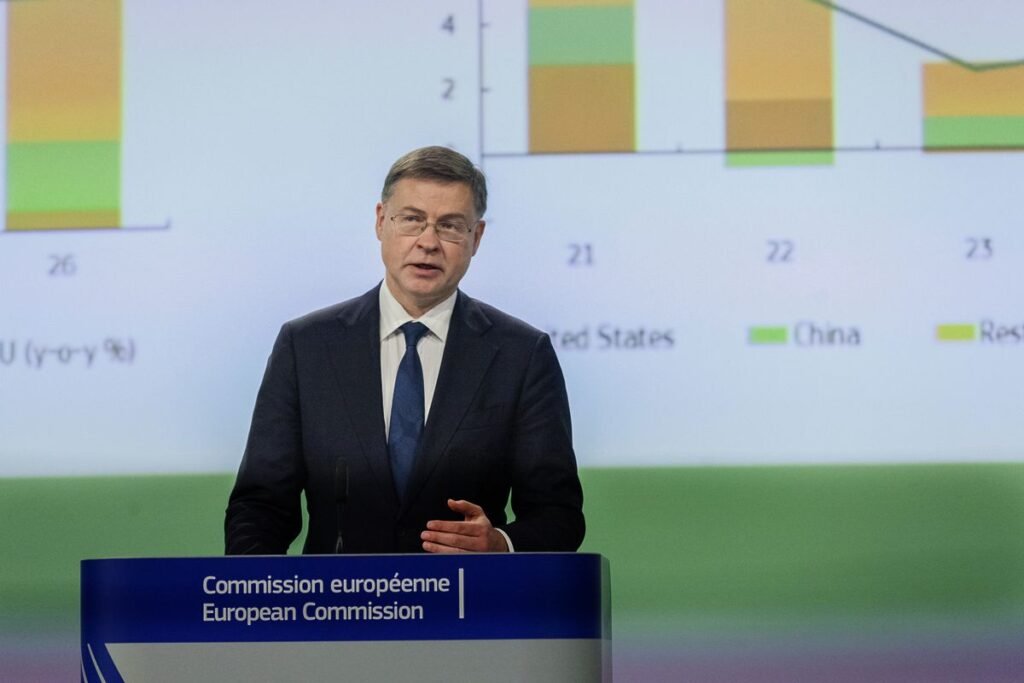
“The EU economy is demonstrating resilience amid high trade tensions and a surge in global uncertainty,” said EU Economy Commissioner Valdis Dombrovskis: “Underpinned by a robust labour market and rising wages, growth is expected to continue in 2025, albeit at a moderate pace.The EU Commission’s Spring 2025 Economic Forecast foresees growth picking up in 2026, despite heightened global policy uncertainty and trade tensions.”
The Commission’s forecast projects real GDP to grow by 1.1% in 2025 in the EU and 0.9% in the euro area, broadly the same pace as recorded in 2024. In 2026, growth is expected to accelerate to 1.5% in the EU and 1.4% in the euro area. Headline inflation in the euro area is expected to slow down from 2.4% in 2024 to an average of 2.1% in 2025 and 1.7% in 2026. In the EU, inflation is set to follow similar dynamics from a slightly higher level in 2024, falling just below 2% in 2026.
The spring forecast revises outlook for growth significantly downward, largely owing to a weakening global trade outlook and higher trade policy uncertainty.
Certain assumptions are included about trade tariffs. Tariffs on US imports of goods from the EU, and virtually all other trade partners, were assumed in the model to remain at 10%, the level applied on 9 April, with the exception of higher tariffs on steel and aluminium and cars (at 25%), and tariff exemptions on certain products (pharma and microprocessors). Bilateral tariffs between US and China were assumed to be lower than those applied on 9 April, but sufficiently high to lead to a significant reduction of US-China bilateral trade of goods. The tariff rates eventually agreed by China and the US on 12 May have turned out to be lower than those assumed, but still high enough not to invalidate the assumption of a hit to the US-China trade relationship.
Global growth outside the EU is now projected at 3.2% for both 2025 and 2026, down from the 3.6% rate forecast in autumn 2024. This downward revision largely reflects a weakened outlook for both the US and China. The slowdown of global trade is even sharper.
EU exports are as a consequence expected to grow by only 0.7% this year, with a renewed contraction in exports of goods partially offset by resilience of services exports – as they are less affected by trade tensions. In 2026, export growth is set to accelerate to 2.1%.
It is uncertainty, more than tariffs, that weighs on domestic demand, says the Commission. Following a 1.8% contraction in gross fixed capital formation for 2024, a moderate recovery of investment is on the horizon. This is more muted than expected in autumn, as lower overall activity reduces capital needs. Meanwhile the volatile market response to the trade tensions is having a tightening impact on financing conditions. Investment is now projected to increase by 1.5% in 2025 and further accelerate to 2.4% in 2026. This acceleration is driven by infrastructure and R&D investment, also thanks to support from the Recovery and Resilience Facility (RRF) and the Cohesion Fund, and a turnaround in residential construction. In 2026, equipment investment is also expected to regain vigour.
As for private consumption, growth is expected to be slightly more robust than projected in autumn, reaching 1.5% in 2025 and 1.6% in 2026. This largely owes to stronger growth momentum in 2024 and a still resilient labour market in the context of rapidly subsiding inflationary pressures. Elevated savings, nevertheless, continue to constrain the consumption dynamics.
Inflation is expected to contrinue its decline. After easing to 2.4% in 2024, Harmonised Index of Consumer Prices (HICP) inflation in the euro area is projected to reach the ECB’s target of 2% already in 2025, falling further in 2026.
Energy commodity prices have declined markedly since autumn 2024 and are set to continue their downward trajectory. Likewise, a strengthened euro should also add to disinflationary pressures.
Risks to the outlook are tilted to the downside, says the Commission. Further fragmentation of global trade could mitigate GDP growth and reignite inflationary pressures. Climate-related disasters are also more frequent and remain a persistent source of downside risk for growth.
On the upside, further de-escalation of EU-US trade tensions or faster expansion of the EU’s trade with other countries, including through new free trade agreements, could sustain EU growth. Increased defence spending could also contribute positively. Advancing reforms to boost competitiveness, such as deepening the Single Market and advancing the Savings and Investments Union, as well as implementing an ambitious simplification agenda can further strengthen the resilience of the EU economy.