Skip to content. | Skip to navigation

Personal tools
Sections
You are here: Home topics Development Development Guides
Document Actions

Development Guides

Up one level
Guides on the EU Development policy.
EU budget proposals for its external instruments from 2014-2020 - guide by EUbusiness — last modified 07 December 2011, 19:30 CET
The European Commission adopted budget proposals for its external instruments from 2014-2020 on 7 December. They will allow the European Union to fulfil its responsibility on the global stage: fighting poverty and promoting democracy, peace, stability and prosperity. The range of instruments will support developing countries as well as countries in the European neighbourhood and those that are preparing accession into the EU. The Commission is seeking to target its resources where it says they are most needed, where they will have the highest impact while ensuring more flexibility to be able to react swiftly to unforeseen events. This budget will also enable the EU to further reinforce its role on the global stage and promote its interests and values.
"Agenda for Change" in EU development policy and EU budget support - guide by EUbusiness — last modified 13 October 2011, 15:56 CET
The EU will re-prioritise its delivery of aid to developing countries to ensure maximum impact on poverty reduction. EU Commissioner for Development Andris Piebalgs has presented the 'Agenda for Change' of EU Development policy and a new policy for EU budget support. These communications set out a more strategic EU approach to reducing poverty, including through a more targeted allocation of funding. Future EU spending should concentrate on sectors which are key for long-term and inclusive growth, target countries that are in the greatest need of external support and where aid can make a difference.
Reform of the EU Generalised System of Preferences by EUbusiness — last modified 10 May 2011, 22:48 CET
The aim of the Generalised System of Preferences (GSP) is to help developing countries by making it easier for them to export their products to the European Union. This is done in the form of reduced tariffs for their goods when entering the EU market. It allows these countries to participate more fully in international trade and generate additional export revenue. It is an autonomous measure by the EU: there is no expectation or requirement that this access be reciprocated by the countries concerned.
EU Development policy - guide by EUbusiness — last modified 10 November 2010, 22:46 CET
The European Commission has launched a public consultation on the future of EU Development policy. Faced with the triple challenge of economic, food and environmental crises, but also the generally encouraging economic performance of Developing countries, the Commission wishes to collect views on how the EU can best support developing countries to speed up their progress towards the Millennium Development Goals and beyond. Building on previous achievements, the Commission proposes four main areas for debate, focusing on the impact of EU aid, the facilitation of more inclusive growth, the promotion of sustainable development, and durable results in agriculture and food security. Following the public consultation open to EU and partner countries, the Commission will table a Communication on a Modernised EU Development policy in 2011. The following FAQ presents the background and main issues addressed by the Green Paper.
Illegal logging - guide by EUbusiness — last modified 07 October 2010, 00:07 CET
The European Union on 6 October signed the Voluntary Partnership Agreement with Cameroon, the largest African exporter of timber products to the EU. By July 2012, all shipments of wood products from Cameroon to the EU will be required to carry a license showing that they contain timber and wood products from a legal origin. This agreement expresses a strong joint commitment to eradicate illegal logging and underpins Cameroon’s ongoing reforms towards good governance of the forest sector and development. European consumers, for their part, will have confidence that wood products, such as furniture, imported from Cameroon are of legal origin.
Illegal logging and the FLEGT voluntary Partnership Agreement - guide by EUbusiness — last modified 15 July 2010, 15:10 CET
The report "Illegal Logging and Related Trade", prepared by international think tank Chatham House, documents progress made at the global level of combating illegal logging and improving forest governance in developing countries. The study is an attempt to measure global efforts to tackle illegal logging of consumer, processing and wood producing countries. It examines the response and actions taken in countries where illegal logging occurs and also in those countries which import, process and consume illegally sourced wood. In addition to measuring how illegal logging has changed over time, the report shows how attention to the problem has changed and how governments and the private sector have responded. It notably mentions the EU FLEGT agreements as one credible and useful tool. The EU's achievements in this area centre around the EU Action Plan for Forest Law Enforcement Governance and Trade Action Plan (FLEGT). They include the signature of voluntary agreements with Congo and Ghana, which will ensure that all wood products entering the European Union from these countries carry a licence showing that the wood they contain is of legal origin.
Revised Cotonou Partnership Agreement - guide by EUbusiness — last modified 24 June 2010, 16:52 CET
The official ceremony of a signature of the second revised Cotonou Agreement took place in Ouagadougou, Burkina Faso, on 22-23 June 2010 in presence of EU Development Commissioner and representatives of the ACP countries. Changes to the agreement highlight an emphasis on climate change, and regional integration to combat problems affecting neighbouring countries. Other goals include coordinated efforts to maintain food security, and prioritisation of fragile states. Commissioner Piebalgs also inaugurated a street "L'Avenue de L'Europe" next to the EU delegation, and met with Burkina Faso's President, Blaise Compaore.
Millennium Development Goals (MDGs): EU action plan - briefing by EUbusiness — last modified 21 April 2010, 14:53 CET
The European Commission has adopted an action plan for EU action to speed up progress towards the Millennium Development Goals (MDGs). In 2009, the EU aid level has slightly decreased and amounted €49bn. This corresponds to 0.42% of EU GNI, making the EU still far from meeting the intermediate collective target of 0,56% GNI by 2010, before reaching 0.7% EU GNI by 2015. The EU remains the most generous global donor, providing over half of global aid. The Commission proposes to EU Member States a number of actions in support of MDGs. They aim at increasing the level of aid while making aid more efficient and focused on those countries and sectors most in need. To feed into the action plan, the Commission also adopted a Communication on taxation and development which aims at increasing developing countries' domestic revenues through building stronger domestic fiscal systems and fighting tax evasion internationally. The action plan sets out a possible EU position ahead of the UN Summit on the MDGs this September.
Banana Accompanying Measures (BAM) - briefing by EUbusiness — last modified 17 March 2010, 23:32 CET
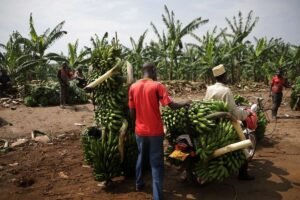
The European Commission has adopted a €190 million support package for banana exporters from African, Caribbean and Pacific (ACP) states. This proposal was part of the historic Geneva Agreement on Trade in Bananas. The EU concluded this deal with Latin American countries and the US in December 2009 which settles 15 years banana disputes. It also cuts the tariff which the EU applies to bananas imported from Latin American countries. Today's measures aim to support ACP banana exporters to adjust to this new trading environment, taking into account each country's specific situation. The measures will focus on three goals: boosting the banana sector's competitiveness, promoting economic diversification and addressing broader social, economic and environmental impacts.
EU Project: Development of Rural Business by Ina Dimireva — last modified 05 February 2010, 15:29 CET
The EU assistance programme has assisted SME development mainly through advisory support for enterprise restructuring and privatisation, and for development of business support services.
EU Assistance in Albania: Activities by Ina Dimireva — last modified 03 February 2010, 17:25 CET
EU Assistance is available in all EU candidate states and potential candidates for membership. The assistance of the EU in Albania include activities in the following areas: Strengthening of public administration and judiciary, Police and public order, Customs, and Development of infrastructure, etc.
Tax and Development - briefing by EUbusiness — last modified 10 December 2009, 11:17 CET
European Commissioners and President of the Development Committee of the European Parliament launch debate on how to improve tax revenue collection in developing countries
Promotion of compliance with international humanitarian law: Guidelines by Ina Dimireva — last modified 10 December 2009, 00:27 CET
The European Union sets out guidelines with a view to promoting compliance with international humanitarian law in its relations with third countries.
EU Development Contacts by Ina Dimireva — last modified 02 October 2009, 22:23 CET
 
Financing for Development by Ina Dimireva — last modified 02 October 2009, 22:28 CET
The 2002 Monterrey Consensus is the partnership between developed and developing countries to find ways of financing development that will meet the Millennium Development Goals. The EU, which provides over half of all official development assistance worldwide, made a number of commitments to achieve this consensus.
Environment and sustainable management of natural resources by Ina Dimireva — last modified 02 October 2009, 22:24 CET
The main objectives of Thematic Programme for Environment and Sustainable Management of Natural Resources including Energy for the period 2007-2013 are to integrate environmental protection requirements into the Community's development and other external policies and to help promote the Community’s environmental and energy policies abroad in the common interest of the Community and partner countries and regions.
'Investing in People' 2007-2013 by Ina Dimireva — last modified 02 October 2009, 22:19 CET
'Investing in People (2007 – 2013)' is the main thematic instrument of the European Commission for support of programmes in the area of human and social development, on top of country programmes that form the corner stone for the implementation of the EC activities in this area.
Policy Coherence for Development by Ina Dimireva — last modified 02 October 2009, 22:28 CET
When exploring ways to accelerate progress towards achieving Millennium Development Goals (MDG), the European Union (EU) considers how non-aid policies can assist developing countries in attaining the MDGs. The EU activity in this field is not only a key political commitment in the context of the MDGs, but also has a firm legal basis in the Treaty establishing the European Community (Article 178).
The European Consensus on Development by Ina Dimireva — last modified 01 October 2009, 16:35 CET
The European Consensus on Development 2005 is a policy statement that reflects the EU's willingness to eradicate poverty and build a more stable and equitable world.
EU Communication Stepping up international climate finance - briefing by EUbusiness — last modified 10 September 2009, 17:48 CET
The European Commission today put forward a blueprint for scaling up international finance to help developing countries combat climate change. This initiative aims to maximise the chances of concluding an ambitious global climate change agreement at the December U.N. climate conference in Copenhagen. By 2020 developing countries are likely to face annual costs of around €100 billion to mitigate their greenhouse gas emissions and adapt to the impacts of climate change. Much of the finance needed will have to come from domestic sources and an expanded international carbon market, but international public financing of some €22-50 billion a year is also likely to be necessary. The Commission proposes that industrialised nations and economically more advanced developing countries should provide this public financing in line with their responsibility for emissions and ability to pay. This could mean an EU contribution of some €2-15 billion a year by 2020, assuming an ambitious agreement is reached in Copenhagen.

Partners

Your channel to EUbusiness.com's global audience of business professionals