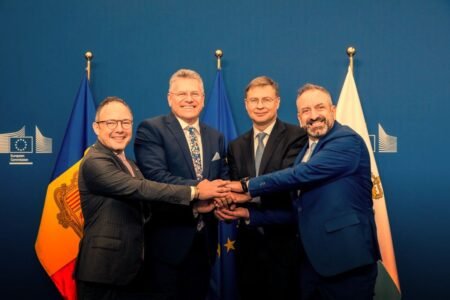
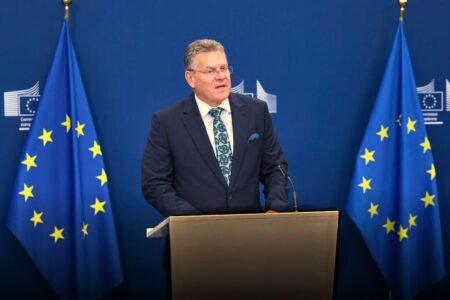
At a visit in Brussels from the President of Kazakhstan, EU leaders welcomed President Tokayev’s visit as a strong signal of the growing strategic partnership between the European Union and Kazakhstan.
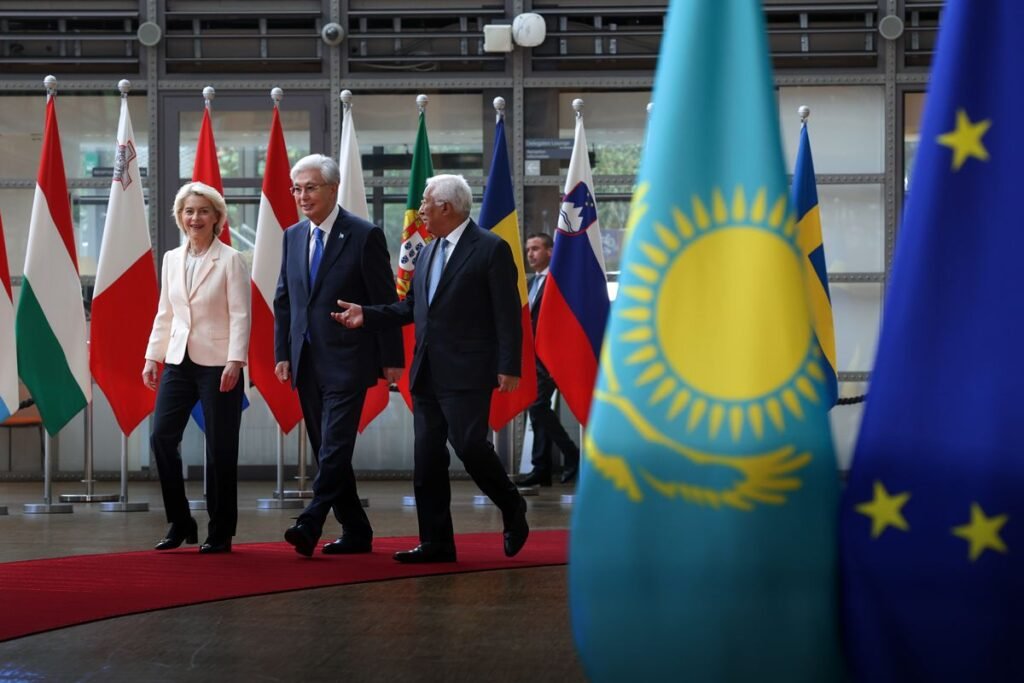
During the visit, the EU and Kazakhstan signed a joint press statement, as well as several agreements that will deliver for citizens and business on both sides. They include agreements on connectivity, in particular aviation, and critical raw materials. Likewise, both sides committed to following through investments under the Global Gateway strategy.
“Kazakhstan is a global gateway, and so is Central Asia”, said Commission president Ursula von der Leyen: “The visit of President Tokayev today signals the growing partnership between the European Union and Kazakhstan. We are ready to turn that gateway into a pathway for jobs, business opportunities and common prosperity.”
The leaders signed a Horizontal Aviation Agreement to improve air connectivity between the EU and Kazakhstan and bring new business opportunities to European airlines.
Under the agreement, all EU airlines can fly between Kazakhstan and any of the 17 Member States that have an air services agreement with Kazakhstan. This in contrast to the current situation in which airlines owned and controlled by the Member States in question, or by their nationals, are generally the ones that can benefit. The agreement is seen as a major achievement in negotiation for over two decades.
Under Global Gateway, a framework loan agreement for up to €150 million was signed between the European Investment Bank and the Kazakh National Road Company.
With a guarantee backed by the EU, this operation will finance the improvement of Kazakh roads along the Trans-Caspian Transport Corridor, a Global Gateway flagship that will create new, direct East-West trade routes and reduce reliance on neighbouring countries.
The European Bank for Reconstruction and Development and the Kazakh Government signed a Memorandum of Understanding to support the feasibility study to build an internationally accredited chemical-analytical laboratory for critical raw materials in Astana.
Chemical-analytical laboratories test substances such as critical raw materials for safety and quality.
The EU is committed to deepening cooperation in this strategic sector and previously supported the pre-feasibility study for the laboratory.
Negotiations for the Visa Facilitation Agreement and Readmission Agreement between the European Commission and Kazakhstan have concluded successfully, opening the internal procedures for their adoption.
Once adopted, the Visa Facilitation Agreement will make the process for Kazakh citizens to request a short-stay EU visa simpler, strengthening people-to-people contacts. Meanwhile the Readmission Agreement will facilitate the enforcement of the EU’s migration rules only days after the full entry into application of the Pact on Migration and Asylum.
Finally, Kazakhstan signed an agreement to buy up to 50 Airbus airplanes. This is a clear example of how European companies, big and small, are benefitting from the EU’s partnerships around the world.