The 11th summit between the EU and South Korea marked a new phase in their strategic partnership, delivering a series of concrete outcomes to enhance economic resilience, security and defence cooperation, research, and the clean energy transition.

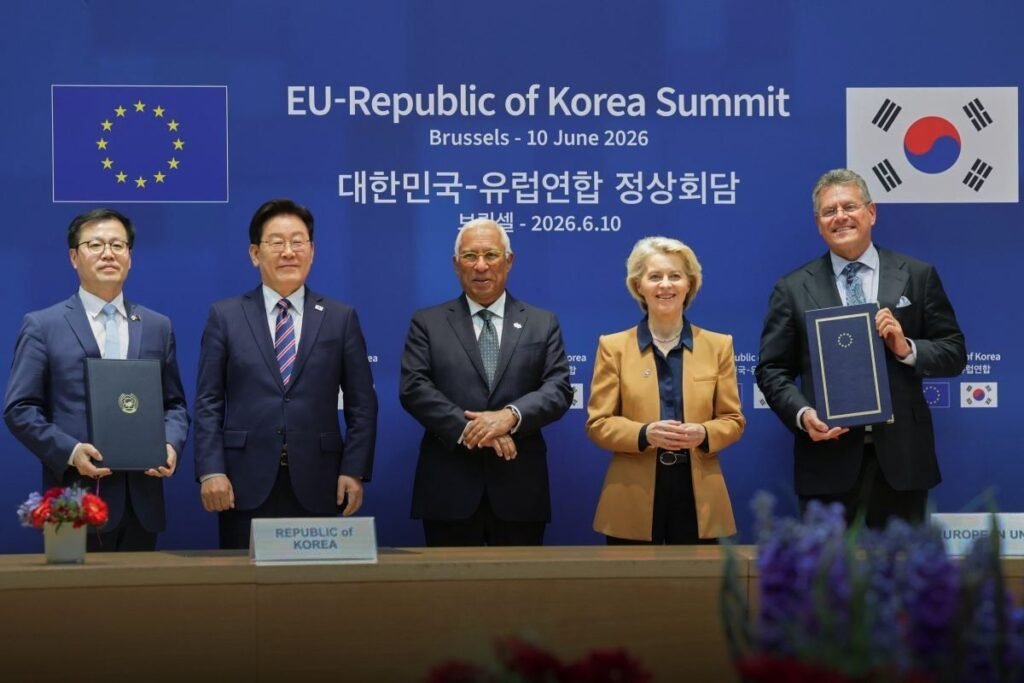
“The partnership between the European Union and the Republic of Korea has never been more important”, said the Commission president Ursula von der Leyen: “We are working together to strengthen economic security and drive innovation. Our close cooperation delivers real benefits for our citizens and helps shape a more prosperous future for the next generation.”
The EU and South Korea agreed to launch a new Competitiveness Partnership to enhance their cooperation on key policies. This will strengthen engagement on issues of strategic importance such as trade, investment, supply chains, digital, advanced technologies, energy, and innovation.
During the Summit, the EU and South Korea signed a Digital Trade Agreement. The deal is of high ambition and makes digital transactions easier and more predictable while upholding a shared commitment to open, competitive and fair digital economies.
The leaders welcomed the good cooperation already taking place under the current trade agreement and highlighted the progress made on trade and sustainable development matters, specifically welcoming Korea’s ratification of the International Labour Organisation core conventions.
The EU noted as well the opportunities for further cooperation, and in this context referred to the finalisation of its internal procedures to launch negotiations for a Mutual Recognition Agreement (MRA) on conformity assessments, certificates and markings with the Republic of Korea. The MRA would avoid double testing and certifications, crucial for European and Korean businesses to thrive. Finally, the leaders committed to continue working to improve market access for agri-food products to each other’s markets, including for beef, poultry and pork from the EU.
The leaders underscored the interconnected nature of European and Indo-Pacific security, re-affirming their joint commitment to multilateralism and the rules-based international order. The EU and the South Korea reaffirmed their strong support for Ukraine in the face of Russia’s illegal war of aggression. They also stressed their grave concerns over the Democratic People’s Republic of Korea unlawful nuclear and ballistic missile programmes and the importance of the complete denuclearisation of the Korean Peninsula.
To deepen security cooperation, the leaders committed to expanding the EU-South Korea Security and Defence Partnership. This includes enhanced cooperation on cyber and hybrid threats, foreign information manipulation and interference (FIMI), counterterrorism, non-proliferation, maritime security, and space security. They also agreed to work toward a Security of Information Agreement to facilitate secure exchanges of classified information.
The EU and the Republic of Korea have launched a High-Level Energy Dialogue to coordinate efforts on energy security, economic resilience, and the transition to clean energy.
In the field of research and innovation, the leaders welcomed the first collaborative projects under the Republic of Korea’s association to Horizon Europe, the EU’s research and innovation programme. They also agreed to support deep-tech startups in expanding internationally through the European Innovation Council.
The Summit welcomed the finalisation of negotiations on Passenger Name Records. Once in force, this agreement will enhance cooperation in combating transnational crime and terrorism, while ensuring full compliance with data protection standards.