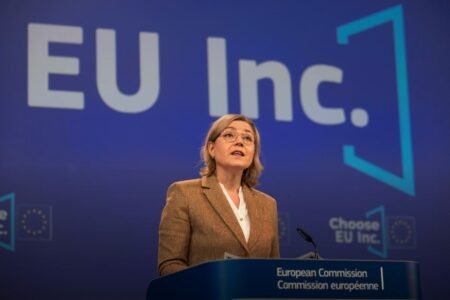
The European Commission adopted a proposal on 29 March for a Directive making it easier for companies to expand the use of digital tools and processes in EU company law.
Advertisement
What are the objectives of the Commission’s proposal?
This proposal aims to cut red-tape and improve transparency and trust in the business environment in the single market. It will achieve more digitalised and connected cross-border public services for companies and reduce the administrative burden for companies carrying out cross-border activities, in particular for SMEs.
How will it help companies?
The proposal will significantly reduce administrative barriers when companies use company information from business registers in cross-border situations, including in administrative or court procedures:
- When companies set up subsidiaries or branches in another Member State, the proposal will ensure the application of the “once-only principle”. This means that companies will not need to re-submit the information already available in their business register, and business registers will exchange that information through BRIS.
- Companies will be able to use a multilingual EU Company Certificate to provide essential information about their company, e.g., when taking part in public tenders, in the context of tax or authorisation procedures or when applying for funding in another Member State.
- Companies may use a multilingual model for a digital EU power of attorney to authorise a person to represent the company in another Member State.
- Companies do not need to obtain an apostille on certified documents or information from business registers, and on certain notarial documents, when such documents are presented in another Member State.
- The proposal reduces the need for certified translations of company documents or information provided by business registers.
How much will the proposal reduce the administrative burden on companies?
By making more company data publicly available in business registers and at EU level through BRIS, and by improving the reliability of such information, the proposal will reduce the overall administrative burden on companies and in turn facilitate access to finance and the creation of businesses. It will apply to around 16 million limited liability companies and 2 million partnerships in the EU.
Companies planning to engage in cross-border business activities, or to create cross-border subsidiaries or branches, will benefit from recurrent annual savings (administrative burden reduction) of around 437 million per year thanks to administrative simplification, including the application of “once-only principle”, abolishing the apostille, and introducing an EU Company Certificate.
How will it help small and medium enterprises (SMEs)?
SMEs account for 98-99% of limited liability companies in the EU, and around 40% of SMEs are engaged in cross-border activities and operations or cross-border investments. SMEs in particular will benefit from the reduction in administrative burden and increased legal certainty, and also from easier access to company information, as they have less financial and administrative resources than large companies.
This proposal helps to make it easier for SMEs and start-ups to expand and scale-up cross-border in line with the 2020 SME Strategy for a sustainable and digital Europe and the EU Start-up Nations Standard.
How will it improve transparency in the business environment?
The proposal will make more information about companies publicly available in particular at EU level through the Business Registers Interconnection System (BRIS). It covers important information for investors, creditors, consumers and authorities about:
- partnerships,
- groups of companies,
- single shareholders of single-member companies,
- the place of central administration and the principal place of business of companies,
- EU branches of non-EU companies.
It will also make searches for information about companies in the EU easier by allowing a search through BRIS and, at the same time, through two other EU systems interconnecting national beneficial ownership registers and insolvency registers, while respecting the existing rules for access to each system.
How will it improve trust in the business environment?
First, the proposal will improve reliability of company information in business registers across the EU and thus ensure that such information can be trusted in cross-border situations. In particular, the proposal requires Member States to ensure that:
- administrative or judicial control, as well as a legality check, of the instruments of constitution takes place when new companies are created and in case of any changes to those documents;
- uniform checks of company information (e.g., checking legality of the company’s name, object) are carried out before the information is entered in business registers.
Second, the proposal will ensure that company information in business registers is up-to-date by:
- asking companies to make timely updates of their information in business registers, and to confirm once a year that the information is up-to-date;
- asking business registers to make new information received from companies publicly available as soon as possible;
- ensuring that sanctions are applied where companies do not file information or file it late to business registers.
How does this proposal relate to the existing company law framework?
The proposal respects the different legal traditions and systems in Member States, including the possible involvement of notaries in company law procedures, and does not aim to modify them.
The 2019 Digitalisation Directive ensured that company law procedures can be carried out online, and in particular that companies can be set up online. This proposal is complementary and provides for the second step of digitalisation of EU company law. It focuses on increasing the availability of company information, in particular at EU level, and on removing administrative barriers when companies and public authorities use such information in cross-border situations, through the use of digital tools and processes.
It does not introduce new systems but builds on existing ones, for example on BRIS that is operational since 2017 and connects all Member State registers. It is also in line with EU rules on electronic identification and trust services (the eIDAS Regulation and its ongoing revision to establish a framework for a European Digital Identity).
Webpage – Company law and corporate governance
Proposal for a Directive to further expand and upgrade the use of digital tools and processes in company law
Annex Proposal for a Directive to further expand and upgrade the use of digital tools and processes in company law
Source: European Commission