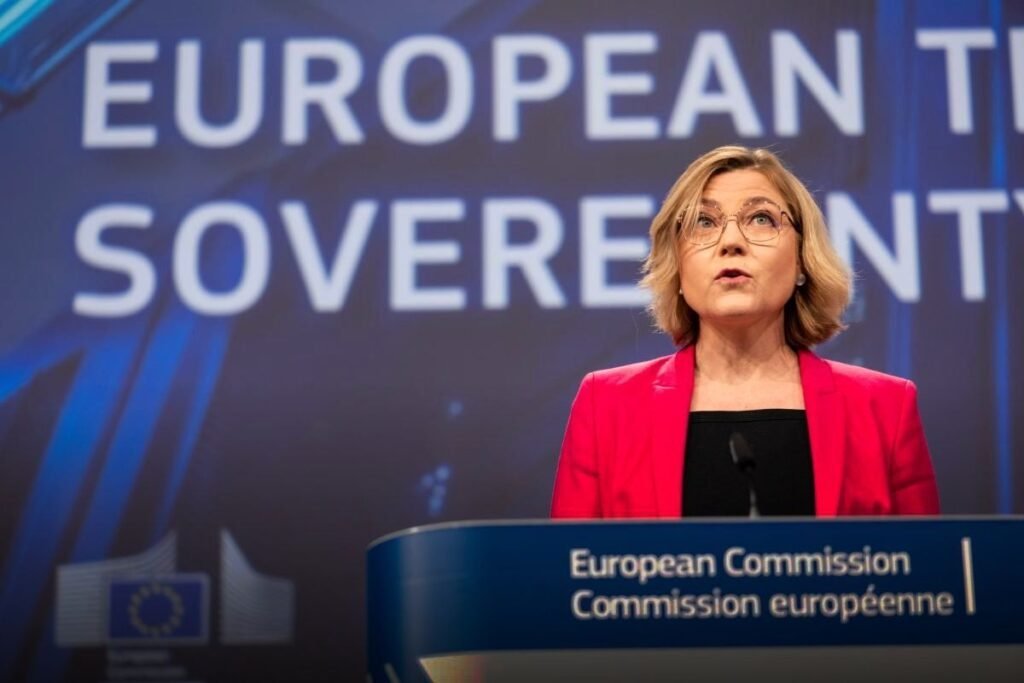
The European Technological Sovereignty Package, presented Wednesday by the EU Commission, sets out a set of measures to strengthen Europe’s capacity in artificial intelligence (AI) and semiconductors.

The package includes two legislative proposals – the Chips Act 2.0 and the Cloud and AI Development Act – as well as the Open Source Strategy and a Strategic Roadmap for Digitalisation and AI in Energy.
As demand for computing capacity rises sharply with the spread of AI, the move is Europe’s response to heavy dependency on suppliers outside the EU for core digital technologies.
“Those who champion technological innovation will shape the future – and we must ensure that Europe plays a leading role in this,” said EC executive vice-president Henna Virkkunen: “Today’s package marks a major shift in how Europe approaches technological sovereignty. It is time for Europe to be in control of its data, of its supply chains, and of its future in a clean and sustainable way. We are strengthening Europe’s digital autonomy and resilience while keeping our economy open to partners around the world.”
The Chips Act 2.0 is designed to build on Europe’s strengths, including in mainstream chips, and build capacity in cutting-edge semiconductor technologies that power AI applications.
It will speed up permitting, deepen cooperation with like-minded partners and introduce a new excellence label for Europe’s semiconductor regions. Also, by adopting an ecosystem approach, it will bring European chipmakers closer to their customers and build on the demand of growth sectors, such as data centres, cloud providers and AI Gigafactories. Finally, it will support investment and strategic projects, while addressing vulnerabilities that could put supply at risk.
The Cloud and AI Development Act aims to triple data centre capacity in Europe over the next five to seven years and strengthen the role of the Apply AI strategy to boost adoption.
The Act will support research and innovation in cutting-edge and sustainable technologies, while balancing AI ambitions with climate commitments. It will streamline conditions for deploying data centres across the EU, with a focus on highly sustainable and innovative facilities at the scale needed for the green and digital twin transition. It will also introduce a single EU-wide framework to assess cloud and AI sovereignty, while keeping most of our market open to like-minded partners.
The Open Source Strategy will scale up open source alternatives in priority areas such as cloud, AI, internet technologies, cybersecurity and semiconductors. It will also promote a stronger open source ecosystem by investing in skills, supporting open source start-ups, and improving the long-term maintenance and security of Europe’s open-source digital infrastructure.
The Strategic Roadmap for Digitalisation and AI in the Energy Sector sets out how AI and other digital solutions can ensure the sustainable integration of digital infrastructure in Europe’s energy system, while at the same time help make Europe’s energy system more efficient.
Before adoption and entry into force, the legislative proposals will now be negotiated by the European Parliament and the Council of the European Union.
Questions and answers on Tech Sovereignty Package
Questions and answers on Strategic Roadmap
Communication on technological sovereignty and EU Open Source Strategy
Strategic Roadmap on digitalisation and AI in the energy sector
Commission presents measures to digitalise Europe’s energy system