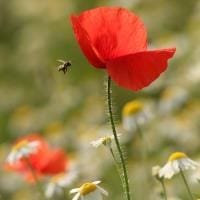
Image © Budimir Jevtic – Fotolia
(BRUSSELS) – The EU must step up support for beekeepers, ban harmful pesticides, invest more in developing safe bee drugs and clamp down on imports of fake honey, MEPs on the EU Parliament’s agriculture said Tuesday.
In their resolution, MEPs call on the EU to increase the budget for national beekeeping programmes by 50% and introduce a new support scheme for beekeepers in the EU’s post-2020 farming policy.
This is needed, they say, to help counter growing threats to pollination by bees, seen as vital to Europe’s food security and ecological balance.
The EU Commission should look at ways to help beekeepers remedy production losses and member states could introduce a compensation scheme for loss of bee colonies, they add.
Noting that the number of bee colonies has declined by more than 50% in some member states, MEPs underline that the EU needs an effective, large-scale and long-term strategy to improve bee health, protect bees and ensure bee repopulation.
To this end, MEPs called for:
- an EU level action plan to combat bee mortality,
- breeding programmes to produce bees that are resilient to invasive species such as Varroa destructor, the Asian hornet or the American foulbrood,
- more research to develop innovative bee drugs and increase their availability,
- a ban on pesticides with scientifically proven negative effects on bee health, including neonicotinoids, and measures to develop safe alternatives for farmers,
- better training, e.g. to improve survival of bees in farmed landscapes, and
- advanced warning of spraying periods to avoid harming bees.
To ensure that imported honey meets high EU standards, the MEPs call on the Commission to develop effective laboratory analysis procedures, such as nuclear magnetic resonance testing, and member states should impose harsher penalties on offenders.
They also advocate harmonising border inspections and single market checks, imposing compulsory batch-sampling and testing for all imported honey and tightening up traceability requirements throughout the supply chain, e.g. by introducing mandatory country-of-origin labelling for honey and bee products.
EU Member states should also do more to inform the public, and especially children, of the benefits of eating honey and the therapeutic uses of bee products, MEPs insist. They want the Commission to spend more money here and focus inter alia on encouraging local and organic honey consumption.
MEPs also insist that honey and bee products should be considered “sensitive” in trade talks with third countries and perhaps completely excluded from free trade negotiations.
Bees pollinate crops and wild plants, which helps to sustain biodiversity and ensure food security. No less than 84% of plant species and 76% of Europe’s food production depend on pollination by bees. This represents an estimated economic value of 14.2 billion a year.
However, over the past few years, beekeepers have been sounding the alarm about decreasing numbers of bees and colonies. Possible reasons for the decline are intensive agriculture and pesticide use, poor bee nutrition, viruses and attacks by invasive species (such as the Varroa destructor, Asian hornet, small hive beetle, American foulbrood), as well as environmental changes and habitat loss.
The EU boasts about 17 million beehives and 600,000 beekeepers, producing some 250,000 tons of honey every year. This makes the EU the second biggest honey producer after China. The major honey producing countries in 2015 were Romania, Spain, and Hungary. However, the EU also imports honey to cover its domestic consumption, mainly from China.
Further information
Procedural steps, European Parliament