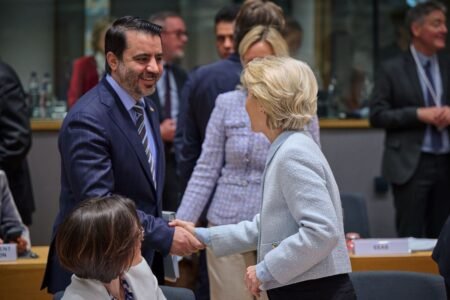
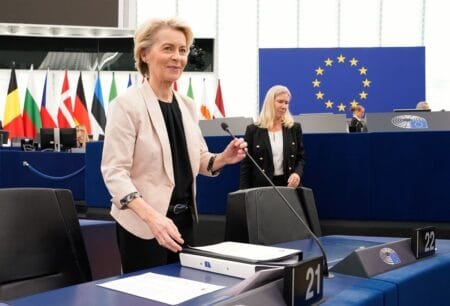
This week, EU leaders at a summit discuss Ukraine, the Middle East, the next Multi-annual Financial Framework, European defence and security and illicit drugs; the Commission holds conferences on green budgeting, nuclear safety, cohesion policy, and energy efficiency driving SME competitiveness; and MEPs in plenary session vote on the EU-US trade deal, updated rules on migrant returns, the EU’s Artificial Intelligence Act and an EU ban on nudifiers, and debate protecting children and their mental health from risks attached to social media use. The week’s events in the European Union including EU Council, Commission and Parliament meetings from 15 to 21 June 2026.
Monday 15 June
European Parliament | Political Meetings | Institutional affairs
Plenary Session of the European Parliament
Strasbourg, France
EU-US trade: following a debate on Monday, MEPs are set to give their final green light to two pieces of legislation implementing EU tariff commitments under the August 2025 EU-US Joint Statement (‘Turnberry agreement’) on Tuesday. Parliament’s media service is organising a press briefing on the topic, including a press conference with the rapporteur, after the vote.
AI Act simplification/ ban on nudifying apps: MEPs will debate on Monday and take a final vote on Tuesday on simplifying rules within the EU’s AI Act as part of the so-called digital omnibus package, including an EU ban on nudifying tools and on the AI-assisted creation of child sexual abuse material.
Monday 15 June
Council of the EU | Political meetings | Ukraine | Middle East | China
Foreign Affairs Council
Luxembourg
The Council will exchange views on Russia’s war of aggression against Ukraine and the situation in the Middle East in light of the latest developments. Ministers will also discuss EU-China relations. The Council will be preceded by an informal exchange over breakfast with Armenian Minister of Foreign Affairs, Ararat Mirzoyan.
Monday 15 June
Other bodies and agencies | Conferences and summits | Economic policy
Green budgeting in the EU: Towards performance budgeting
Brussels
This year’s conference turns the spotlight on two frontier challenges of green budgeting: (Sub)national budgeting against environmental pressures – waste, biodiversity loss, water degradation and pollution, and transforming green budgeting into a genuinely performance-oriented exercise.
Tuesday 16 June
Council of the EU | Political meetings | Health
Employment, Social Policy, Health and Consumer Affairs Council
Luxembourg
EU health ministers will seek to agree their negotiating position on a directive accompanying the European Biotech Act I, which adapts existing EU legislation on genetically modified micro-organisms and the processing of organs. They will also hold a policy debate on the European Biotech Act I regulation. The Cyprus presidency will share its progress on the regulation to revise the rules on medical and in vitro devices. Under “other business”, ministers will receive information on the recent Ebola outbreak in Central Africa.
Tuesday 16 June
European Parliament | Political Meetings | Institutional affairs
Plenary Session of the European Parliament
Strasbourg, France
EU-US trade: following a debate on Monday, MEPs are set to give their final green light to two pieces of legislation implementing EU tariff commitments under the August 2025 EU-US Joint Statement (‘Turnberry agreement’) on Tuesday. Parliament’s media service is organising a press briefing on the topic, including a press conference with the rapporteur, after the vote.
Middle East: MEPs and EU diplomacy chief Kaja Kallas will discuss recent developments in the ongoing crises in the Middle East and the EU’s role in de-escalation.
President of Montenegro: Jakov Milatovic, President of Montenegro, will address MEPs in a formal sitting.
Tuesday 16 – Wednesday 17 June
Other bodies and agencies | Conferences and summits | Energy policy | Nuclear energy
8th European Nuclear Safety Conference: Regulating nuclear safety in a rapidly changing and challenging environment
Brussels
The 8th edition of the ENSREG Conference will give an opportunity to European nuclear safety authorities / regulators, their technical support organisations (TSOs) and other stakeholders, including representatives of the European institutions, NGOs and media, as well as participants from non-EU countries – particularly from the major actors in the civil nuclear field – to exchange experiences and views on the current nuclear context and its unprecedented challenges in the EU and globally.
Tuesday 16 June
Council of the EU | Political meetings | Economic affairs
General Affairs Council
Luxembourg
Ministers for European affairs will meet in Luxembourg to continue preparations for the June European Council by discussing draft conclusions. The Council will also hold a policy debate on the negotiating box of the new Multi-annual Financial Framework (MFF) 2028-2034 and will be invited to adopt partial general approaches on three of its main pillars. Ministers will then focus on the European Semester and receive an update on the rule of law situation in Hungary in the context of the Article 7 procedure. Finally, the Council will be invited to endorse its 18-month programme covering the period from 1 July 2026 to 31 December 2027 and take stock of a progress report on simplification prepared by the presidency.
Wednesday 17 June
European Parliament | Political Meetings | Institutional affairs
Plenary Session of the European Parliament
Strasbourg, France
Updated rules on migrant returns: MEPs will hold a vote on the reform of EU returns policy, to ensure people without a right to stay in the EU leave once they are ordered to. A short debate will take place on Tuesday.
June EU summit/EU-China economic relations: in a joint debate on Wednesday morning, MEPs will outline their expectations for the 18-19 June European Council and discuss the future of EU-China economic relations with European Commission and Council Presidency representatives.
Plants obtained with new genomic techniques: plenary is set to approve new rules to make the EU food system more secure and sustainable, with climate- and pest-resistant plants that produce higher yields and require the use of fewer fertilisers and pesticides. A press conference will take place after the vote.
Social media/protecting children: MEPs will discuss solutions to improve the protection of children and their mental health from risks attached to social media use.
Enlargement: following debates on Tuesday, Parliament is set to adopt its annual reports on Wednesday on the progress made by Albania, Bosnia and Herzegovina, Georgia, Kosovo, North Macedonia, Montenegro, and Türkiye towards EU membership. Press conferences will take place after the votes.
2025 Sakharov Prize laureate: in a formal sitting, Andrzej Poczobut, 2025 Sakharov Prize laureate and recently released from prison in Belarus, will speak to MEPs.
Wednesday 17 June
Other bodies and agencies | Conferences and summits | Cohesion Policy
4th Cohesion4Transitions Conference
Brussels
This year’s C4T Conference, hosted by DG REGIO and the C4T Secretariat, will bring together Managing Authorities, regional and local authorities, practitioners and other stakeholders interested in implementing investments under Policy Objective 2 (PO2) of the 2021-2027 Cohesion Policy. The 2026 edition will highlight how sustainability, competitiveness and resilience are interconnected, and how Cohesion Policy can accelerate high-quality, future-proof investments.
Wednesday 17 June
Other bodies and agencies | Training and workshops | Knowledge management | Research | Innovation | Business start-up
Creating Venture Builder Roles in Universities and Research Organisations
Brussels
Venture builders’ roles support the transfer from scientific results originating in universities, research-performing organisations and research infrastructures into high-potential commercial ventures. How can we recognise best practices and models for venture building across Europe? What are the main challenges and how can the creation of venture builders’ roles in universities and research organisations be supported?
Wednesday 17 June
Other bodies and agencies | Conferences and summits | Energy policy | Energy efficiency
AccelerateEU through energy efficiency and electrification – Driving SME competitiveness from Brussels to Montreal
Brussels
This live-streamed event, open to everyone including small business owners, industry representatives, and financial partners, will explore 2 interconnected themes:
– how energy efficiency and smart electrification work together as the practical engine of the Clean Industrial Deal
– how targeted financing can be unlocked to drive SME competitiveness
Wednesday 17 June
Other bodies and agencies | Training and workshops | Protected area | Biodiversity
Online applicant workshop: European Natura 2000 Award
Online only
The people and organisations protecting and managing Natura 2000 site(s) and interested in applying to become the next Natura 2000 Award winner are invited to participate in this online applicant workshop. This dedicated, online workshop will provide an overview of the competition process, designed to help applicants across Europe understand the necessary steps needed to make a successful application.
Wednesday 17 June
Other bodies and agencies | Training and workshops | Translation
Artificial intelligence for public services: free tools to increase productivity and improve communication with citizens
Lisbon, Portugal
This workshop provides a practical introduction to the use of artificial intelligence in public administration. Participants will explore free AI tools developed by the European Commission that can support administrative work, document analysis and communication with citizens, while promoting efficiency and the responsible use of AI in the public sector.
Thursday 18 – Friday 19 June
European Council Political meetings | Ukraine | Defence | Finance
European Council
Brussels
EU leaders will discuss Ukraine, Middle East, the next Multiannual Financial Framework, global economic challenges, European defence and security, migration, illicit drugs, and other items.
Thursday 18 June
European Parliament | Political Meetings | Institutional affairs
Plenary Session of the European Parliament
Strasbourg, France
A greener automotive sector: Parliament is expected to give its final approval to new EU circularity rules covering a vehicle’s entire lifecycle, from design to end-of-life treatment, including recycling and the export of used vehicles.
Thursday 18 – Friday 19 June
Other bodies and agencies | Conferences and summits | Agriculture
Conference: Boosting generational renewal in EU agriculture – improving access to finance for young farmers
Warsaw, Poland
This two-day gathering will advance Commission’s Strategy for Generational Renewal in Agriculture and support ongoing work to develop innovative financial and advisory solutions for the sector.
The conference will present the outcomes from the dedicated roundtable on access to finance between EU banks and young farmers that took place in March 2026, and will deliver on the specific products on access to finance as part of the EU strategy for generation renewal.
Thursday 18 June
Other bodies and agencies | Conferences and summits | Updating of skills | Labour market | Vocational training
A Skills-First Labour Market
Online only
Labour markets across OECD countries are undergoing rapid transformation, widening the gap between the skills employers need and those that formal education systems alone can provide. This webinar will discuss why skills-first approaches to hiring, talent management and skills development are becoming essential for improving labour market functioning and productivity, and what systemic changes are needed to adopt them at scale.
Friday 19 June
Other bodies and agencies | Conferences and summits | EU financing
Innovation Fund: Stakeholder Consultation Event on the IF26 Calls for Proposals
Etterbeek, Belgium
The Directorate-General for Climate Action (DG CLIMA) will host a hybrid Stakeholder Consultation Event on the upcoming 2026 Innovation Fund Call for Proposals (IF26 Call).
The objective of this event is to provide an overview of the Innovation Funds’ progress and achievements, and to gather stakeholder feedback on future calls for proposals. Thus, this event presents an opportunity for sector-specific stakeholders to provide their input on the design of the 2026 Innovation Fund Call for Proposals.