The EU has made significant strides on many of its sustainable development goals, according to a 2026 monitoring of EU progress released Wednesday by the EU’s statistics agency Eurostat.

Eurostat’s 2026 monitoring of EU progress towards the Sustainable Development Goals (SDGs) shows that the EU has made significant strides, based on the assessment of the past 5 or 6 years of available data (the ‘short-term’), however it also notes no progress or movement away for 3 out of the 17 goals.

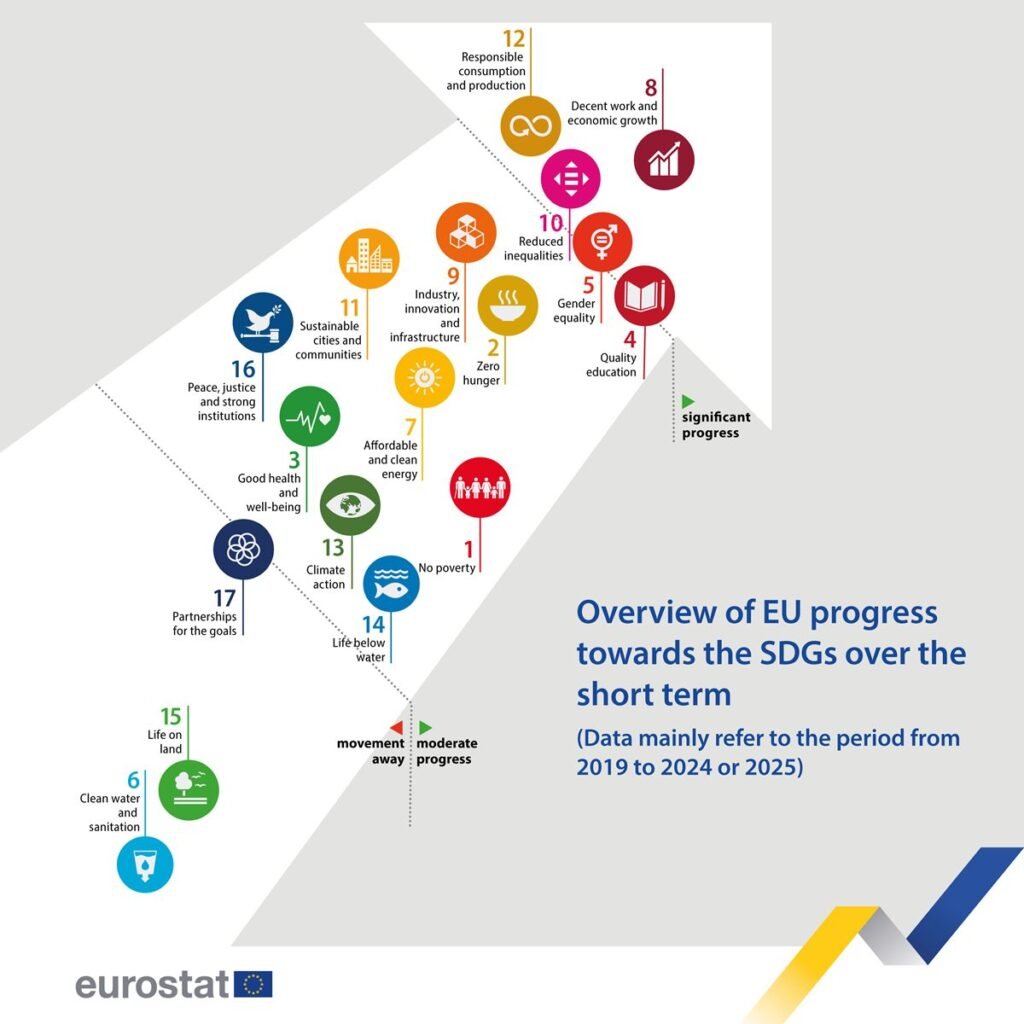
Over the short-term period, the EU has made significant progress towards 5 SDGs: decent work and economic growth (SDG 8), responsible consumption and production (SDG 12), reduced inequalities (SDG 10), gender equality (SDG 5) and quality education (SDG 4).
The EU has also progressed towards 9 other SDGs, but at a moderate pace. Among these goals, the EU has performed best for industry, innovation and infrastructure (SDG 9) and zero hunger (SDG 2). By contrast, no progress was observed for partnerships for the goals (SDG 17).
Moreover, the EU has moved away from the sustainable development objectives of life on land (SDG 15) and clean water and sanitation (SDG 6) due to biodiversity loss, water scarcity and deteriorating water quality.
In summary, the EU has made progress towards most SDGs, at varying paces and despite remaining challenges, while it has stagnated on SDG 17 and fallen back on SDG 15 and SDG 6.
A short, visual overview of the monitoring results is presented in the brochure ‘Sustainable development in the European Union – Overview of progress towards the SDGs in an EU context – 2026 edition’.