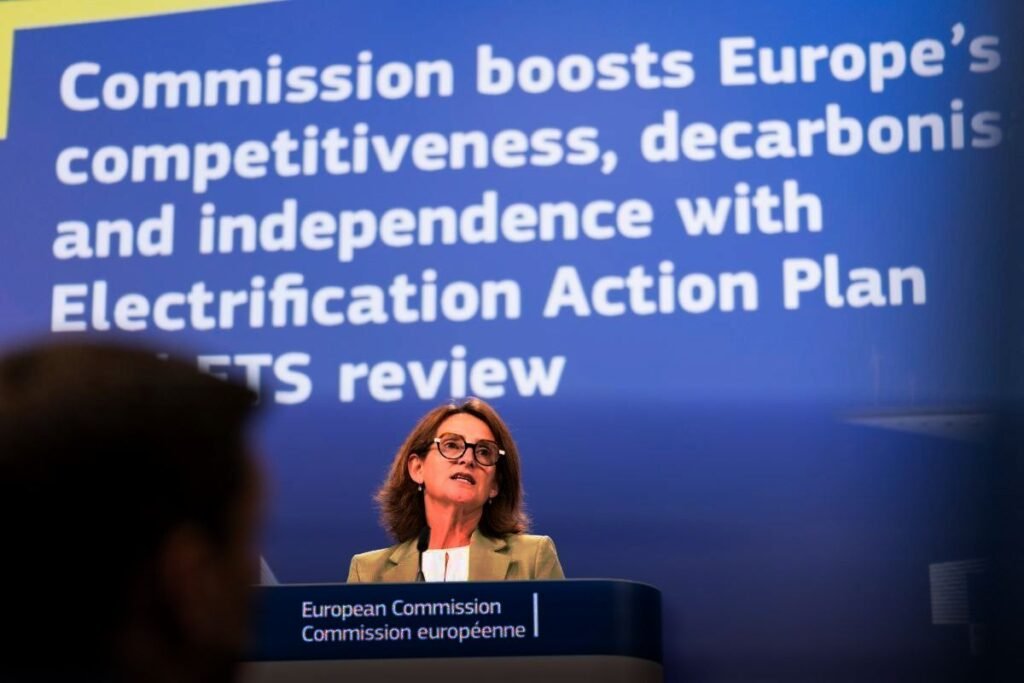
The European Commission has unveiled its proposal for the heavily debated reform of the EU Emissions Trading System (ETS) as well as its Electrification Action Plan (EAP).

The plans to ‘modernise’ the EU’s main decarbonisation policy – the EU ETS – ease the demands on industry, says the Commission, updating the Linear Reduction Factor (LRF) of 3.7% for 2031-2035 and 1.7% for 2036-2040, making the trajectory more gradual and aligned with domestic climate ambition level. Up to 2% high-quality international credits will allow to finance decarbonisation projects abroad and provide breathing space in 2036-2040 when the emission reduction in Europe will become more challenging.
“Europe’s competitiveness will be built on clean energy, not on imported fossil fuels”, EC executive vice-president Teresa Ribera insisted: “By strengthening the carbon market and accelerating electrification, we are giving businesses the confidence to invest, innovate and lead next generation technologies.”
The revised ETS will have a strong focus on investments. The Industrial Decarbonisation Bank will have €100bn funding going towards industrial decarbonisation across Europe at scale. The ETS Investment Booster will be available before 2030 as the first phase of the Bank. The EU ETS Innovation Fund will continue to support first commercial applications of innovative clean technologies in a wide range of sectors. And Member States will be required to spend 50% of their national ETS revenues on investments to decarbonise ETS sectors. This adds up to more than €100bn in investments before 2030.
At the same time, the Modernisation Fund will continue to support lower-income EU Member States to upgrade energy systems and industrial transformation.
Free allocation for companies will continue beyond 2030, and will be more closely linked to investments in decarbonisation in Europe. National ETS revenues should be reinvested in ETS sectors. The principle is clear: contributions by industry should flow back to industry. This approach encourages and rewards those that invest in the clean transition – and incentivises those who struggle to catch up.
The proposal also integrates permanent carbon removals into the EU ETS. This will give additional flexibility for the hardest-to-abate sectors and will at the same time support the scale-up of these technologies.
A separate proposal on benchmarks aims to increase free allocation to industry worth €6 billion for the period 2026-2030. For sectors that are covered by the Carbon Border Adjustment Mechanism (CBAM), the reduction of free allocation will be slowed and the phase-out extended until 2038.
The Commission also proposes a reform of the Market Stability Reserve (MSR) to further strengthen market stability and predictability for investments, maintain liquidity and reduce excessive price volatility. This complements the Commission’s proposal of April to stop the automatic invalidation of allowances held in the Reserve.
The proposal strengthens EU ETS for aviation and maritime sectors and extends it to waste incineration. Across these sectors, the review is creating new business opportunities, addresses risks of circumvention and levels the playing field. It also provides coherence with international developments.
The Plan focuses on reducing the price gap between electricity and fossil energy costs and on incentivising the uptake of cleaner, electricity-based technologies such as heat pumps, electric vehicles and batteries, among others, across Europe. The Action Plan seeks to level the playing field between electricity and gas. Their price differential often discourages the shift to cleaner options such as heat pumps, electric vehicles and electric industrial processes.
To tackle this, the proposal to future-proof electricity bills in the EU will empower Member States to reduce network charges for certain consumer groups and taxes for energy-intensive businesses. It also spurs faster deployment of smart meters, which will make it easier for consumers to save on their energy bills. The proposal also seeks to make sure that electricity is not taxed more heavily than gas.
The Action Plan also proposes solutions to lowering the upfront costs of electrification technologies across key demand sectors, such as buildings, transport and industry. It sets out a wide variety of tools that can be mobilised, such as the use of social leasing schemes, ETS financial instruments, including the Social Climate Fund and the Industrial Decarbonisation Bank, and a Clean Heat Market mechanism.
Proposal on monitoring, reporting and verification (MRV)
Proposal on the revised values for the ETS heat and fuel benchmarks
Impact assessment on the ETS Directive (including ETS aviation and maritime)
Questions and answers on Emission Trading Scheme
Factsheet on Emission Trading Scheme
Questions and answers on EU Electrification Action Plan and Network charges
Factsheet on EU Electrification Action Plan and Network charges