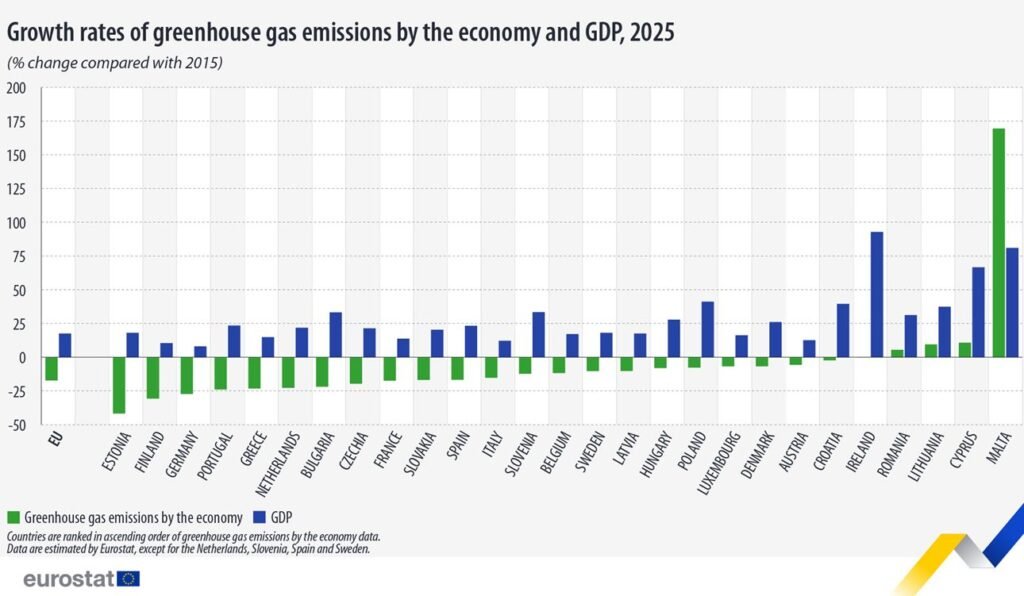
Greenhouse gas emissions from the EU’s economy and households were estimated at 3.3 billion tonnes of CO2 equivalent in 2025, covering all economic activities and households combined – a 17.2 per cent decrease compared with 2015.

The information comes from early estimates for 2025 that the EU’s statistics agency Eurostat releases for the first time 6 months after the end of the reference year.
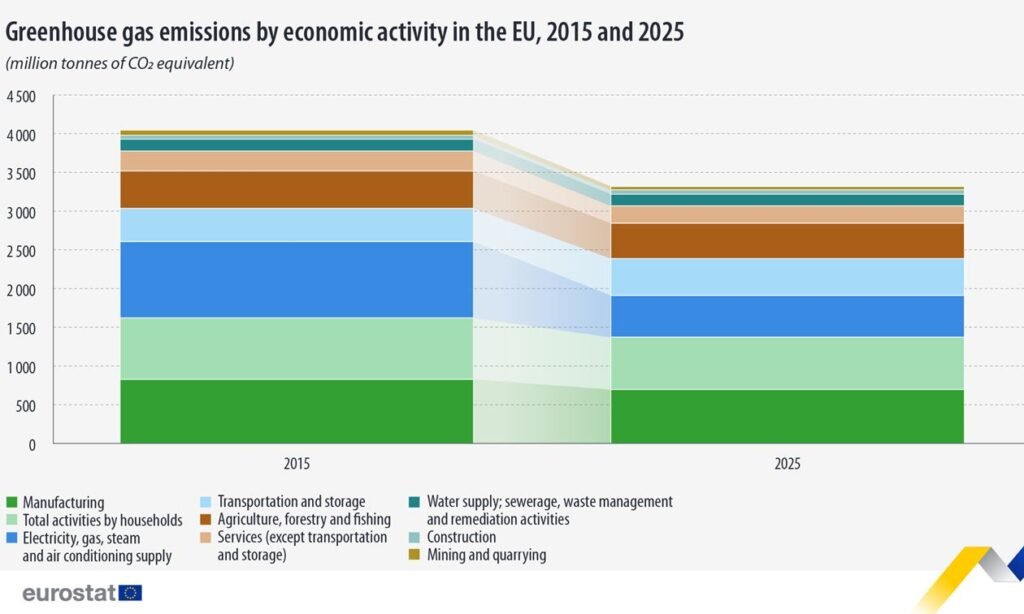
In 2025, most sectors of the economy emitted less greenhouse gases than in 2015. Emissions from the energy sector (supply of electricity, gas, steam and air conditioning) fell by 45.3%, while emissions from mining and quarrying decreased by 33.3%.
Emissions from manufacturing declined by 16.0%, household emissions fell by 14.7% and from the services sector by 11.9%.
Reductions were also recorded in agriculture, forestry and fishing (-5.9%) and in water supply, sewerage, waste management and remediation activities (-2.6%).
In contrast, emissions from the construction sector and transportation and storage increased by 11.4% and 10.9%, respectively.

In the decade between 2015 and 2025, greenhouse gas emissions (GHG) have decreased in 23 EU countries and increased in 4, according to Eurostat.
The largest reductions in greenhouse gases were estimated for Estonia (-41.7%), Finland (-30.7%) and Germany (-27.3%).
Increases were estimated for Malta (+169.4%), Cyprus (+10.7%), Lithuania (+9.5%) and Romania (+5.4%).
While the GHG emissions decreased for most countries, all EU countries increased their gross domestic product (GDP) in the same period. The EU economy as a whole increased its GDP by 17.5%.