France and Denmark are building containment fences on the border with Belgium and Germany. Bulgaria has culled 120,000 pigs. Romania has reported 300 new outbreaks in July, up from 80 in June. The European Commission describes the situation as “an extreme and urgent challenge.” But what is actually being done about the European outbreak of African Swine Fever (ASF)?
“This is the biggest animal disease outbreak we’ve ever had on the planet,” Dirk Pfeiffer, a veterinary epidemiologist at City University of Hong Kong and expert on African swine fever explained. “It makes the foot and mouth disease and BSE [mad cow disease] outbreaks pale in comparison to the damage that is being done.”
“Any pig producing country in the world is at risk, and how high that is depends on each country’s border inspection and veterinary service capability and the structure of each country’s pig industry,” Pfeiffer added.
Already African swine fever has been spreading through eastern Europe. Romania, Bulgaria, Slovakia, Latvia, Lithuania, and Poland ? outbreaks have been detected in each of these countries. The European Commission also designated Bulgaria, Lithuania, and Poland as particularly high-risk areas in a statement regarding the spread of the virus and areas that are required to take immediate preventative actions.
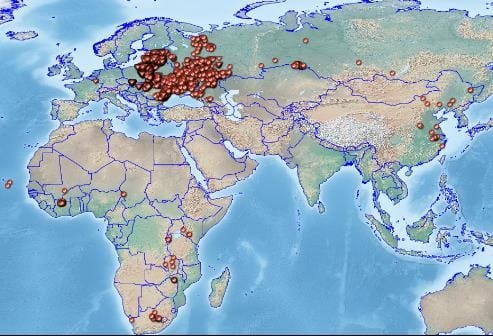
And now the virus has reached Belgium, where one case has been detected in wild boar ? a few kilometers from the French border, no less. The threat to Europe’s vast pork industry is becoming hard to ignore.
“This new outbreak represents the expansion of the disease, for the first time during the current pandemic, into Western Europe,” said Paul Sundberg, executive director of the Swine Health Information Center in the United States. “This new outbreak may represent a new change in the epidemiologic situation of ASF worldwide, suggesting that the disease may have reached pandemic proportions,” he added.
The prospect of a European domesticated pig outbreak has all the major pork producers rattled.
A Flemish farmers’ group, called ABS, has called for the cull of wild boars to protect domestic pigs from infection. And in Wallonia, the agriculture ministry has banned hunting in a 63,000 hectare-wide area to prevent the spread of wild boars, which naturally will flee when pursued.
The EU is collectively the second largest global producer of pork, with farms concentrated mostly in Germany, France, Spain, and Denmark. Denmark has already begun construction of a 42-mile border fence designed to keep out wild boar from Germany, and France has plans for a fence to ward off the spread of the Belgian boar outbreak, although next steps have not been finalised.
China, the number one producer in the world has seen massive, uncontrolled outbreaks devastate domestic pig populations. The cost to the countries $128 billion pig industry is hard to predict as the situation is ongoing, but a 30 to 40 percent drop in pork production is expected, representing an enormous cost for the industry globally.
In Europe, where there are sizable wild boar populations, a widespread outbreak could be both devastating and difficult to shake off. As domestic pigs are culled to contain the disease it will live on and persist in wild boar, which after rebuilding of livestock populations, could then re-infect the farm animals.
The Chinese cases are predicted to result in the death of one quarter of the world’s pigs. Something similar could also happen in Europe if measures to control the virus are not intensified. Many groups are calling for more to be done to contain the spread, starting with stricter control of imports of farming equipment and animal feed. The whole Chinese pork industry is facing excess soybean and livestock supplements, and Chinese producers are now seeking to export surpluses to ASF-free countries where demand for pork is dramatically growing.
But “imported feed could be one of the sources that can bring ASF virus with it,” said Jaspinder Komal, CFIA vice-president of science and chief veterinary officer for Canada. Paul Sundberg, executive director with the US Swine Health Information Center confirms: “There are several potential methods of transmission for the disease, including through contaminated feed or feed ingredients, and the outbreak in China raises concerns that it could be brought to the US.”
In the EU, things are still moving slowly. ASF-STOP is an international group aiming to spread knowledge of and techniques for combatting ASF in pigs and wild boar throughout the member countries in the EU and neighbouring states. The experts involved hope that more can be done to coordinate the different stakeholders in Europe, and that greater urgency will be demonstrated by governments.
While ASF is not harmful to humans, it is lethal in pigs, with only 1 in 10 animals surviving infection. The highly-contagious nature of the virus, combined with an extremely robust resilience to environments and long life-span, make ASF a formidable problem.
While the damage to China’s pork production has not yet been felt by the consumer, soon pork reserves will dwindle and prices will go up massively. However, given the scale of the harm already being done in China, the EU should be doing everything within its power to combat the virus, or soon we could have bigger problems than high bacon prices.