Did you know that in the UK, musculoskeletal conditions remain the leading cause of long-term absence, with over 30 million working days lost annually, according to the Health and Safety Executive and supported by the Chartered Institute of Personnel and Development?
UK government data show that 17.9% of adults in England live with a long-term musculoskeletal condition, including back pain (Office for Health Improvement and Disparities, 2025).
In desk-based populations such as Canary Wharf office workers, the burden is likely to be higher because prolonged sedentary time is associated with a 33% higher risk of chronic back pain when daily sitting exceeds six hours (Jiang et al., 2024).
This is consistent with Harvard’s guidance that moving more and sitting less may help prevent worsening back pain (Harvard Health Publishing, 2025).
Taken together, a reasonable evidence-based estimate for sedentary office populations is around 1 in 4, although this figure is an inference from the available evidence rather than an official Canary Wharf prevalence statistic.
For London-based employers, this translates directly into rising costs tied to musculoskeletal sick leave in the UK and declining employee musculoskeletal health.
The financial burden is substantial.
The HSE estimates that work-related musculoskeletal disorders cost UK businesses billions each year through absence, presenteeism, and productivity loss (HSE, 2023).
The question is no longer whether these conditions affect business performance. It is whether the response matches the scale of the risk.
This article explores how UK businesses are shifting from reactive sick-leave models towards structured recovery strategies, reshaping outcomes for long-term sickness absence in the UK.
What Musculoskeletal Absence Is Actually Costing UK Businesses
Musculoskeletal absence has two cost layers: direct absence and indirect presenteeism. Most businesses measure the first, but underestimate the second.
According to CIPD (2023), over 60% of UK organisations report workplace musculoskeletal disorders as their primary cause of long-term absence. These cases also last longer than stress-related absence, amplifying the cost per employee.
Presenteeism is the hidden factor. Employees working through chronic back pain experience reduced concentration, slower decision-making, and higher error rates (Deloitte, 2022). For London’s executive workforce, this cognitive drag can cost more than absence itself.
The presenteeism cost UK employers face is rarely quantified, but often exceeds direct absence costs.
The gap between perceived and actual cost is where most strategies fail.
If you’ve never calculated the full cost of one musculoskeletal case in your team, it may reshape how you prioritise prevention.
Vertebrae Disc Injuries: Not an Occupational Problem, but a Universal One
The notion that spinal disc injuries are confined to manual labour remains widespread – and fundamentally incorrect.
In clinical practice, disc herniation and related conditions are rarely the result of a single factor such as job type.
Instead, they reflect an accumulation of mechanical stress, suboptimal movement patterns, and inadequate recovery over time.
This explains why both sedentary professionals and elite athletes can present with the same pathology.
Anyone can experience a disc injury – public examples make this difficult to ignore:
- Patrick Stewart – the Star Trek actor has experienced persistent spinal issues since early life, despite a non-physical career.
- Serena Williams and Simona Halep, despite training and having the best coaches, managed significant back problems during their careers, yet both returned to world-class performance.
- Tony Blair and Johnny Mercer have both reported disc-related conditions, reflecting risk within largely sedentary roles.
- Ken Owens was forced out of international rugby due to a cervical disc injury, despite elite conditioning.
- Matt Baker has spoken about back pain interfering with his professional demands.
- Tiger Woods underwent lumbar surgery in 2014 to address nerve compression associated with a disc problem, following a period of escalating pain and functional limitation.
Disc injuries do not discriminate – they emerge wherever accidents, physical weaknesses, and mechanical demand exceed the body’s capacity to adapt.
For high-performing individuals, the implication is clear. Lower back pain and neck pain should not be dismissed as incidental or age-related. Early intervention, grounded in sound assessments, biomechanics, and progressive rehabilitation, is essential to prevent transient spine dysfunction from becoming a long-term limitation.
In this context, spinal health is not dictated by what you do, but by how well your body tolerates – and recovers from – what you repeatedly ask of it.
Why Reactive Absence Management Is Not Working
The current pathway is familiar: GP note → occupational referral → physiotherapy wait → partial return.
Guidelines from the National Health Service (NHS) and National Institute for Health and Care Excellence emphasise activity and structured exercise, but real-world implementation often falls short.
This reactive model creates recurrence. CIPD data shows repeated absence episodes are common in musculoskeletal conditions. Each recurrence multiplies the cost.
There’s also a seniority gap. A London executive working at 60% capacity for months costs more than a short-term absence.
And there is a precision gap.
Standard physiotherapy often addresses symptoms using textbook approaches rather than the underlying biomechanical cause, and this includes physiotherapists not being trained as exercise specialists, therefore not always being able to help you close the gap effectively and efficiently – from spine injuries to a safe return to sport and exercise, where you will feel at your best.
The result? A cycle of recurring absence.
Consider whether your current musculoskeletal absence management actually prevents recurrence, or simply delays it.
The Strategic Recovery Model – What Specialist-Led Rehabilitation Looks Like
Forward-thinking businesses are adopting structured recovery models built on three pillars:
- Comprehensive medical history taking
- Individual biomechanical, exercise, and injury risk assessment
- Customised and progressive, evidence-based spine – body segment loading
- Measurable and safe return-to-work targets, medium intensity recreational movement, and sport where you will feel best
Guidance from NICE supports structured exercise over passive rest (NICE, 2022). The missing piece is correct assessment, customisation, rehab implementation, and precision.
For example, understanding factors such as posture, load tolerance, and disc recovery timelines becomes critical if you want to be successful in herniated disc rehabilitation without having to undergo back surgery.
This is why professional organisations and patients are now exploring trustworthy resources around understanding disc healing timelines without surgery to safely and effectively help bridge this gap.
Institutions such as Mayo Clinic and Harvard University also emphasise active rehabilitation over rest in spinal conditions (Harvard Health, 2021).
This model shifts recovery from generic care to effective and successful targeted rehab intervention.
What the Evidence Says Prevention Can Do – Expert Commentary
Research consistently supports evidence, assessment based, customised intervention.
Studies from the University of Oxford and the University of Cambridge show exercise-based rehabilitation improves long-term outcomes in chronic back pain (Foster et al., 2018).
Herniated disc recovery requires a precise, multi-layered approach informed by both clinical expertise and applied rehabilitation.
The following expert commentary reflects the work of one of London’s leading authorities in spinal health and performance nutrition.
As a lecturer at the Athletic Division of the London School of Economics (LSE) and long-term London spine injury rehabilitation expert, he specialises in the assessment of herniated disc pathology, the development of successful individualised recovery frameworks, and the structured progression of back-injured patients through each stage of the spine health transformation process.
His unique spine rehab methodology is defined by comprehensive assessments, biomechanical precision, clinical rigour, and the controlled—and, most importantly, safe—return to high-level physical performance.
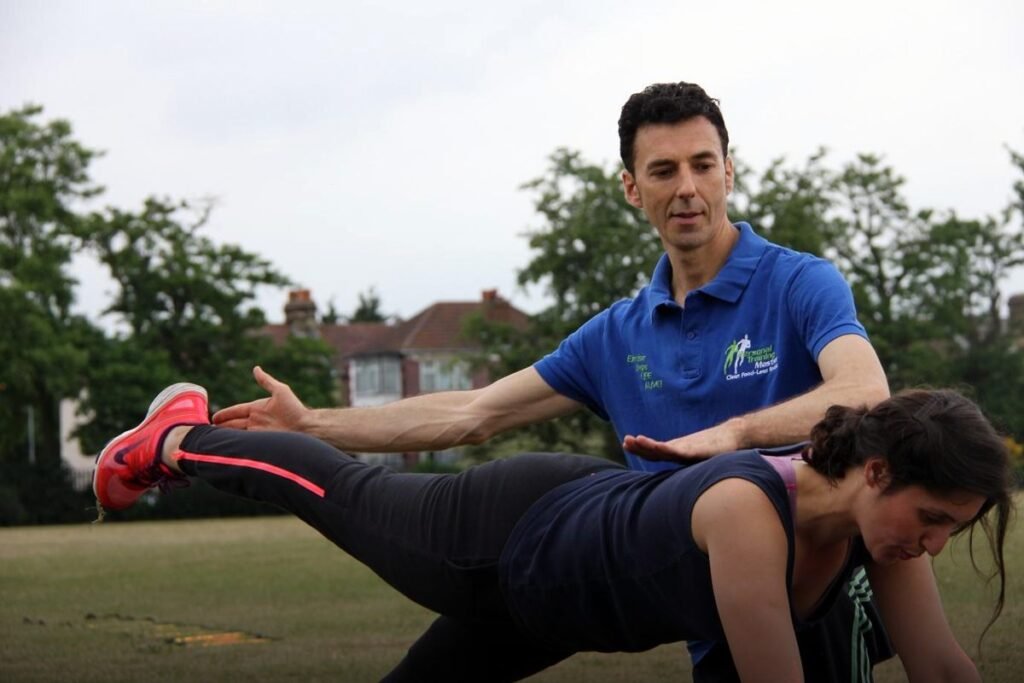
“In a corporate context, I often get asked how quickly someone can return to full capacity. The answer depends on whether we address symptoms or underlying mechanics. Pain-free function is not achieved through rest; it requires correct assessments, recreating load symmetry, eliminating body compensations and dominant sides, rebuilding your spine load tolerance safely, improving agility and neuromuscular control, and safely retraining you to return to at least medium-intensity movements and sports where you will not be limited—you will enjoy your life in full and feel at your best,” said Jazz Alessi, the founder of Personal Training Master, Head of the Sciatica Rehabilitation Department, and creator of The Spine Method.
“When I help clients align their spine rehabilitation with recreational movements and occupational demands, and move them safely back into sport, I see complete transformation in their strength, agility, posture, and spine load resilience without negative effects. The Spine Method helps reduce and eliminate long-term back pain recurrence and stabilises long-term performance in working professionals,” Jazz Alessi continues.
Durable recovery reduces and eliminates back pain recurrence, and therefore total cost per employee.
The real question isn’t how fast someone returns, but how long they stay well after they do.
Sciatica – The Condition Costing UK Businesses the Most Unplanned Absence
Sciatica is one of the most disruptive drivers of work productivity loss, where, in many cases, there is a herniated disc involved. Its episodic nature creates excruciating flare-ups and repeated cycles of absence.
Research published in The Lancet highlights low back pain as the leading cause of disability globally (Hartvigsen et al., 2018). In London’s desk-based workforce, the sciatica pain risk is amplified.
Reactive management, rest, and medication often fail to address disc mechanics or posture and sciatica pain.
For organisations and patients, a structured sciatica rehabilitation programme focuses on root causes, reducing and eliminating sciatica pain recurrence, and improving return to work musculoskeletal outcomes.
This makes sciatica rehabilitation not just a health issue, but a strategic HR priority.
If sciatica keeps returning in your workforce, it may not be the condition only – it may be the rehab approach.
So, how does this work in practice?
Case Studies – Real Outcomes That Change the Spine Rehab Conversation
Jan Case Study
Severe Sciatica to Full Functional Recovery: 85-90% Long-Term Pain Reduction and 300% Strength Increase Through Targeted Rehabilitation
“My left leg felt solid; my left buttock and left lower back had constant shooting pain. In the five months before contacting Jazz, I was in severe and constant pain. I had never felt anything like this before. I became intermittently depressed about my future. It was different during this period in that it did not go.”
“The physical inconsistencies and asymmetries diminished by 85–90 per cent very quickly, and the pain also reduced to a final reduction of 85–90%. My strength increased by 300%, and I can now exercise for significantly longer. I could potentially take up a new sport, for example.”
Hayley’s Case Study
Severe L5/S1 Sciatica to Near Pain-Free Functional Recovery: Rapid Symptom Resolution Within 16 Sessions Through Targeted Rehabilitation
“I sought Jazz’s help after dealing with constant daily lower back and sciatica pain for six months, caused by a herniated disc in my lower back (L5/S1). Putting my socks and shoes on was almost impossible at times. Sitting down triggered pain. So did standing still, getting in and out of a car, getting things in and out of the dishwasher, washing machine, drawers, and cupboards, even sneezing and coughing. I could not lift anything. I could not look over my shoulder.”
“When you have an injury, there is no margin for error. You have to choose people who really know what they are doing. As my back rehabilitation training went on, the pain shifted around as Jazz worked on retraining my muscle groups and realigning my structure, and all the discomfort localised in my left hip and stayed like that for quite a while. Jazz is very vigilant when it comes to carrying out movements safely in order to prevent further injury, which is such an important factor. Then one day, just after my 16th session, the pain suddenly decreased to next to nothing. It was like a miracle. His knowledge of anatomy, physiology, nutrition, and how to exercise safely – SAFELY being the key word, I believe—is unparalleled.”
These outcomes highlight what structured recovery can achieve when precision replaces generalisation.
What Forward-Thinking London Businesses Are Already Doing
London’s professional sectors, finance, corporate accountants, law, and consulting, are shifting their approach.
Instead of passive referrals, they’re integrating specialist recovery into operations.
So, where are you living in London?
These days, video technology makes it easy to successfully rehabilitate your back pain and spine injuries.
Across the City, Canary Wharf, Kensington Gardens, Campden Hill Place, London W11, Holland Park, and Academy Gardens, Duchess of Bedford’s Walk, expert back rehabilitation training is embedded in occupational strategies. Local organisations and patients now rely on specialist rehabilitation training in Kensington in the area to successfully bridge the gap between sciatica and herniated disc diagnosis and full functional return.
The ROI is simple: reducing recovery time restores productivity faster.
This is not a benefit; it’s risk management for corporate rehabilitation specialist London strategies.
When recovery becomes part of your operational model, absence stops being unpredictable.
Four Things Businesses Should Do Differently Starting Now
Measure Total Cost Per Condition
Include absence, presenteeism, and recurrence risk. This reframes pre-emptive back health rehab investment decisions.
Assess Before Return-To-Work and Provide The Correct Rehab Support
A structured functional assessment and referral to the best back injury experts, helping your employee to rehabilitate successfully, reduces repeat absence.
Expand Occupational Health Pathways and Emphasise Specialisation
Specialist spine health programmes outperform all one-size-fits-all generic pathways for back pain rehab cases.
Build Prevention Into Workforce Design
An ageing workforce increases musculoskeletal risk (ONS, 2023). Correct ergonomics, standing up desks, very short walking breaks, and movement prevention reduce back pain incidence.
Small structural changes in your occupational strategy can produce disproportionate gains in productivity.
Five Scientific Tips from Jazz
Build Load in A Customised Manner and Gradually
Tissues adapt to addressing specific issues,safe-progressive load, not sudden overload.
Address Posture Actively
Static correction fails; assessment movement-based postural retraining works better.
Strengthen Globally
The spine relies on your body systems, full-body coordination, not isolated muscles – retrain your full body structure correctly.
Track Functional Progress
Measure your strength, endurance, flexibility, agility, and mobility accurately, not just pain levels. Eliminating limitations of any nature and safely progressing into exercise and sport is where you will feel at your best.
Prioritise Consistency And Always Be Specific
Regular and customised structured back rehab work outperforms sporadic effort.
Conclusion
Musculoskeletal conditions dominate long-term absence and remain consistently underestimated in cost.
Businesses that shift from reactive management to structured prevention and recovery will reduce recurrence and long-term burden.
In an ageing workforce, employee musculoskeletal health is no longer a wellbeing issue; it is a strategic business priority tied directly to performance and cost control, and the two case studies presented show what expertly led, innovative back rehabilitation can do for our back health.