


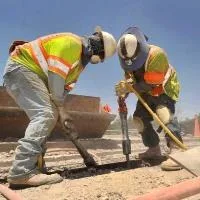
Construction workers – Photo Exaktime
(BRUSSELS) – EU labour markets showed remarkable resilience in 2022 in the face of the economic slowdown from Russia’s invasion of Ukraine, but labour and skills shortages persist, the EU’s 2023 employment report shows.
The Commission’s Employment and Social Developments in Europe (ESDE) report 2023 reveals that the EU economy grew by 3.5% in real terms in 2022. Employment rates were at a record high at 74.6% with 213.7 million people employed in 2022, and unemployment rates at a historic low at 6.2%.
However, the report also finds that challenges remain with a low labour market representation of certain groups, such as women or persons with a disability. Youth unemployment fell from 16.7% in 2021 to 14.5% in 2022, but remains a major challenge. In addition, companies face labour shortages and there is the need for both employers and workers to adapt to evolving skill needs, in the context of the green and digital transitions.
Key findings on skills and labour shortages
As part of the European Year of Skills, the ESDE report puts a special focus on the analysis of labour shortages and skills gaps and lays out policies to address them. The report’s key findings for 2022 include:
- Labour shortages exist in various sectors and occupations across all skills levels and are set to increase. They are expected to persist in both high skills and low skills occupations, driven by the creation of new jobs and the need to replace workers who retire. Sectors such as construction, healthcare, and STEM (science, technology, engineering, and mathematics), particularly ICT (Information and Communications Technology), were among the most affected in 2022. These shortages will likely increase with the projected decline in the working age population from 265 million in 2022 to 258 million by 2030.
- At the same time, structural drivers contributing to persistent labour shortages vary by occupation and sector. For some professions like doctors, nurses, carers, and drivers, challenging working conditions or difficulties in human resource management contribute to the difficulties of employers to retain and attract workers. For other occupations, e.g. in STEM, a lack of available highly specialised skills is a contributing factor.
- Labour shortages in some occupations might also be exacerbated by evolving skills and employment needs due to the necessary green transition. Employment growth is expected in some sectors/occupations that are already experiencing labour shortages (e.g., transportation and storage, building, electrical and electronic trades), or are likely to do so in the future (e.g., net-zero technologies, water supply, waste management and certain science and engineering professions).
- In the context of the green transition, the investment needs for retraining, reskilling and upskilling in manufacturing of strategic net-zero technologies are estimated between 1.7 billion and 4.1 billion up to 2030.
- As regards the digital transition, the report finds it contributes to persistent labour shortages among ICT professionals but does not seem to be a key driver of shortages in other occupations.
- The lower labour market participation of women, lower-educated people, people with a migrant background, as well as older and young people also contributes to labour shortages. Most shortage occupations are dominated either by men or by women 86% of occupations with labour shortages are not gender-balanced. This also mirrors gender segregation in the respective field of studies leading up to a certain occupation, limiting the pool of people to fill vacancies.
The ESDE 2023 report also looks at possible policy measures to tackle labour shortages and bridge skills gaps. These include:
- Investing in adult learning and skills development and training programmes, as well as better job matching with people’s education, experience, and skills. To support Member States, the EU budget and NextGenerationEU provide 64.8 billion for skills measures, for instance through the Recovery and Resilience Facility, and the European Social Fund Plus. The EU Pact for Skills brings together industry, social partners and training providers to tackle challenges in skills development. So far, 2 million people have benefited from the Pact’s up-and re-skilling activities; 18 skills partnerships were launched, including in key sectors for the green and digital transitions, such as electronics, renewable energy and energy-intensive industries.
- Addressing the gender employment gap and boosting labour market participation of young people, older people, people with a migrant background, and people with lower educational attainment to tackle labour shortages. This is key to meet the EU 2030 social targets on training, employment and poverty reduction, which Member States achieve with their national contributions. The Commission has also put forward a Youth Employment Support package and has committed to review the Quality Framework for Traineeships to support young people entering the labour market.
- Removing barriers to entering the workforce, such as providing accessible, affordable, high-quality early childhood education and care. The Commission put forward the European Care Strategy to support both carers and care receivers. Member States have adopted two Council Recommendations on long-term care and early childhood education and care. The Work-Life Balance Directive sets out minimum standards for paternity, parental and carers’ leave and establishes additional rights, such as the right to request flexible working arrangements.
- Improving working conditions and pay in certain jobs to attract and retain workers. Member States have adopted the EU Directive on adequate minimum wages, and are required to transpose it into national law.
- Improving the financial incentives for work, such as reviewing taxes and benefits systems targeting low-income earners, and promoting active inclusion to support the labour market participation of those who can work, for instance also through inclusive education and training and individualised support. This is also highlighted in the Council Recommendation on adequate minimum income ensuring active inclusion.
- Promoting targeted labour migration from non-EU countries to reduce labour shortages in specific skills groups. The Commission has launched an EU Talent Pool pilot, helping to match people’s skills with job offers. Attracting people from outside the EU with the skills needed is also among the main objectives of the European Year of Skills, and the Commission will present an initiative to improve the recognition of qualifications of non-EU nationals and roll out talent partnerships with selected non-EU partner countries.
- Enhancing social dialogue and involving social partners in training, improving working conditions, and facilitating adult learning opportunities. Member States have adopted a Council Recommendation on strengthening social dialogue at national and EU level, as proposed by the Commission.
Employment and Social Developments in Europe 2023 (ESDE)