Close Menu
    Latest Category
    • Finance
    • Tech
    • EU Law
    • Energy
    • About
    • Contact
    EUbusiness.com | EU news, business and politicsEUbusiness.com | EU news, business and politics
    Login
    • EU News
    • Focus
    • Guides
    • Press
    • Jobs
    • Events
    • Directory
    EUbusiness.com | EU news, business and politicsEUbusiness.com | EU news, business and politics
    Home » CETA investor dispute system ‘compatible with EU law’

    CETA investor dispute system ‘compatible with EU law’

    npsnps30 January 2019Updated:25 June 2024 Finance
    — Filed under: Canada EU Law EU News Headline2 Trade
    Share
    Facebook Twitter LinkedIn Pinterest Email
    CETA investor dispute system 'compatible with EU law'

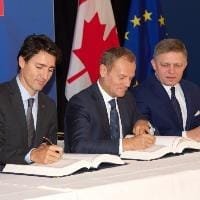
    CETA signing – Trudeau – Tusk – Photo EU Council

    (LUXEMBOURG) – The investment dispute mechanism of the free trade agreement between the EU and Canada (CETA) is compatible with EU law, an advocate-general of the EU Court said Wednesday in an Opinion.

    In his Opinion, Advocate General Bot confirmed that the agreement ‘does not adversely affect the autonomy of EU law’ and does not affect the principle that the Court of Justice has exclusive jurisdiction over the definitive interpretation of EU law.

    The case concerned the mechanism for the settlement of disputes between investors and States which forms part of trhe Comprehensive Economic and Trade Agreement (CETA) the EU signed with Canada in October 2016.

    The Investor State Dispute Settlement System (ISDS) envisaged creation of a Tribunal and an Appellate Tribunal and, in the longer term, a multilateral investment tribunal. The aim is thus to establish an ‘Investment Court System’ (ICS).

    Belgium in 2017 requested the Court of Justice’s opinion concerning the compatibility of the mechanism for the settlement of disputes (ISDS) with EU law.

    In today’s Opinion, Advocate General Yves Bot holds that the mechanism for the settlement of disputes is compatible with the EU Treaty, the FEU Treaty and the Charter of Fundamental Rights of the European Union.

    First, the Advocate General takes the view that the agreement does not adversely affect the autonomy of EU law and does not affect the principle that the Court of Justice has exclusive jurisdiction over the definitive interpretation of EU law.

    Moreover, the Advocate General states that the dispute settlement mechanism does not affect the role of national courts and tribunals of ensuring the effective application of EU law. Even though, given that the agreement does not have direct effect, it is not the role of the courts and tribunals of the Member States to apply that agreement, those courts and tribunals are not, however, deprived of their status as ‘general law’ courts within the EU legal order, including of their role in any making of references for a preliminary ruling. Furthermore, the Court is not deprived of its power to reply, by preliminary ruling, to questions referred by those courts and tribunals. According to the Advocate General, there is no alteration of the essential character of the powers which the Treaties confer on the institutions of the EU and on the Member States.

    The Advocate General is therefore of the opinion that the system for the settlement of disputes is entirely consistent with the objectives of the Union’s action on the international stage by combining rules on the protection of investments and a specific dispute settlement mechanism with the express confirmation of the Parties’ right to adopt legislation necessary to achieve legitimate objectives in the public interest, for example in the areas of public health, safety, the environment and social protection.

    Second, the agreement does not infringe the general principle of equal treatment in respect of access to the dispute settlement mechanism. The situation of Canadian investors who invest in the EU is not comparable with the situation of European investors who invest within their own economic area. Only the investors of each Party who invest in the territory of the other Party are in comparable situations.

    Third, procedural safeguards ensure a sufficient level of protection of the right of access to an independent and impartial tribunal, a right enshrined in Article 47 of the Charter. The mechanism provided for is merely an alternative method of dispute resolution relating to the application of the free trade agreement which complements the remedies offered by the Parties.

    Furthermore, the provisions of the agreement set out the main features of the remuneration scheme for Members of the Tribunal, which includes a fixed component and a component dependent on the volume and the complexity of litigation brought before them. That scheme is consistent with the hybrid nature of the dispute settlement mechanism established and with the fact that, at least initially, those Members will not be working on a full-time basis.

    Last, the conditions relating to the appointment and possible removal of those Members and the safeguards put in place are sufficient. In addition, the agreement contains specific rules of ethics applicable to Members and intended to guarantee their independence and their impartiality.

    Advocate General’s Opinion in Avis 1/17 initiated by the Kingdom of Belgium

    Add A Comment
    Leave A Reply Cancel Reply

    You must be logged in to post a comment.

    nps
    • Website

    Related Content

    Fitto - Mînzatu - Photo © European Union 2026

    EUR 34.6 bn cohesion funds reallocated to EU’s strategic priorities

    ESM

    Procurement Officer, European Stability Mechanism, ESM

    Parmelin - von der Leyen - Photo by Dati Bendo © European Union 2026

    EU and Switzerland strengthen ties with package of agreements

    EUSPA logo

    Financial Officer, European Union Agency for the Space Programme, EUSPA

    Raffaele Fitto - Photo by Bogdan Hoyaux © European Union 2026

    EU to step up support for states bordering Russia, Belarus and Ukraine

    Tax haven - Photo by John Prefer on Unsplash

    EU adds Vietnam and Turks & Caicos Islands to tax havens blacklist

    LATEST EU NEWS
    House sparrow - Photo by Alexas Fotos on Pexels

    Brussels issues guidance for ‘more balanced’ rules on protecting wild birds

    1 April 2026
    Bankruptcy - Image by Michael Schüller from Pixabay

    EU Council greenlights common EU rules for insolvency proceedings

    30 March 2026
    European-made armoured vehicles - Photo © European Union 2025

    Brussels EUR 1.5 bn work programme to boost European and Ukrainian defence industry

    30 March 2026
    Trade port cargo - Image by Pexels from Pixabay

    Landmark deal for reform of EU Customs Union

    27 March 2026
    E-commerce - Photo by Antoni Shkraba Studio on Pexels

    1 in 3 online traders in Europe incorrectly displayed discounts on Black Friday and Cyber Monday

    26 March 2026

    Subscribe to EUbusiness Week

    Get the latest EU news

    CONTACT INFO

    • EUbusiness, 117 High Street, Chesham Buckinghamshire, HP5 1DE, United Kingdom
    • +44(0)20 8058 8232
    • service@eubusiness.com

    INFORMATION

    • About Us
    • Advertising
    • Contact Info

    Services

    • Cookie Policy
    • Terms
    • Disclaimer

    SOCIAL MEDIA

    Facebook
    eubusiness.com © EUbusiness Ltd 2026

    Type above and press Enter to search. Press Esc to cancel.

    Manage Consent
    To provide the best experiences, we use technologies like cookies to store and/or access device information. Consenting to these technologies will allow us to process data such as browsing behavior or unique IDs on this site. Not consenting or withdrawing consent, may adversely affect certain features and functions.
    Functional Always active
    The technical storage or access is strictly necessary for the legitimate purpose of enabling the use of a specific service explicitly requested by the subscriber or user, or for the sole purpose of carrying out the transmission of a communication over an electronic communications network.
    Preferences
    The technical storage or access is necessary for the legitimate purpose of storing preferences that are not requested by the subscriber or user.
    Statistics
    The technical storage or access that is used exclusively for statistical purposes. The technical storage or access that is used exclusively for anonymous statistical purposes. Without a subpoena, voluntary compliance on the part of your Internet Service Provider, or additional records from a third party, information stored or retrieved for this purpose alone cannot usually be used to identify you.
    Marketing
    The technical storage or access is required to create user profiles to send advertising, or to track the user on a website or across several websites for similar marketing purposes.
    • Manage options
    • Manage services
    • Manage {vendor_count} vendors
    • Read more about these purposes
    View preferences
    • {title}
    • {title}
    • {title}

    Sign In or Register

    Welcome Back!

    Login to your account below.

    Lost password?