Close Menu
    Latest Category
    • Finance
    • Tech
    • EU Law
    • Energy
    • About
    • Contact
    EUbusiness.com | EU news, business and politicsEUbusiness.com | EU news, business and politics
    Login
    • EU News
    • Focus
    • Guides
    • Press
    • Jobs
    • Events
    • Directory
    EUbusiness.com | EU news, business and politicsEUbusiness.com | EU news, business and politics
    Home » Economic Partnership Agreements (EPAs) – principles & objectives

    Economic Partnership Agreements (EPAs) – principles & objectives

    eub2eub231 October 2007 Trade
    Share
    Facebook Twitter LinkedIn Pinterest Email
    — last modified 31 October 2007

    The negotiations leading to the Economic Partnership Agreements (EPA) were launched in Brussels on 27 September 2002 to be conducted in two phases. The first phase is conducted at “All-ACP”-EU level and takes on board cross-cutting themes of interest to all parties concerned, mainly: legal matters, the development “dimension” of the EPAs, Agriculture and Fisheries agreements, services, market access and trade-related matters. The Second phase is conducted at ACP national and regional level with spotlight on specific commitments.


    Advertisement


    PRINCIPLES AND OBJECTIVES

    The fundamental principles and objectives of the EPAs are defined by the Cotonou Agreement.

    Objectives

    sustainable development of the ACP States, their smooth and gradual integration in the world market, and eradication of poverty.

    enhancing sustainable growth, increasing production and supply capacities of the ACP countries, promoting structural processing and economic diversification of the ACP states while supporting regional integration.

    Principles

    The EPAS should be underpinned by the following fundamental principles :

    The EPAs should serve as instruments of development that contribute to the promotion of gradual and smooth integration of the ACP states in world economy while respecting their political options and development priorities, promoting thereby their sustainable development and contributing to the eradication of poverty in the ACP states and not an end in themselves.

    In this context, the European and ACP parties agreed that the EPAs contribute directly to the development of the ACP states while helping them to expand their markets and improving the predictability and transparency of the legal framework governing trade, creating thereby suitable conditions for investment growth and the mobilization of private sector initiatives in order to improve the supply capacity of the ACP States. To this end, the EPAs should take account of the economic, social, environmental and structural constraints specific to each ACP state and region concerned, as well as their capacity to adapt their economies to the EPA process. The EPAs should also take on board the development guidelines of the countries and regions concerned. Besides, they should be economically and socially sustainable.

    The EPAs should support the existing regional integration initiatives in the ACP states and not compromise them. They should therefore be based on the integration objectives of the ACP regions concerned. They should also contribute to the reinforcement of regional integration while promoting, among other things, the harmonization of the regulations at regional level. In this perspective, the EPAs should first of all help to consolidate the ACP markets before promoting commercial integration with the EC.

    The two sides agreed that the EPAs maintain and improve upon the current level of preferential access of ACP exports to the European market. As regards the commodity protocols, the two sides agreed to re-examine them in the context of the new trade agreements especially from the viewpoint of their compatibility with the WTO rules, in order to safeguard the advantages accruing thereto in the light of the special legal status of the sugar protocol. As regards the non-LDC ACP states which will not be in a position to conclude EPAs, both sides have agreed that the EC assess the situation of such countries and explore all the possible avenues in order to provide them with a new framework equal to their existing situation and compatible with the WTO rules.

    An agreement has been reached on the fact that the EPAs should be compatible with the WTO rules in force at the time of their conclusion and that they should take into account the evolutionary nature of the relevant rules especially in the framework of the Doha Programme for Development. The two sides have agreed to cooperate closely in the framework of the WTO negotiations with a view to defending the agreements concluded especially as regards the degree of flexibility obtained for that moment.

    :

    The two sides agreed that a special and differential treatment be accorded all-ACP States, especially the vulnerable LDCs and the small landlocked and island countries.

    Add A Comment
    Leave A Reply Cancel Reply

    You must be logged in to post a comment.

    eub2
    • Website

    eub2 is the default publisher for EUbusiness.

    Related Content

    Trade in cars - Photo by Tom Fisk on Pexels

    EU trade deficit with China EUR 359.8 bn in 2025

    Trade port cargo - Image by Pexels from Pixabay

    Landmark deal for reform of EU Customs Union

    Trade - Image by Markus Kammermann from Pixabay

    EU trade in goods surplus down to EUR 128 bn in 2025

    Trade port cargo - Image by Pexels from Pixabay

    EU trade in goods with Australia in 2025

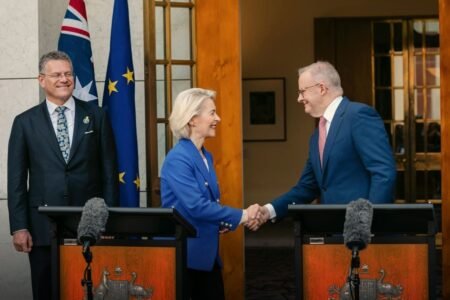
    Sefcovic - von der Leyen - Albanese - Photo © European Union 2026

    EU and Australia conclude talks on trade agreement

    Michael McGrath - Photo © European Union 2026

    Cosmetics the most dangerous products on EU market

    LATEST EU NEWS
    Trade in cars - Photo by Tom Fisk on Pexels

    EU trade deficit with China EUR 359.8 bn in 2025

    10 April 2026
    Green jobs - Photo by Gustavo Fring on Pexels

    Green jobs in EU grow by 2.2 million over last decade

    8 April 2026
    Students in Lisbon - Photo by Vytautas Markunas on Pexels

    EU offers 40,000 ‘DiscoverEU’ free travel passes to young people

    8 April 2026
    BEAK UAV drone made by Origin Robotics - Photo by Gints Ivuskans © European Union 2025

    Brussels boosts support to Ukrainian deep tech innovators

    2 April 2026
    Zelensky - Kallas- Ukraine - Photo © European Union 2026

    EU to deliver EUR 1.4 bn revenue from frozen Russian assets to be used for support to Ukraine

    2 April 2026

    Subscribe to EUbusiness Week

    Get the latest EU news

    CONTACT INFO

    • EUbusiness, 117 High Street, Chesham Buckinghamshire, HP5 1DE, United Kingdom
    • +44(0)20 8058 8232
    • service@eubusiness.com

    INFORMATION

    • About Us
    • Advertising
    • Contact Info

    Services

    • Cookie Policy
    • Terms
    • Disclaimer

    SOCIAL MEDIA

    Facebook
    eubusiness.com © EUbusiness Ltd 2026

    Type above and press Enter to search. Press Esc to cancel.

    Manage Consent
    To provide the best experiences, we use technologies like cookies to store and/or access device information. Consenting to these technologies will allow us to process data such as browsing behavior or unique IDs on this site. Not consenting or withdrawing consent, may adversely affect certain features and functions.
    Functional Always active
    The technical storage or access is strictly necessary for the legitimate purpose of enabling the use of a specific service explicitly requested by the subscriber or user, or for the sole purpose of carrying out the transmission of a communication over an electronic communications network.
    Preferences
    The technical storage or access is necessary for the legitimate purpose of storing preferences that are not requested by the subscriber or user.
    Statistics
    The technical storage or access that is used exclusively for statistical purposes. The technical storage or access that is used exclusively for anonymous statistical purposes. Without a subpoena, voluntary compliance on the part of your Internet Service Provider, or additional records from a third party, information stored or retrieved for this purpose alone cannot usually be used to identify you.
    Marketing
    The technical storage or access is required to create user profiles to send advertising, or to track the user on a website or across several websites for similar marketing purposes.
    • Manage options
    • Manage services
    • Manage {vendor_count} vendors
    • Read more about these purposes
    View preferences
    • {title}
    • {title}
    • {title}

    Sign In or Register

    Welcome Back!

    Login to your account below.

    Lost password?