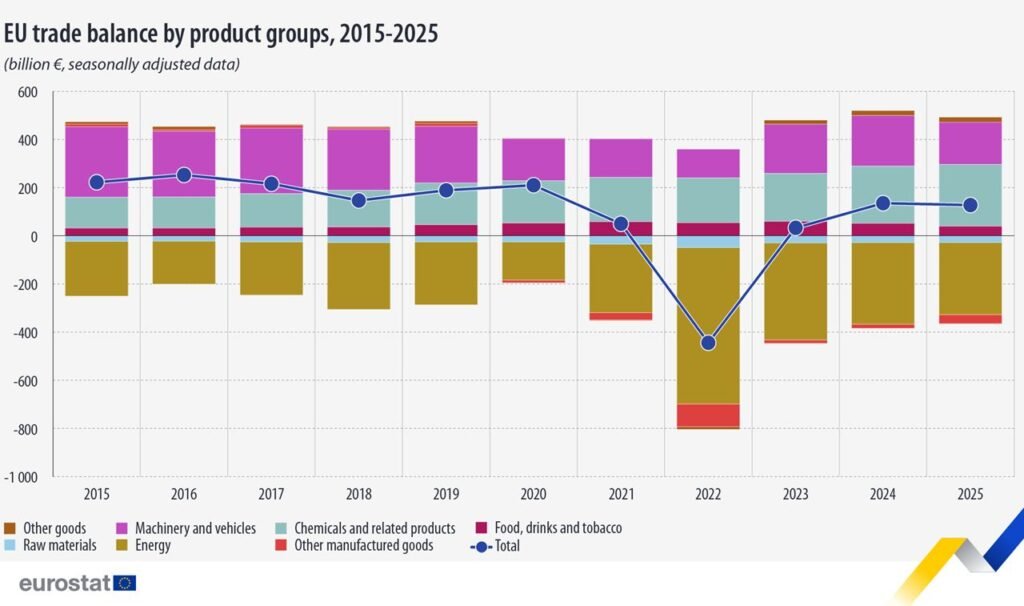
The EU’s trade in goods balance registered a surplus of €128 billion in 2025, representing a decrease of €8 billion compared with 2024 (€136 billion), according to Eurostat.

The data from the EU’s statistics agency shows that between 2015 and 2025, the EU recorded a trade surplus every year except for 2022, when a negative trade balance was driven by a trade deficit in the energy sector. In all other years, trade surpluses in machinery, vehicles, and chemicals and related products outweighed deficits caused by energy.
Chemicals and related products registered the largest increase in the last decade, doubling a surplus seen in 2015 from €128.3 billion to €256.7 billion.
The balance of trade in food and drink also increased from €32.0 billion to €39.7 billion, and of other goods from €9.5 billion to €20.7 billion. By contrast, other manufactured goods moved from a surplus of €11.3 billion in 2015 to a deficit of €37.6 billion in 2025.
An energy deficit increased from €226.4 billion in 2015 to €298.9 billion in 2025. Fluctuating prices played an important role on the deficit which was lowest in 2020 at €157.2 billion and highest in 2022 at €649.5 billion.
This information comes from data on international trade in goods published recently by Eurostat. This article presents a handful of findings from the more detailed Statistics Explained article.
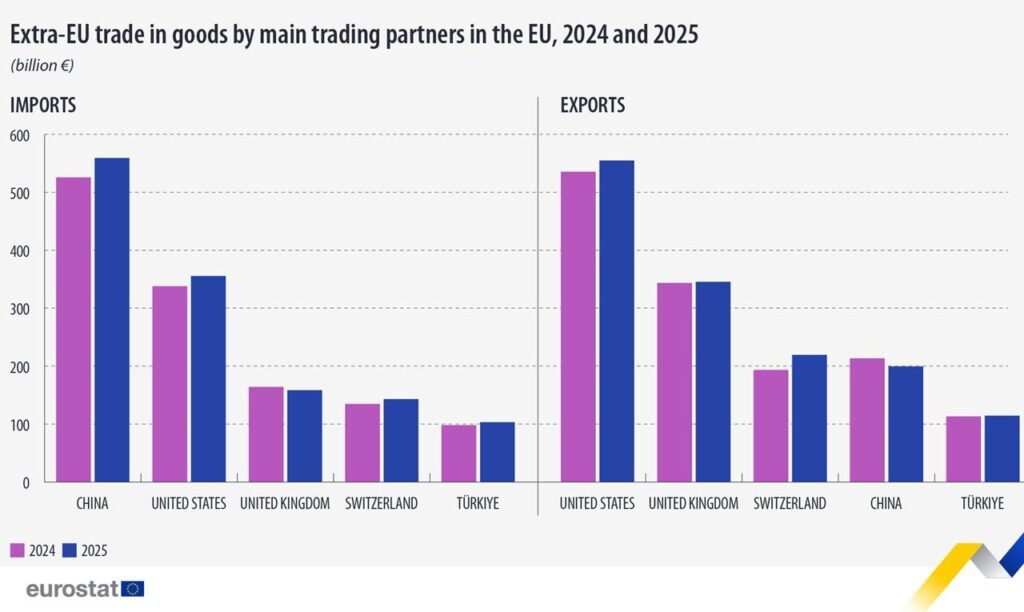
Regarding main trade partners, the United States was the main export destination in 2025, accounting for 21.0% of all EU exports. Exports to the United States were worth €554.9 billion, up 3.6% compared with 2024. The United States was followed by the United Kingdom (€345.5 billion), at 13.1% of the total exports and Switzerland (€219.5 billion) with 8.3%.
On the other hand, China accounted for the biggest value of EU imports, worth €559.4 billion (up 6.4% compared with 2024), with a total share of 22.3% of all imports. China was followed by the United States (€355.5 billion; 14.1% of the total share) and the United Kingdom (€158.6 billion; 6.3%).