Life expectancy at birth in the EU was 81.5 years in 2024, a 0.1-year increase from 2023, following decreases in 2020 (80.4 years) and 2021 (80.1 years) due to the COVID-19 pandemic.

The data, from the EU’s statistics agency Eurostat data on mortality and life expectanc, show life expectancy recovering from the pandemic and reaching values higher than in 2019 (81.3 years).
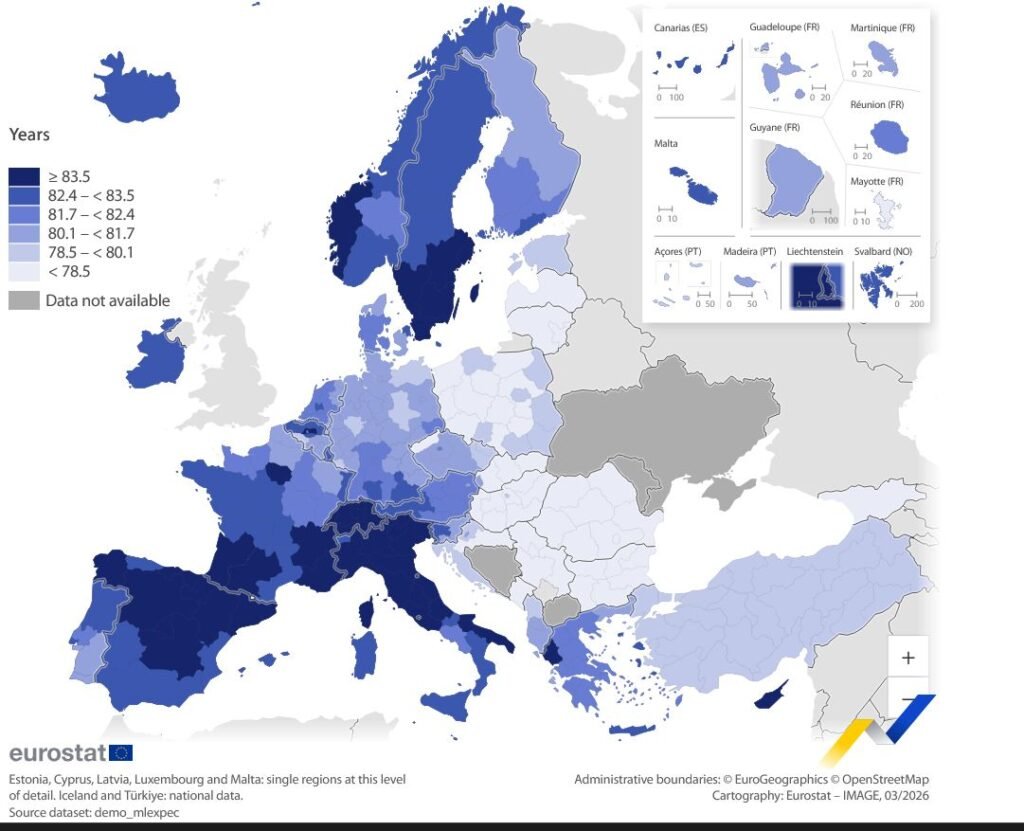
At regional level, 4 regions reached life expectancy of 85 years or above: the Spanish region of Comunidad de Madrid, with 85.7 years, and the Italian regions of Provincia Autonoma di Trento and Provincia Autonoma di Bolzano/Bozen and the Swedish capital region of Stockholm, all with 85.0 years.
Conversely, among the 5 EU regions with the lowest life expectancy at birth, 3 were in Bulgaria: Severozapaden (73.9 years), Severen tsentralen (74.9 years), and Severoiztochen (75.4 years). The other 2 were Mayotte in France (74.5 years) and Észak-Magyarország in Hungary (75.1 years).
Life expectancy at birth, 2024 (click on image for interactive map)
(by NUTS 2, in years)
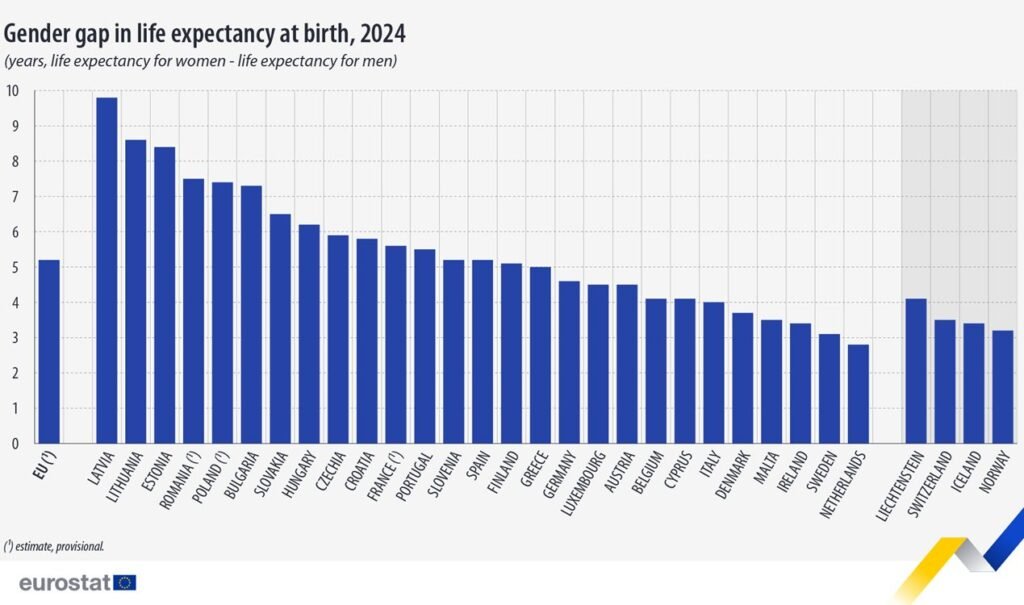
In 2024, life expectancy at birth for women in the EU reached 84.1 years (up by 0.1 years compared with 2023), while for men it was 78.9 years (+0.2 years). This indicates that women are expected to live 5.2 years longer than men.
This gap varied considerably among EU countries. In Latvia, women were expected to live 9.8 years longer than men, followed by Lithuania (8.6 years) and Estonia (8.4 years). The smallest gender gaps were in the Netherlands (2.8 years), Sweden (3.1 years) and Ireland (3.4 years).
Database on demography, population stock and balance, Eurostat
Thematic section on population and demography