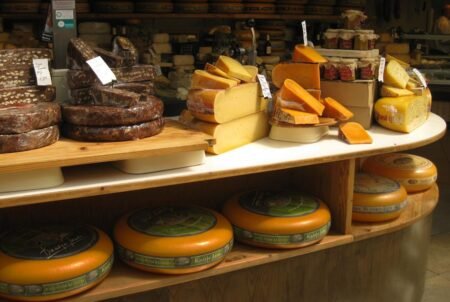
Consumer confidence in the safety of food products has sometimes been shaken in recent years by the cumulative impacts of food-related health crises. Responding to the challenge, the European Union has put in place a comprehensive strategy to restore people’s belief in the safety of their food “from the farm to the fork”.
Advertisement
There are three pillars to the EU strategy:
- legislation on the safety of food and animal feed;
- sound scientific advice on which to base decisions;
- enforcement and control.
Safety of food and animal feed
The general principles of food safety are in a Regulation adopted in 2002 and often known as the General Food Law. This thoroughly overhauled EU food safety legislation, with a new emphasis on feed because feed contamination has been at the root of all major food scares of the last few years. Under this law, it became compulsory from 1 January 2005 for food and feed businesses to guarantee that all foodstuffs, animal feed and feed ingredients are traceable right through the food chain. Separate, updated hygiene rules came into effect on 1 January 2006.
The General Food Law is supplemented by targeted legislation on a raft of food safety issues, such as use of pesticides, food supplements, colourings, antibiotics and hormones in food production, and products in contact with foodstuffs, such as packaging; and by stringent procedures on release, marketing, labelling and traceability of crops and foodstuffs containing genetically modified organisms (GMOs). The basic rules apply to all food and feed. In addition, there are targeted rules for products ranging from meat to gelatin, and from dairy products to frogs’ legs.
EU responsibility extends also to the welfare of livestock on the farm and during transport in the interests of common high standards, disease prevention and keeping track of animals across the single market. The EU facilitates the movement of animals for trade, providing animal welfare standards are met. The EU ‘pet passport’ scheme makes it easier to take domestic pets on holiday while guaranteeing that precautions are taken against spreading disease. The EU fights animal disease by funding research and through common disease prevention measures. If there are disease outbreaks nevertheless, the European Commission oversees measures to protect public health.
Rapid alerts nip risks in bud
In order to spot food and feed risks effectively and nip problems in the bud, the EU operates a rapid alert system. Every EU government has an early warning system when feed or food could be unsafe and therefore expose consumers to the risks of illnesses such as salmonella. It alerts the Commission, which is the hub of an EU-wide notification system.
Warning bells also sound when banned substances are identified or legal limits for high-risk substances have been exceeded. These substances may be veterinary medicine residues, food colourings known to be carcinogenic or naturally occurring toxic moulds. The system deals with several hundred alerts on immediate risks each year.
What happens will depend on the type of risk. It may be enough to stop a single batch, or it may be necessary to stop all shipments of a particular product from the farm, factory or port of entry. Products already in warehouses and shops may be recalled. Sometimes every shipment from one suspect source is tested for some months. In emergencies, the European Commission can step in directly to protect public health rather than waiting to consult EU governments.
Sound scientific foundations
Science is the essential foundation on which the EU bases its decisions on any part of the food chain. The European Food Safety Authority (EFSA) in Parma, Italy, plays a central role in this. EFSA has a wide brief. It can look into all stages of food production and supply, from primary production to the safety of animal feed through to the supply of food to consumers. Its brief also extends to the properties of non-food and feed GMOs and to nutrition issues.
EFSA provides the European Commission with independent, scientific advice that is also made public to enable it to be fully open to scrutiny. EFSA provides input when legislation is being drafted and advice when policymakers are dealing with a food scare, like ‘mad cow disease’, dioxin in milk or avian influenza. In deciding what to do, the Commission applies the precautionary principle. In other words, it will act without waiting for scientific certainty if the scientists say there is at least a potential danger.
Enforcement and control
Legislation is pointless if it is not enforced. The Commission enforces EU feed and food law by checking that EU legislation has been properly incorporated into member state law, by double-checking compliance through reports from member states and other countries, and through on-the-spot inspections in the EU and outside.
Inspections are the job of the Commission’s Food & Veterinary Office (FVO) based at Grange in Ireland. The FVO can check individual food production plants, but its main task is to check that EU governments and those of other countries have the necessary machinery for checking that their own food producers are sticking to the safety standards.
New rules which took effect on 1 January 2006 streamline controls across the EU and put more emphasis on relating checks to likely risk. The European Commission will monitor whether EU governments are running their control systems effectively. Penalties for breaching the law become more severe in many cases.
Beyond safety
It is not enough for food to be safe: consumers are entitled to know what they are buying and that it meets their needs. EU food labelling rules have existed for many years, but they are constantly being updated. As a result, consumers will in future be able more readily to identify ingredients to which they may be allergic. Clear definitions identical across the EU are under discussion for the use of terms like ‘low fat’ and ‘high fibre’.
Preserving diversity
While the framework for food safety is a common one, it accommodates diversity. The EU takes great care in designing the rules to ensure that traditional foods are not forced off the market by its food standards, that the rules leave room for quality improvements, that innovation is not stifled, and that variety and choice are not curtailed.
EU Food Safety web links
European Commission Food Safety DG
EU Food Safety Calls for Tender
EU Legislation in Force: Food Safety Policy
Recent case-law of the Court of Justice and the Court of First Instance : EU Food Safety
Further information on EU Food Safety Policy on Europa