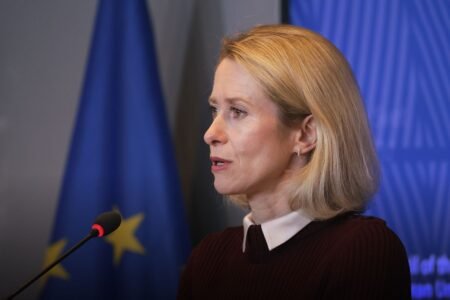
Frans Timmermans – Photo © European Union 2022
(BRUSSELS) – The European Commission proposed Wednesday to strengthen EU environment rules on ambient air, surface and groundwater pollutants, and treatment of urban wastewater.
Air pollution alone means nearly 300,000 Europeans die prematurely each year, and the Commission says the proposed new rules will reduce deaths resulting from levels of the main pollutant PM2.5 above World Health Organization guidelines by more than 75% in ten years.
The EU executive is proposing to tighten allowed levels of pollutants and also to improve implementation to ensure pollution reduction goals are more often reached in practice.
“An unhealthy environment has direct and costly consequences for our health,” said EC vice-president Frans Timmermans: “Each year, hundreds of thousands Europeans die prematurely and many more suffer from heart- and lung diseases or pollution-induced cancers. The longer we wait to reduce this pollution, the higher the costs to society. By 2050, we want our environment to be free of harmful pollutants.”
Air pollution is the greatest environmental threat to health and a leading cause of chronic diseases, including stroke, cancer and diabetes. The proposed revision of the Ambient Air Quality Directives will set interim 2030 EU air quality standards, aligned more closely with World Health Organization guidelines, while putting the EU on a trajectory to achieve zero pollution for air at the latest by 2050, in synergy with climate-neutrality efforts. The annual limit value for the main pollutant – fine particulate matter (PM2.5) – is proposed to be cut by more than half.
The revision will ensure that people suffering health damages from air pollution have the right to be compensated in the case of a violation of EU air quality rules. They will also have the right to be represented by non-governmental organisation through collective actions for damage compensation.
The Commission’s proposals leave it to national and local authorities to determine the specific measures they would take to meet the standards. At the same time, existing and new EU policies in environment, energy, transport, agriculture, R&I and other fields will make a significant contribution, as detailed in the factsheet.
The proposal will help achieve dramatic improvement in air quality around Europe by 2030, leading to gross annual benefits estimated at 42 billion up to 121 billion in 2030, for less than a 6 billion costs annually.
The revised Urban Wastewater Treatment Directive will help Europeans benefit from cleaner rivers, lakes, groundwaters and seas, while making wastewater treatment more cost-effective. It is proposed to aim for energy-neutrality of the sector by 2040, and improve the quality of sludge to allow for more reuse contributing thus to a more circular economy.
Several improvements will support health and environmental protection. These include obligations to recover nutrients from wastewater, new standards for micropollutants and new monitoring requirements for microplastics.
Obligations to treat water will be extended to smaller municipalities with 1,000 inhabitants (from 2,000 inhabitants currently). To help manage heavy rains, made more frequent by climate change, there is a requirement to establish integrated water management plans in larger cities. Finally, building upon the Covid-19 experience, the Commission proposes to systematically monitor wastewater for several viruses, amongst which CoV-SARS-19, and anti-microbial resistance.
EU countries will be required to ensure access to sanitation for all, in particular vulnerable and marginalised groups.
As 92% toxic micro-pollutants found in EU wastewaters come from pharmaceuticals and cosmetics, a new Extended Producer Responsibility scheme will require producers to pay for the cost of removing them. This is in line with the ‘polluter pays’ principle and it will also incentivise research and innovation into toxic-free products, as well as making financing of wastewater treatment fairer.
The wastewater sector has significant untapped renewable energy production potential, for example from biogas. EU countries will be required to track industrial pollution at source to increase the possibilities of re-using sludge and treated wastewater, avoiding the loss of resources. Rules on recovering phosphorus from sludge will support their use to make fertiliser, benefiting food production.
The changes are estimated to increase costs by 3.8% (to 3.8 billion a year in 2040) for a benefit of over 6.6 billion a year, with a positive cost-benefit ratio in each Member State.
Based on up-to-date scientific evidence, the Commission is also proposing to update lists of water pollutants to be more strictly controlled in surface waters and groundwater.
25 substances with well-documented problematic effects on nature and human health will be added to the lists. These include:
- PFAS, a large group of “forever chemicals” used among others in cookware, clothing and furniture, fire-fighting foam and personal care products;
- a range of pesticides and pesticide degradation products, such as glyphosate;
- Bisphenol A, a plasticiser and a component of plastic packaging;
- some pharmaceuticals used as painkillers and anti-inflammatory drugs, as well as antibiotics.
The substances and their standards have been selected in a transparent and science-driven process.
In addition, learning the lessons from incidents such as the mass death of fish in the Oder river, the Commission proposes mandatory downstream river basin warnings after incidents. There are also improvements to monitoring, reporting, and easier future updates of the list to keep up with science.
The new rules recognise the cumulative or combined effects of mixtures, broadening the current focus which is on individual substances solely.
In addition, standards for 16 pollutants already covered by the rules, including heavy metals and industrial chemicals, will be updated (mostly tightened) and four pollutants that are no longer an EU-wide threat will be removed.
Surface water and groundwater pollutants:
Questions and Answers on Surface water and groundwater pollutants
Factsheet on Surface water and groundwater pollutants
Proposals for a revision of the List of Groundwater and Surface Water Pollutants
Urban Wastewater Treatment Directive:
Questions and Answers on the Review of the Urban Wastewater Treatment Directive
Factsheet on the Review of the Urban Wastewater Treatment Directive
Proposal for a revision of the Urban Wastewater Treatment Directive
EU Ambient Air Quality Legislation:
Revision of EU ambient air quality legislation - guide
Factsheet on the Revision of EU ambient air quality legislation