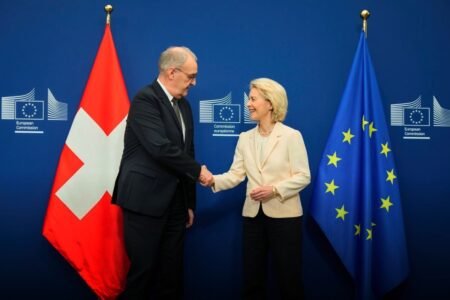
Paolo Gentiloni – Photo © European Union
(BRUSSELS) – With Europe in the grip of the coronavirus pandemic, the EU’s winter economic forecast provided grounds for cautious optimism Thursday, projecting stronger growth momentum for the second half of 2021 and 2022.
The Winter 2021 Economic Forecast projects that the euro area economy will grow by 3.8% in both 2021 and 2022. The forecast projects that the EU economy will grow by 3.7% in 2021 and 3.9% in 2022.
The euro area and EU economies are expected to reach their pre-crisis levels of output earlier than anticipated in the Autumn 2020 Economic Forecast, largely because of the stronger than expected growth momentum projected in the second half of 2021 and in 2022.
“We remain in the painful grip of the pandemic, its social and economic consequences all too evident,” said Paolo Gentiloni, Commissioner for Economy: “Yet there is, at last, light at the end of the tunnel. As increasing numbers are vaccinated over the coming months, an easing of containment measures should allow for a strengthening rebound over the spring and summer.”
After strong growth in the third quarter of 2020, economic activity contracted again in the fourth quarter as a second wave of the pandemic triggered renewed containment measures. With those measures still in place, the EU and euro area economies are expected to contract in the first quarter of 2021. Economic growth is set to resume in the spring and gather momentum in the summer as vaccination programmes progress and containment measures gradually ease. An improved outlook for the global economy is also set to support the recovery.
The economic impact of the pandemic remains uneven across Member States and the speed of the recovery is also projected to vary significantly.
Inflation: The forecast projects that inflation in the euro area is set to increase from 0.3% in 2020 to 1.4% in 2021, before moderating slightly to 1.3% in 2022. The inflation forecast for the euro area and the EU has increased slightly for 2021 compared to the autumn but is, overall, expected to remain subdued. The delayed recovery is set to continue dampening aggregate demand pressures on prices. In 2021, it will be temporarily pushed up by positive base effects in energy inflation, tax adjustments – especially in Germany – and the impact of pent-up demand hitting some remaining supply constraints. In 2022, as supply adjusts and base effects taper out, inflation is expected to moderate again.
Risks surrounding the forecast are more balanced since the autumn, though they remain high. They are mainly related to the evolution of the pandemic and the success of vaccination campaigns.
Positive risks are linked to the possibility that the vaccination process leads to a faster-than-expected easing of containment measures and therefore an earlier and stronger recovery. Also, NextGenerationEU, the EU’s recovery instrument of which the centrepiece is the Recovery and Resilience Facility (RRF), could fuel stronger growth than projected, since the envisaged funding has – for the most part – not yet been incorporated into this forecast.
Turning to negative risk, the report warns that the pandemic could prove more persistent or severe in the near-term than assumed in this forecast, or there could be delays in the roll-out of vaccination programmes. This could delay the easing of containment measures, which would in turn affect the timing and strength of the expected recovery. There is also a risk that the crisis could leave deeper scars in the EU’s economic and social fabric, notably through widespread bankruptcies and job losses. This would also hurt the financial sector, increase long-term unemployment and worsen inequalities.