The EU economy continued to grow in the third quarter, and is expected to continue expanding at a moderate pace over the forecast horizon, despite a challenging external environment.
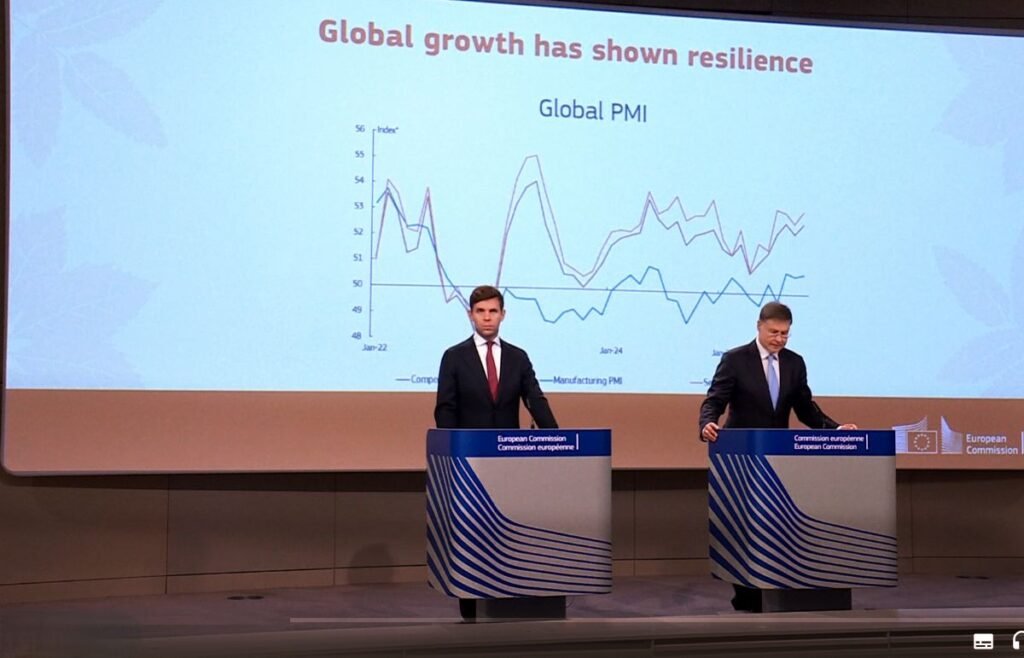
The European Commission’s Autumn 2025 Economic Forecast shows that growth in the first three quarters of 2025 outperformed expectations, with the strong performance initially being driven by a surge in exports in anticipation of tariff increases.
This year’s Autumn Forecast projects real GDP to grow by 1.4% in the EU in 2025 and 2026, edging up to 1.5% in 2027. The euro area is expected to mirror this trend, with real GDP projected to grow by 1.3% in 2025, 1.2% in 2026, and 1.4% in 2027. Inflation in the euro area is forecast to continue its decline, falling to 2.1% in 2025, and to hover around 2% over the forecast horizon. In the EU, inflation is set to remain marginally higher, falling to 2.2% in 2027.
Latest business indicators and survey data point to sustained positive momentum in the coming quarters. Looking further ahead, the global environment remains challenging, says the report, but a resilient labour market, improving purchasing power and favourable financing conditions are set to support moderate economic growth.
“Even in an adverse environment, the EU’s economy has continued to grow,” said Valdis Dombrovskis, EU Commissioner for the Economy: “Now, given the challenging external context, the EU must take resolute action to unlock domestic growth. This means accelerating our work on the competitiveness agenda—including by simplifying regulation, completing the Single Market, and boosting innovation.”
Private consumption is expected to grow steadily, supported by the above factors, but also by a gradual decline in the saving rate. Investment is set to regain momentum, mainly driven by non-residential construction and capital spending on equipment.
The EU’s highly open economy remains susceptible to ongoing trade restrictions, but the trade deals reached between the US and its trading partners, including the EU, have alleviated some of the uncertainties that overshadowed the Spring Forecast.
The forecast assumes that all country- and sector-specific tariffs implemented by the US administration at the cut-off date of 31 October will be in place throughout the forecast horizon. Globally, trade barriers have reached historic highs, and the EU now faces higher average tariffs on exports to the US than assumed in the Spring 2025 Forecast. Nevertheless, tariffs on EU exports remain lower than those applied to several other major global players. This represents a modest relative advantage for the EU economy, albeit in a context of weak global goods trade and a strong euro tempering foreign demand.
Inflation in the euro area has been revised slightly up from the Spring Forecast. It is now expected to come down from 2.4% in 2024 to reach the ECB’s target of 2% in 2027. This forecast assumes that the new EU Emissions Trading System (ETS2) will enter into force in 2027, as has been legislated.
The gradual slowdown of employment growth that started in 2022 continued in the first half of 2025. Still, the EU economy generated 380,000 jobs during that period. Employment is set to continue expanding moderately—by 0.5% in 2025 and 2026—before decelerating to 0.4% in 2027;
The EU general government deficit is expected to increase from 3.1% of GDP in 2024 to 3.4% by 2027, partly due to the increase in defence spending from 1.5% of GDP in 2024 to 2% in 2027, measured according to the Classification of the Functions of Government (COFOG).
The EU debt-to-GDP ratio is projected to rise from 84.5% in 2024 to 85% in 2027, with the euro area ratio set to rise from around 88% to 90.4%. This reflects ongoing primary deficits and the fact that the average cost of public debt is higher than nominal GDP growth. By 2027, four Member States are expected to have debt ratios above 100% of GDP.
Looking forward, the forecast says risks to the growth outlook are tilted downwards. Persistent trade policy uncertainty continues to weigh on economic activity, with tariffs and non-tariff restrictions potentially constraining EU growth more than expected.
Any further escalation of geopolitical tensions could intensify supply shocks. At the same time, repricing of risks in equity markets, especially in the US technology sector, could impact investor confidence and financing conditions. Domestic political uncertainty might also weigh on confidence. Finally, the increasing frequency of climate-related disasters could undermine growth.
Full document: Autumn 2025 European Economic Forecast