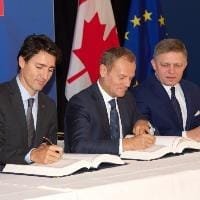
CETA signing – Trudeau – Tusk – Photo EU Council
(LUXEMBOURG) – The investment dispute mechanism of the free trade agreement between the EU and Canada (CETA) is compatible with EU law, an advocate-general of the EU Court said Wednesday in an Opinion.
In his Opinion, Advocate General Bot confirmed that the agreement ‘does not adversely affect the autonomy of EU law’ and does not affect the principle that the Court of Justice has exclusive jurisdiction over the definitive interpretation of EU law.
The case concerned the mechanism for the settlement of disputes between investors and States which forms part of trhe Comprehensive Economic and Trade Agreement (CETA) the EU signed with Canada in October 2016.
The Investor State Dispute Settlement System (ISDS) envisaged creation of a Tribunal and an Appellate Tribunal and, in the longer term, a multilateral investment tribunal. The aim is thus to establish an ‘Investment Court System’ (ICS).
Belgium in 2017 requested the Court of Justice’s opinion concerning the compatibility of the mechanism for the settlement of disputes (ISDS) with EU law.
In today’s Opinion, Advocate General Yves Bot holds that the mechanism for the settlement of disputes is compatible with the EU Treaty, the FEU Treaty and the Charter of Fundamental Rights of the European Union.
First, the Advocate General takes the view that the agreement does not adversely affect the autonomy of EU law and does not affect the principle that the Court of Justice has exclusive jurisdiction over the definitive interpretation of EU law.
Moreover, the Advocate General states that the dispute settlement mechanism does not affect the role of national courts and tribunals of ensuring the effective application of EU law. Even though, given that the agreement does not have direct effect, it is not the role of the courts and tribunals of the Member States to apply that agreement, those courts and tribunals are not, however, deprived of their status as ‘general law’ courts within the EU legal order, including of their role in any making of references for a preliminary ruling. Furthermore, the Court is not deprived of its power to reply, by preliminary ruling, to questions referred by those courts and tribunals. According to the Advocate General, there is no alteration of the essential character of the powers which the Treaties confer on the institutions of the EU and on the Member States.
The Advocate General is therefore of the opinion that the system for the settlement of disputes is entirely consistent with the objectives of the Union’s action on the international stage by combining rules on the protection of investments and a specific dispute settlement mechanism with the express confirmation of the Parties’ right to adopt legislation necessary to achieve legitimate objectives in the public interest, for example in the areas of public health, safety, the environment and social protection.
Second, the agreement does not infringe the general principle of equal treatment in respect of access to the dispute settlement mechanism. The situation of Canadian investors who invest in the EU is not comparable with the situation of European investors who invest within their own economic area. Only the investors of each Party who invest in the territory of the other Party are in comparable situations.
Third, procedural safeguards ensure a sufficient level of protection of the right of access to an independent and impartial tribunal, a right enshrined in Article 47 of the Charter. The mechanism provided for is merely an alternative method of dispute resolution relating to the application of the free trade agreement which complements the remedies offered by the Parties.
Furthermore, the provisions of the agreement set out the main features of the remuneration scheme for Members of the Tribunal, which includes a fixed component and a component dependent on the volume and the complexity of litigation brought before them. That scheme is consistent with the hybrid nature of the dispute settlement mechanism established and with the fact that, at least initially, those Members will not be working on a full-time basis.
Last, the conditions relating to the appointment and possible removal of those Members and the safeguards put in place are sufficient. In addition, the agreement contains specific rules of ethics applicable to Members and intended to guarantee their independence and their impartiality.
Advocate General’s Opinion in Avis 1/17 initiated by the Kingdom of Belgium