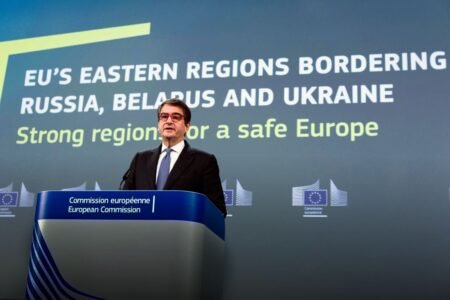
Pierre Moscovici – Photo EC
(BRUSSELS) – The European Commission kick-started a debate Tuesday on ending the requirement for unanimity among EU states on EU taxation policy, to avoid delays and ‘sub-optimal’ policies on key tax initiatives.
Its Communication suggests a roadmap for a transition to qualified majority voting (QMV) under the ordinary legislative procedure in certain areas of shared EU taxation policy, as is the case with most other EU policy areas.
Under QMV, Member States would be able to reach “quicker, more effective and more democratic” compromises on taxation matters, says the Commission.
The EU executive says it is not proposing any change in EU competences in the field of taxation, or to the rights of Member States to set personal or corporate tax rates as they see fit. Instead, its aim is “to allow Member States to exercise more efficiently their already pooled sovereignty so that shared challenges can be addressed more swiftly”.
Economic and Financial Affairs Commissioner Pierre Moscovici said:”if unanimity in this area made sense in the 1950s, with six Member States, it no longer makes sense today. The unanimity rule in taxation increasingly appears as politically anachronistic, legally problematic and economically counterproductive.” He added that he was fully aware of how sensitive an issue this is, “but that cannot mean that the discussion is off limits.”
The unanimity rule has meant that some key proposals (for growth, competitiveness and tax fairness in the Single Market) have been blocked for years. At the same time, the European Parliament has only a consultative role in the decision-making process so far.
The approach outlined by the Commission would “usher in a new dynamic and revitalise decision-making” in this area at a time when the future of taxation has become a burning issue for the international community. Addressing the difficulties inherent in the current framework would cement the EU’s reputation as a global leader in developing realistic solutions to the taxation policy challenges of the 21st century.
In the Communication, the Commission asks that EU leaders, the European Parliament and other stakeholders assess the possibility of a gradual, four-step progression towards decision-making based on QMV as set out below:
- In Step 1, Member States would agree to move to QMV decision-making when it comes to measures that improve cooperation and mutual assistance between Member States in fighting tax fraud, tax evasion, as well as for administrative initiatives for EU businesses, e.g. harmonised reporting obligations. These measures are usually welcomed by all Member States but are prone to being blocked for reasons unrelated to the issues at hand.
- In the same vein, Step 2 would introduce QMV as a useful tool to progress measures in which taxation supports other policy goals, e.g. fighting climate change, protecting the environment or improving public health.
- The Commission Communication suggests that Member States decide swiftly to converge on a decision to develop Steps 1 and 2.
- The use of QMV under Step 3 would help to modernise already harmonised EU rules such as VAT and excise duty rules. Faster decision-making in these areas would allow Member States to keep up with the latest technological developments and market changes to the advantage of EU countries and businesses alike.
- Step 4 would allow a shift to QMV for major tax projects, such as the Common Consolidated Corporate Tax Base (CCCTB) and a new system for the taxation of the digital economy, that are urgently needed to ensure fair and competitive taxation in the EU. In particular, the CCCTB is still progressing very slowly as a result of unanimity.
The Communication suggests that Member States consider developing Steps 3 and 4 by the end of 2025.
Action in the areas outlined would be possible under the so-called ‘passerelle clause’ (Article 48(7) TEU) in the EU Treaties which allows for a shift to qualified majority voting and the ordinary legislative procedure under certain circumstances. No EU Treaty change is necessary.
The Commission is now calling on EU Member States, the European Parliament and all stakeholders to engage constructively in a debate on QMV in EU tax policy, and to define a timely and pragmatic approach for its implementation.
In particular, it ask EU leaders to endorse the roadmap and to make timely decisions on the use of the relevant legal provisions set out in the Treaties.
A gradual renewed approach to decision-making in EU tax policy - background guide
Communication: Towards a more efficient and democratic decision making in EU tax policy