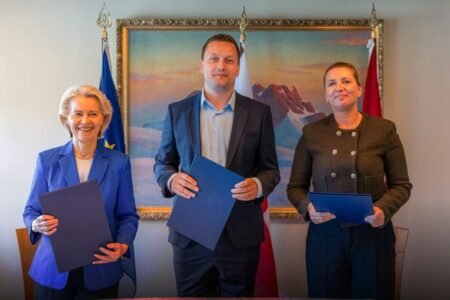
Croatia Prime Minister Andrej Plenkovic – Photo © European Union 2022
(BRUSSELS) – Croatia became the twentieth member of the European Union’s common currency on 1 January 2023, when it also joined the EU’s borderless Schengen zone.
Croatia’s entry into the eurozone is an important milestone in the country’s history and follows a period of intensive preparation and substantial efforts to meet all the necessary requirements.
“I warmly welcome Croatia in the euro and in the Schengen free travel area,” said the Commission’s president Ursula von der Leyen: “From this Sunday, citizens driving to and from Croatia can start traveling without internal border controls. Schengen enlargement makes us stronger, and Croatia can now fully contribute to a more prosperous and resilient Schengen area. On the same day, Croatians are joining a community of 347 million Europeans who are using the euro in their everyday lives. This is a major achievement for Croatia, a symbol of its deep-rooted attachment to the EU, and a symbolic moment for the euro area as a whole.”
With Croatia, 20 EU Member States and 347 million EU citizens will share the EU’s common currency. At the same time, it is the eighth Schengen enlargement and the first for 11 years.
The euro will deliver practical benefits to Croatian citizens and businesses, says the EU Commission. It will make travelling and living abroad easier, boost the transparency and competitiveness of markets, and facilitate trade.
Euro notes and coins will also be seen as a tangible symbol for all Croatians of the freedom, convenience and opportunity that the EU makes possible. Public support for the euro in the euro area remains very strong, with broad majorities of EU citizens believing the euro is a good thing for the EU as a whole and for their own country.
From Sunday, the euro will gradually replace the kuna as the currency of Croatia. In line with a consistent record of exchange-rate stability, the kuna will be exchanged at a conversion rate of 1 euro for 7.53450 Croatian kuna. The two currencies will be used alongside each other for a period of two weeks. When receiving a payment in kuna, the change will be given in euro. This will allow for a progressive withdrawal of the kuna from circulation.
The dual display of prices in kuna and euro became compulsory on 5 September 2022 and will apply until 31 December 2023. In order to protect consumers and address their concerns about unjustified price increases in the changeover period, a Business Code of Ethics has been introduced to ensure stability of prices for goods and services by helping businesses to correctly recalculate and display prices. Businesses who sign up to the initiative can display its logo to reassure customers, and will lose this right if found to be in breach of the Code. The Code of Ethics is enforced by the State Inspectorate, which will also monitor the prices of frequently-purchased products and services during the changeover.
Commercial banks have received euro banknotes and coins in advance from the Croatian National Bank and have in turn supplied euro cash to shops and other businesses. Kuna banknotes and coins can be exchanged for euro banknotes and coins at the Financial Agency and post offices until 30 June 2023. The exchange is free of charge. The exchange of kuna banknotes and coins at commercial banks is possible until 31 December 2023. It is free of charge for all exchanges done before 1 July 2023 up to a limit of 100 kuna banknotes and 100 kuna coins. For changes as of 1 July 2023, commercial banks can charge a fee. Croatia’s national central bank will exchange kuna banknotes without a time limit, and kuna coins until 31 December 2025. This service is free of charge.
70% of automatic teller machines (ATMs) in Croatia will distribute euro banknotes already on 1 January 2023, and the rest will follow as soon as possible thereafter (within two weeks). To facilitate the process, commercial banks will publish online information on which ATMs distribute euro.