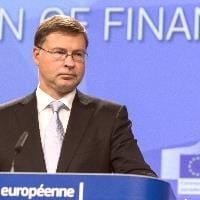
Valdis Dombrovskis – Photo EC
(BRUSSELS) – The EU Commission proposed reforms Wednesday to tighten the EU’s supervisory architecture for the financial sector, paving the way for further financial integration after Brexit.
The reforms will promote further capital market integration following the UK’s departure from the EU, and European consumers, investors and businesses will benefit from stronger and more integrated financial markets, says the EU executive.
The proposals include steps to foster the development of financial technologies (FinTech) and to make sure that sustainability considerations are systematically taken into account in supervisory practices at the European level.
A Single Rulebook for financial regulation in Europe was created when the EU overhauled its financial system in the wake of the financial crisis, as well as the European Supervisory Authorities and the European Systemic Risk Board. These bodies were seen as pivotal in ensuring that financial markets across the EU are well regulated, strong and stable. However, the Commission says more needs to be done to enhance regulatory and supervisory convergence within the Single Market to help European financial markets work more effectively and to address new challenges.
“Financial markets are changing fast. We are seeing renewed cross-border integration, new opportunities in FinTech and a boom in sustainable and green finance,” says Financial Services Commissioner Valdis Dombrovskis: “The EU needs to act as one player so that we can stay ahead of the curve. More integrated financial supervision will make the Economic and Monetary Union more resilient. These pragmatic proposals will also make it easier for our companies to operate cross-border and build consumer trust.”
Once adopted, the proposals will improve the mandates, governance and funding of the ESAs for banking (European Banking Authority, EBA), for securities and financial markets (European Securities and Markets Authority, ESMA), and for insurance and pensions (European Insurance and Occupational Pensions Authority, EIOPA). To ensure a uniform application of EU rules and promote a true Capital Markets Union, the proposals also entrust ESMA with direct supervisory power in specific financial sectors. In addition, the Commission is proposing targeted changes to the composition and organisation of the ESRB, which monitors stability risks for the financial system as a whole.
The reforms will also introduce changes to the supervisory relations with non-EU countries so as to ensure proper management of all financial-sector risks.
Key features
Stronger coordination of supervision across the EU
The ESAs will set EU-wide supervisory priorities, check the consistency of the work programmes of individual supervisory authorities with EU priorities and review their implementation. They will monitor authorities’ practices in allowing market players – such as banks, fund managers and investment firms – to delegate and outsource business functions to non-EU countries, to ensure that risks are properly managed and to prevent circumventions of the rules. In addition, EIOPA will have a stronger role in promoting convergence in the validation of the internal models that some large insurance companies use to calculate requirements on solvency capital. This will help overcome fragmentation and ensure better supervision of the large cross-border insurance groups. Finally, the functioning of the ESRB will be made more efficient in order to strengthen its oversight of risks for the financial system as a whole.
Extended direct capital markets supervision by ESMA
The Commission is proposing to make ESMA the direct supervisor over certain sectors of capital markets across the EU:
- Capital market data: ESMA will authorise and supervise the EU’s critical benchmarks and endorse non-EU benchmarks for use in the EU. This will improve the reliability and harmonisation of supervision of benchmarks, which are the indices or indicators used to price financial instruments and financial contracts or to measure the performance of an investment fund.
- Capital market entry: In a bid to streamline procedures for companies to tap into EU capital markets and attract investment from across the EU, ESMA will now be in charge of approving certain EU prospectuses and all non-EU prospectuses drawn up under EU rules. Prospectuses are documents that contain the information an investor needs before making a decision whether to invest in a company.
- Capital market actors: ESMA will authorise and supervise certain investment funds with an EU label with the aim of creating a genuine single market for these funds (European Venture Capital Funds, European Social Entrepreneurship Funds and European Long-Term Investment Funds).
- Market abuse cases: ESMA will have a greater role in coordinating market abuse investigations. It will have the right to act where certain orders, transactions or behaviours give rise to well-founded suspicion and have cross-border implications or effects for the integrity of financial markets or financial stability in the EU.
The ESAs will take decisions more independently from national interests. Under the new governance system, newly-created Executive Boards with permanent members will lead to quicker, more streamlined and EU-oriented decisions. Moreover, interested parties will be able to ask the Commission to intervene if the majority consider that the ESAs have exceeded their competences when issuing guidelines or recommendations. The reform will also make the funding of the ESAs independent from national supervisors. This will guarantee that the ESAs have improved autonomy and independence. While the EU budget will continue to contribute a share of the ESAs’ funding, the rest will be funded by contributions from the financial sector.
Promoting sustainable finance and FinTech
- The ESAs will promote sustainable finance, while ensuring financial stability. They will take account of environmental, social and governance-related factors and risks in all the tasks they perform.
- The ESAs will prioritise FinTech and will coordinate national initiatives to promote innovation and strengthen cybersecurity. They will take account of technological innovation in all the tasks they perform.
The proposals the main Regulation and the subsequent changes to a number of sectoral Directives will now be discussed by the European Parliament and the Council.