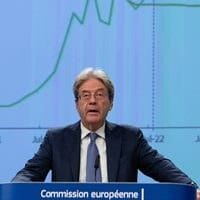
Paolo Gentiloni – Photo – © European Union 2022
(BRUSSELS) – Russia’s war of aggression against Ukraine continues to negatively affect the EU economy, as Thursday’s interim Summer Economic Forecast points to lower growth and higher inflation.
The Summer 2022 (interim) Economic Forecast projects that the EU economy will grow by 2.7% in 2022 and 1.5% in 2023. Growth in the euro area is expected at 2.6% in 2022, moderating to 1.4% in 2023. Annual average inflation is projected to peak at historical highs in 2022, at 7.6% in the euro area and 8.3% in the EU, before easing in 2023 to 4.0% and 4.6%, respectively.
Many of the negative risks surrounding the Spring 2022 Forecast have materialised.
“Russia’s unprovoked invasion of Ukraine continues to send shockwaves through the global economy,” said Economy Commissioner Paolo Gentiloni: “Moscow’s actions are disrupting energy and grain supplies, pushing up prices and weakening confidence. In Europe, momentum from the reopening of our economies is set to prop up annual growth in 2022, but for 2023 we have markedly revised down our forecast. Record-high inflation is now expected to peak later this year and gradually decline in 2023.”
The EU economy remains particularly vulnerable to developments in energy markets due to its high reliance on Russian fossil fuels, and weakening global growth detracts from external demand. Momentum gathered with the rebound of last year and a somewhat stronger than previously estimated first quarter is set to prop up the annual growth rate for 2022. Still, economic activity in the remainder of the year is expected to be subdued, notwithstanding a promising summer tourism season. In 2023, quarterly economic growth is expected to gather momentum, on the back of a resilient labour market, moderating inflation, support from the Recovery and Resilience Facility and the still large amount of excess savings.
Overall, the EU economy is set to continue expanding, but at a significantly slower pace than expected in the Spring 2022 Forecast.
Headline inflation until June has hit record highs as energy and food prices continued growing and price pressures broadened to services and other goods. In the euro area, inflation grew strongly in the second quarter of 2022, from 7.4% in March (y-o-y) to a new all-time high of 8.6% in June. In the EU, the increase was even more pronounced, with inflation jumping a full percentage point, from 7.8% in March to 8.8% in May.
The forecast for inflation has been revised considerably upwards compared to the Spring Forecast. Besides the strong price increase in the second quarter, a further surge in European gas prices is set to pass through to consumers also via electricity prices. Inflation is projected to peak at 8.4% y-o-y in the third quarter of 2022 in the euro area and from there decline steadily and fall below 3% in the last quarter of 2023, in both the euro area and the EU, as the pressures from supply constraints and commodity prices fade.
Risks to the forecast for economic activity and inflation are heavily dependent on the evolution of the war and in particular its implications for gas supply to Europe. New increases of gas prices could further drive up inflation and stifle growth. Second round effects could in turn amplify inflationary forces and lead to a sharper tightening of financial conditions that would not only weigh on growth, but also come with increased risks for financial stability. The possibility that the resurging pandemic in the EU brings renewed disruptions to the economy cannot be excluded.
At the same time, recent downward tendencies of oil and other commodity prices could intensify, bringing about a faster decline in inflation than currently expected. Moreover, thanks to a strong labour market, private consumption could prove more resilient to increasing prices if households were to use more of their accumulated savings.