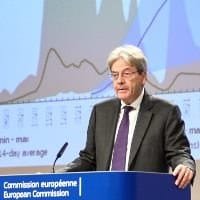
Paolo Gentiloni – Photo – © European Union 2021
(BRUSSELS) – Europe’s economy is rebounding from the pandemic recession faster than expected, says an EU forecast Thursday, but faces uncertainty from surging energy prices and an increase in COVID cases.
The European Commission’s Autumn 2021 Economic Forecast reports that as vaccination campaigns progressed and restrictions started to be lifted, growth resumed in spring and continued unabated through summer, underpinned by the re-opening of the economy.
Despite mounting headwinds, the EU economy is projected to keep expanding over the forecast horizon, achieving a growth rate of 5%, 4.3% and 2.5% in 2021, 2022 and 2023 respectively. Growth rates for the euro area are projected to be identical to those for the EU in 2021 and 2022, and 2.4% in 2023. This outlook depends heavily on two factors: the evolution of the COVID-19 pandemic and the pace at which supply adjusts to the rapid turnaround in demand following the re-opening of the economy.
“An unprecedented policy response cushioned the impact of COVID-19 on workers and businesses and a successful vaccination campaign has enabled the reopening of our economies since the spring,” said Economy Commissioner Paolo Gentiloni. However, he warned of “three key threats to this positive picture: a marked increase in COVID cases, most acute in areas where vaccinations are relatively low; rising inflation, driven largely by a spike in energy prices; and supply-chain disruptions that are weighing on numerous sectors.”
At almost 14% in annual terms, the rate of GDP growth in the EU in the second quarter of 2021 was the highest reading on record as high as the unprecedented fall in GDP in the same period last year, during the first wave of the pandemic. The EU economy regained the pre-pandemic output level in the third quarter of 2021 and moved from recovery into expansion.
Domestic demand is set to continue to drive this expansion. Improvements in labour markets and a projected decline in savings should contribute to a sustained pace of consumer spending.
The growth momentum is facing new headwinds, however. Bottlenecks and disruptions in global supply are weighing on activity in the EU, in particular in its highly integrated manufacturing sector. Moreover, after having fallen sharply in 2020, energy prices, particularly for natural gas, have increased at a tumultuous pace over the last month and are now well above pre-pandemic levels. This is set to weigh on consumption and investment.
EU labour markets improved markedly thanks to an easing to restrictions on consumer-related activities. In the second quarter of this year, the EU economy created about 1.5 million new jobs, many workers exited job retention schemes and the unemployment rate decreased. However, total headcount employment in the EU was still 1% shy of its pre-pandemic level.
Since then, unemployment has declined further. At 6.8%, the EU unemployment rate in August stood just above the rate recorded at the end of 2019. Data released after the cut-off date of the forecast show that it declined slightly further in September. The Commission’s business surveys reveal emerging pockets of labour shortages, particularly in sectors where activity is surging most. The longer these last, the higher the risk that they dampen activity and feed into inflation through wage pressures.
The forecast projects employment in the EU to grow at a rate of 0.8% this year, 1% in 2022 and 0.6% in 2023. Employment is expected to surpass its pre-crisis level next year and move into expansion in 2023. Unemployment in the EU is forecast to decrease from 7.1% this year to 6.7% and 6.5% in 2022 and 2023, respectively. In the euro area, it is projected at 7.9%, 7.5% and 7.3% over the three years.
Regarding inflation, following several years of low inflation, the strong resumption of economic activity in the EU and many advanced economies has been accompanied by a pick-up in inflation that exceeded predictions.
Annual inflation in the euro area rose from a negative -0.3% in the last quarter of 2020, to 2.8% in the third quarter of 2021. The October reading was 4.1%, a rate matched only once since the publication of euro area inflation data began in 1997.
This strong pick-up in inflation is mainly driven by the surge in energy prices, but appears also linked to a broad set of post-pandemic economic adjustments, suggesting that the current elevated levels are largely transitory.
Inflation in the euro area is forecast to peak at 2.4% in 2021, before declining to 2.2% in 2022 and 1.4% in 2023, as energy prices are set to gradually level out. For the EU, inflation is expected at 2.6% in 2021, 2.5% in 2022 and 1.6% in 2023.
The report makes clear that uncertainty and risks surrounding the growth outlook remain very high
Although the impact of the pandemic on economic activity has weakened considerably, COVID-19 has not yet been defeated and the recovery is heavily dependent on its evolution, both within and outside the EU. In light of the recent surge of cases in many countries, the reintroduction of restrictions impacting on economic activity cannot be ruled out. In the EU this risk is particularly relevant in Member States with relatively low vaccination rates.
The main upside risk to the growth outlook is related to the potential efficiency gains and durable productivity advances triggered by the pandemic-induced structural changes. Investments fostered by the RRF and the accompanying structural reforms will be instrumental in this respect. Overall, the balance of risks surrounding this forecast has tilted to the downside.
And inflation may turn out higher than forecast if supply constraints are more persistent and above-productivity wage increases are passed on to consumer prices.