The EU and Australia concluded negotiations for a free trade agreement Tuesday and agreed to launch formal talks for Australia’s association to the EU’s Horizon Europe research programme.

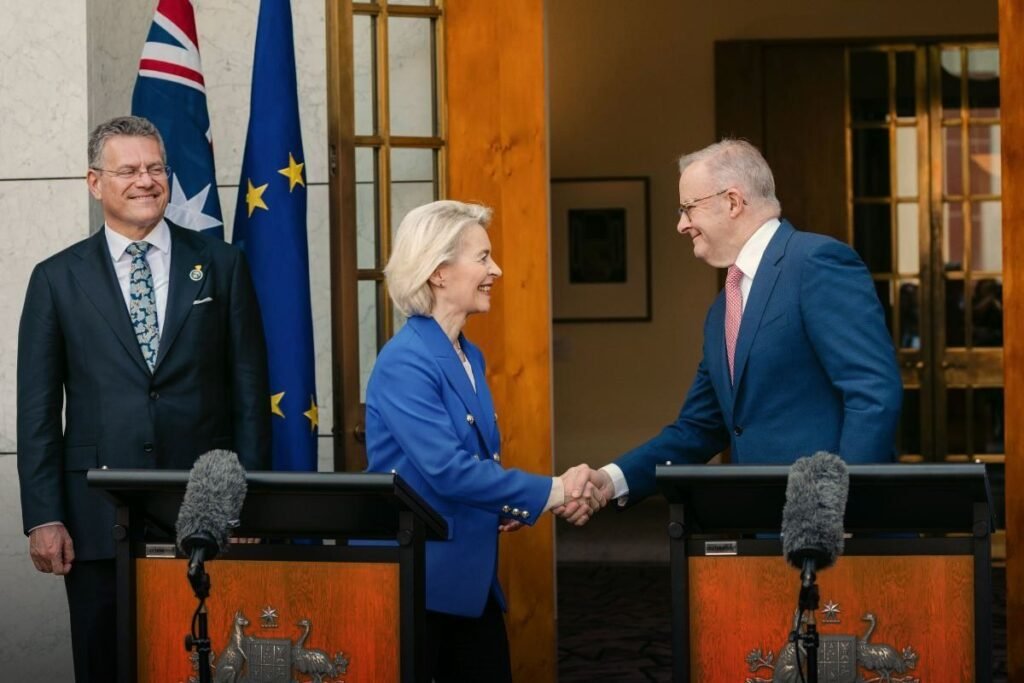
At the same time, the EU and Australia also announced the adoption of a groundbreaking Security and Defence Partnership.
With the conclusion of negotiations for the free trade agreement (FTA), the EU says it is opening the market to one of the world’s fastest-growing developed economies and thereby bringing significant economic opportunities to European companies, consumers and farmers.
EU exports are expected to grow by up to 33% over the next decade, with export value reaching up to €17.7 billion annually. Key sectors with strong growth potential include dairy (expected to increase by up to 48%) motor vehicles (52%), and chemicals (20%). EU investment into Australia has the potential to grow by over 87%, according to the EU executive.
With this deal the EU also reinforces its strategic interests in the area of critical raw materials, making EU supply chains stronger and more resilient against geopolitical shocks. The FTA also includes strong sustainability commitments, which will contribute to greener and fairer trade, and ensures that imports into the EU are more aligned with the EU’s own production standards on climate, environmental and animal welfare.
Following recently concluded deals with Indonesia and India, this agreement further diversifies the EU’s network of trade partners in the strategically important Indo-Pacific region and strengthens Europe’s position on the global stage.
The agreement will give EU exporters privileged access to the Australian market, including:
- Removing over 99% of tariffs on EU goods exports to Australia, thus cutting some €1 billion a year in duties for companies of all sizes;
- Opening of the Australian services market in key sectors, including financial services and telecommunications;
- Providing greater access for EU companies to Australian government procurement contracts;
- Setting ambitious rules on data flows prohibiting data localisation requirements; and
- Securing supply chains of critical raw materials (CRMs) by lowering tariffs on imports and opening investment opportunities.
Regarding agri-food exports, the deal will eliminate tariffs on major EU exports such as cheeses, meat preparations, wine and sparkling wine, some fruits and vegetables including preparations, chocolate, and sugar confectionary.
The EU and Australia have also agreed on a modernised bilateral wine agreement, updating the full list of EU wine GIs and traditional terms protected in Australia.
The deal facilitates EU access to Australian critical raw materials, with dedicated provisions making the market more predictable and reliable for EU businesses.
Factsheet – Trade and sustainable development