SME (Small to medium enterprise) cash flow problems are being felt all over the world today, but perhaps none more so than in Europe. With soaring overheads, fluctuating inflation and world economic uncertainty from war, it is a wonder that any small business can survive in 2026. However, when the main reasons are highlighted, any business owner can begin the necessary steps to combat the most severe, from inflation-based operational costs to stagnant inventory.


Late Payment and Slow Receivables
One of the biggest challenges facing European and indeed global SMEs is late payment and slow receivables. Because of these, cash flow cycles are often disrupted with an estimated average loss of €250 million across the continent. This can force companies to fall back on their credit providers, simply adding to the overall costs, but invoicing software, especially AI-assisted tools, is helping some companies automate financial workflows for reduced revenue problems.
Inflation-Based Increased Operational Costs
No one can escape inflation, and it cannot be controlled, no matter how much credit is taken for reducing it by unscrupulous politicians or blame is shifted onto adversarial parties. At some record highs, inflation hit 2.1% in the EU in 2025, and was even higher in countries like the UK. This has forced many small businesses to increase their prices in response to higher operational costs, but the balance is fragile as consumers turn away from unfair price hikes.
SME Cash Flow Problems with Forecasting
Forecasting is necessary for most companies, even small ones. However, studies by the European Commission found that only 1% of EU firms actually hit forecasts exactly, with 22% coming within 5% of predictions, meaning over 75% of businesses operate at a significant loss. This is because management of funds becomes much more challenging when a company cannot predict when it will run out, resulting in corporate insolvency from leaner revenue.
Excessive and Stagnant Inventory
Managing inventory is a skill that most business owners overlook when starting out. There are so many variables beyond control that the need for an experienced stock controller is huge today. However, it isn’t just a case of ordering what a business needs, as in 2025 alone, 76% of EU businesses experienced supply chain problems. Of course, AI is playing a role in better stock management by monitoring levels, predicting demand and automatically ordering.
Capital Restrictions and Poor Financing
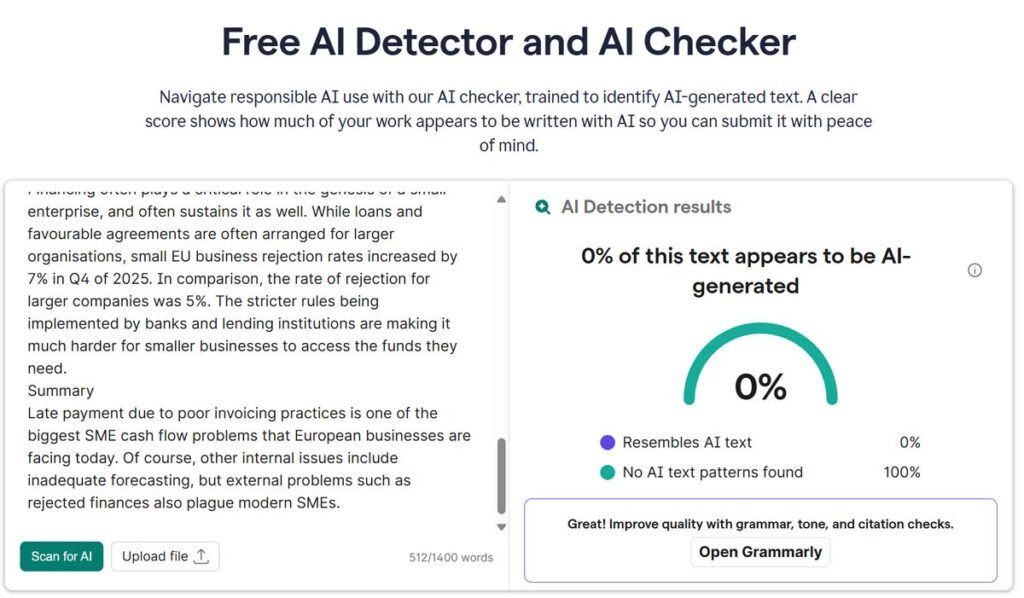
Financing often plays a critical role in the genesis of a small enterprise, and often sustains it as well. While loans and favourable agreements are often arranged for larger organisations, small EU business rejection rates increased by 7% in Q4 of 2025. In comparison, the rate of rejection for larger companies was 5%. The stricter rules being implemented by banks and lending institutions are making it much harder for smaller businesses to access the funds they need.
Summary
Late payment due to poor invoicing practices is one of the biggest SME cash flow problems that European businesses are facing today. Of course, other internal issues include inadequate forecasting, but external problems such as rejected finances also plague modern SMEs.