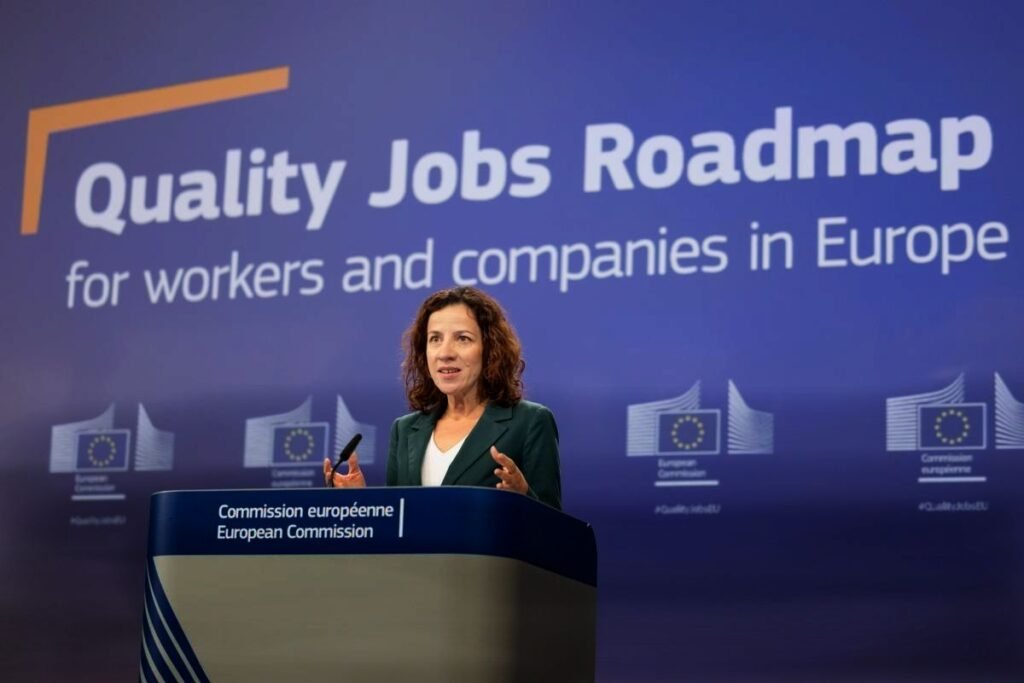
The European Commission has presented the Quality Jobs Roadmap, a strong commitment to improving job quality and creating high-quality and future-proof jobs in Europe.

With the roadmap, the Commission also launched a first-stage consultation on the forthcoming Quality Jobs Act, a new legislative proposal to ensure workers’ rights while keeping up with technological, economic and societal changes.
While job quality in the EU is generally high, workers continue to feel the impact of global crises and rising living costs, says the Commission. At the same time, companies face labour and skills shortages while striving to remain competitive in a fast-changing global environment.
“Every job in Europe must be a quality job,” said EC executive vice-president Roxana Minzatu: “That is how we attract talent, reduce in-work poverty, and strengthen Europe’s competitiveness and social cohesion.”
The Roadmap focuses on areas where EU action can make the greatest difference:
- Creating and maintaining quality jobs across the EU;
- Ensuring fairness and modernisation in the world of work;
- Supporting workers and employers in the green, digital and demographic transitions;
- Strengthening social dialogue and collective bargaining;
- Ensuring effective access to rights, quality public services and adequate investment.
The roadmap has been developed based on extensive consultations with European and national trade unions and employer organisations (‘social partners’), mobilising around 200 organisations across the EU and engaging in more than 50 discussions in all Member States.
Towards a Quality Jobs Act
As announced in the Commission’s 2026 work programme, the EU executive will propose a Quality Jobs Act in 2026. The new law will update EU rules protecting workers while supporting productivity and competitiveness.
Today’s first-stage consultation seeks social partners’ views on the direction of EU action to improve job quality. The consultation highlights several areas that a future law could cover, including:
- Algorithmic management and artificial intelligence (AI) at work: Digital tools are now central to working life. AI can save time and increase productivity. However, 84% of Europeans believe that these technologies must be carefully managed at work.
- Safety and health at work: New technologies and mobile digital equipment have transformed workplaces and expanded remote work. Psychosocial and ergonomic risks at work have increased, highlighting the need to update EU rules on safety and health at work. In 2025, 29% of workers reported experiencing stress, anxiety or depression caused or worsened by their job, up from 27% in 2022, according to the latest EU-OSHA pulse survey.
- Subcontracting: Subcontracting helps companies access expertise and innovate. However, it can also lead to abusive practices and poor compliance with labour, health, and safety regulations, especially in long and complex subcontracting chains.
- Just transition: The green and digital transitions are driving companies across the EU to restructure, creating major challenges for both workers and employers.
- Enforcement and role of social partners: Strong enforcement is essential for workers to benefit from their rights. Persistent issues such as undeclared work and weak compliance undermine job quality and fair competition.
This new consultation will complement the right to disconnect and telework consultation finalised in October 2025.
Next Steps
The first-stage consultation of social partners on the future Quality Jobs Act will run until 29 January 2026.